This book is designed specifically for students studying at the Technological University of the Shannon – Midlands Midwest, Ireland. It presents a step-by-step practical guide to academic writing, referencing and presentation, with clear explanations and structured approaches with examples that support the development of clear and concise writing.
This discussion paper explores how student success in higher education is understood, defined and supported in contemporary Irish and international contexts. It brings together international research, national policy and insights from student focus groups conducted in Ireland in 2025 to examine success beyond traditional metrics such as retention, progression and completion.
The paper presents a holistic and relational view of student success, foregrounding belonging, mattering, agency and wellbeing alongside academic and outcomes-based measures. It situates student success as simultaneously student-defined, institution-enabled and outcomes-oriented, and considers the implications of this framing for teaching, learning, policy and system-level practice.
This report presents findings from the HEA Student Success Survey 2025, capturing how students across Ireland define, experience and achieve success in higher education. Based on responses from over 3,400 students across publicly funded higher education institutions, it provides a national, student-centred perspective on success.
The report explores students’ definitions of success, the supports and enablers that help them thrive, and the barriers that can hinder progress. It highlights the relational and holistic nature of student success, encompassing academic achievement alongside well-being, belonging, personal growth and future readiness.
In 2018, the Glucksman Library at the University of Limerick launched Leganto, a reading list management tool designed to streamline access to academic resources for students. Leganto ensures equitable access to academic content, helping students engage with reliable sources and easing their transition into university-level study.
In 2024/25 research was undertaken in higher education institutions in Ireland to explore commuter students’ experiences and to consider changes that would improve their experiences and outcomes. It addressed the questions: i. How does being a commuter student impact on student experiences and outcomes in higher education institutions in Ireland? ii. How can higher education institutions improve the experience and outcomes of commuter students? The study combined a semi-structured review and thematic analysis of the websites of the seven higher education institutions (HEIs) in Ireland, with two online ‘town hall focus groups’ (THFGs) involving 33 participants: six staff and 27 students, eight of whom were trained as facilitators and ‘jurors’ to reflect on the evidence heard. The THFGs addressed the key research questions, collecting individual responses via an online form; small groups discussed the topics and then a commuter student facilitator reported key points from their discussion into the main room. Commuter students generally found the experience of commuting to be quite negative, with few advantages. Furthermore, they felt their on-campus experience is not designed to facilitate their engagement. Students find that the organisation and delivery of the academic experience does not accommodate their needs, and they have few opportunities to engage with the wider student experience.
In Ireland around 40% of students remain in the family home – with their parents, partner or children – while participating in higher education (HE) and commute to their higher education institution (HEI). In 2024-25, the Technological Higher Education Association, now the Technological Universities Association (TUA) and the N-TUTORR Student Empowerment project leadership team, worked in partnership with Professor Liz Thomas, University of York. This resulted in an innovative project to explore commuter students’ experiences in Irish HEIs, and to consider changes that would improve the experience and outcomes for commuter students.
This Irish study builds on qualitative research undertaken in the UK (Thomas & Jones 2017). This found that commuter students are poorly defined, but self-identified commuters experienced commuting to be more tiring, stressful, and expensive than they imagined. They also reported lower engagement in some elements of the academic experience, and in the enhancement and social domains. Available secondary evidence finds that commuter student status is often correlated with not only poorer engagement but also lower outcomes, such as continuation, completion, attainment, and progression to graduate employment.
The study reported here addressed the following two questions:
i. How does being a commuter student impact on student experiences and outcomes in technological HEIs in Ireland
ii. How can technological HEIs improve the experience and outcomes of commuter students?
The study combined a semi-structured review and thematic analysis of the websites of the seven technological HEIs in Ireland, with two online ‘town hall focus groups’ (THFGs) involving 33 participants: six staff and 27 students, eight of whom were trained as facilitators and ‘jurors’ to reflect on the evidence heard. The THFGs addressed the key research questions, collecting individual responses via an online form; small groups discussed the topics and then a commuter student facilitator reported key points from their discussion into the main room. Ethical approval was secured from the University of York and participating HEIs.
In 2024/25 research was undertaken in higher education institutions in Ireland to explore commuter students’ experiences and to consider changes that would improve their experiences and outcomes. It addressed the questions: i. How does being a commuter student impact on student experiences and outcomes in higher education institutions in Ireland? ii. How can higher education institutions improve the experience and outcomes of commuter students? The study combined a semi-structured review and thematic analysis of the websites of the seven higher education institutions (HEIs) in Ireland, with two online ‘town hall focus groups’ (THFGs) involving 33 participants: six staff and 27 students, eight of whom were trained as facilitators and ‘jurors’ to reflect on the evidence heard. The THFGs addressed the key research questions, collecting individual responses via an online form; small groups discussed the topics and then a commuter student facilitator reported key points from their discussion into the main room. Commuter students generally found the experience of commuting to be quite negative, with few advantages. Furthermore, they felt their on-campus experience is not designed to facilitate their engagement. Students find that the organisation and delivery of the academic experience does not accommodate their needs, and they have few opportunities to engage with the wider student experience.
In 2024/25 research was undertaken in higher education institutions in Ireland to explore commuter students’ experiences and to consider changes that would improve their experiences and outcomes. It addressed the questions: i. How does being a commuter student impact on student experiences and outcomes in higher education institutions in Ireland? ii. How can higher education institutions improve the experience and outcomes of commuter students? The study combined a semi-structured review and thematic analysis of the websites of the seven higher education institutions (HEIs) in Ireland, with two online ‘town hall focus groups’ (THFGs) involving 33 participants: six staff and 27 students, eight of whom were trained as facilitators and ‘jurors’ to reflect on the evidence heard. The THFGs addressed the key research questions, collecting individual responses via an online form; small groups discussed the topics and then a commuter student facilitator reported key points from their discussion into the main room.
This Toolkit was created by students at University College Dublin, for students, to break down sustainability in a way that’s simple and easy to understand. Climate change is something that affects all of us—no matter what you’re studying, where you’re from, or what you do. It’s here, and it’s impacting our world—but many of us aren’t sure what we can do about it.
The purpose of this toolkit is a starting point for what students need to learn about living more sustainably on and off campus. We hope it’ll inspire students to take small steps that make a big impact, and they can do it all at their own pace. You can access the Moodle page to view the Toolkit. There are also Zip files of the SCORM packages used to create the Toolkit (Part 1 and Part 2) that can be downloaded and imported into a Virtual Learning Environment.
• Part 1: Climate Change → Watch short Youtube videos followed by a little quiz to brush up on your sustainability knowledge.
• Part 2: What Can You Do? → Find tips and tricks to incorporate sustainability into your day-to-day life, this is a resource tool to help you get started!
Curricular approaches to well-being are important and impactful, as universal supports for all students. This OER is a padlet of resources and talks from the April 2024 jointly hosted UCC and MTU seminar on this critical area for teaching and learning enhancement in Irish higher education.
In the denouement of the COVID-19 pandemic, talk of a return to “normalcy” in higher education belies the great challenges and ongoing disruptions that yet lie ahead for many institutions. Public perceptions of the value of postsecondary education continue their downward slide, placing institutions in the position of having to demonstrate their worth and find solutions to declining enrollments. Data and analytics capabilities continue to evolve, introducing new opportunities and new risks to the institution. Chief among these capabilities, generative AI promises to change teaching and learning in ways many of us have yet to fully understand or prepare for.
For this year’s teaching and learning Horizon Report, expert panelists’ discussions highlighted and wrestled with these present and looming challenges for higher education. This report summarizes the results of those discussions and serves as one vantage point on where our future may be headed.
The 10-dot Matrix is a quick and easy way to assess how well employability is embedded in classroom activities or module assessments. The video explains how to use 10 key criteria (4 graduate attribute criteria and 6 employability criteria), to quantitatively or qualitatively measure employability in your module or programme.
Your Brainpower is a free, online, self-paced course, focusing on harnessing the power and potential of adolescent [age 10 – 24 years] brain and behaviour for enhanced learning, wellbeing, and student success in higher education.
Infographic promoting Moodle’s analytics graphs, which come packaged in a single block and offer a host of statistics and figures on various aspects of students’ Moodle usage
Infographic promoting Moodle’s activity completion feature, which allows the lecturer to assign completion criteria to specific activities and resources within Moodle
Infographic providing information on Moodle’s attendance feature, which allows lecturers to take attendance in Moodle and for individual students to see their own attendance record
This seminar presented an overview of current policy, research and practice relating to student wellbeing in higher education and how the curriculum can be leveraged to enhance wellbeing. It showcased a range of innovative curricular wellbeing initiatives in UCC and MTU.
Drawing on this knowledge, and expertise in occupational science/therapy, psychology and neuroscience, the ‘DOTS – Developmental Opportunities for Transitions in Students’ seminar sought to inform stakeholders of the biobehavioural transitions that influence undergraduate wellbeing and academic achievement in the current socio-cultural climate.
Chair of the National Forum, Lynn Ramsey officially opens VIT&L Week. The keynote speaker is Prof Frank Coton (Senior Vice Principal and Deputy Vice Chancellor (Academic) at University of Glasgow and international advisor to the Board of the National Forum. Prof Coton shares his thoughts on Why Valuing Teaching and Learning is VITAL.
This session leads into VIT&L Week’s first Scholarship Hour.
Since March 2020 higher education has experienced one of the most disruptive phases in its recent history. In a sector typified by considered, researched and incremental change, overnight everyone began emergency remote teaching, learning and assessing. The dramatic shift resulted in positives and negatives, and posed a series of questions for students, staff and other stakeholders. Though still living through the pandemic, in March 2021 fifteen partners from a range of stakeholders across the sector agreed to work together to answer one shared persistent and urgent question: In the context of Covid-19, what have we learnt and what does it mean for the future of teaching and learning in Irish higher education?
The Seven Cs for Embedding Student Success: A Toolkit for Higher Education Institutions (Seven Cs Toolkit) has been developed as a resource for higher education institutions (HEIs).
The National Forum for the Enhancement of Teaching and Learning in Higher Education in partnership with the Higher Education Authority hosts an online launch of a new resource ‘Seven Cs for Embedding Student Success: A Toolkit for Higher Education Institutions’ designed to support the sustainable enhancement of student success across the sector. We are delighted to have Minister for Further and Higher Education, Research, Innovation and Science, Simon Harris TD formally launch the resource.
Bringing together occupational therapists from HEIs across Ireland, this resource spotlights 11 innovative Occupational Therapy led interventions at the three major tiers of service: universal, targeted, and intensive levels.
The National Forum’s ‘Embedding Data Use for Supporting Students’ webinar took place on Tuesday 28 April 2020. It is the third in an ongoing National Forum webinar series that looks at effective practices for using data to support students.
This report looks at the major recurring themes in a number of exemplar international analytics policies and highlights the actions institutions may wish to take in developing their own policies and strategies
Analytics is invaluable for answering questions, but impact can only be achieved by acting on the answers. This guide outlines some of the key considerations for developing effective data-informed student interventions.
Although bespoke platforms are not essential for developing a data-informed approach, for any institution that is considering doing so, identifying the right platform is important. This document lists a number of essential considerations for opting for a reporting system that is right for your institution’s reporting needs.
Case Study: Dr Hazel Farrell of Waterford Institute of Technology gives an overview of how she uses low stakes, weekly quizzes to inform her teaching practice and identify students that may be experiencing difficulty
The Teaching Hero Awards learning impact awards were first launched in January 2014. The awards are run in partnership with the Union of students of Ireland (USI). Students can nominate…
This guide details some of the key reporting features in Blackboard that can be of benefit to staff who teach that wish to employ a data-informed approach to their practice.
This guide details some of the key reporting features in Moodle that can be of benefit to staff who teach that wish to employ a data-informed approach to their practice.
This guide details some of the key reporting features in Sakai that can be of benefit to staff who teach that wish to employ a data-informed approach to their practice.
Collaboration and consultation are essential for whole-of-institution approaches. This resource outlines some of the colleagues that you may wish to consider working with to develop your approach.
Adapted from the Data Protection Commissioner’s Office’s data protection checklist, this guide outlines the key steps staff and institutions must take to ensure compliance with data protection legislation.
Automated interventions can be highly impactful, once they are worded and structured carefully and thoughtfully. This resource introduces some of the key steps for ensuring effective student communications.
Data quality is a major challenge for most institutions as they begin to develop a data-enabled approach, but it is a critical early step. Any answers generated by your data will only be as accurate as the data itself. This resources highlights some of the key steps to ensuring the quality of the data you have access to.
The value of data lies in answering questions so knowing what question(s) you want to answer is an essential first step. This guide details some of the areas that data can be used to investigate.
The EDTL student intern team has collaborated to produce advice for students for effective remote learning during Covid-19, to accompany the EDTL Approach for modules and programmes.
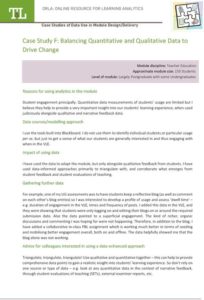
This resource is an executive summary of a key literature review which stemmed from an interdisciplinary project that examines how qualitative and quantitative student feedback and evaluation of teaching methods, at module and programme level, can help to enhance student learning and contribute to the continuing professional development of staff who teach.
This resource stems from an interdisciplinary project that examines how qualitative and quantitative student feedback and evaluation of teaching methods, at module and programme level, can help to enhance student learning and contribute to the continuing professional development of staff who teach.
This resource has been developed to provide a framework for programme teams and lecturers to consider the role and place of group-work in their programmes and teaching and to plan and manage it in a way that enhances learning and promotes a positive student experience.
The All Ireland Journal of Teaching and Learning in Higher Education (AISHE-J) is an open-access, peer-reviewed, journal of scholarly research into Teaching and Learning in Higher Education.
An EDTL webinar presenting the importance of student partnership underpinning the EDTL project, with students being the heart and core feeding through each of the themes of the work.
A resource developed to support the Irish higher education community in the initial weeks of the move to online/remote teaching and learning in March 2020
This Compendium of Active Learning Strategies for Student Engagement serves as a helpful collaborative resource with ideas for continuing to improve practice and enhancing student engagement.
A flexible resource that supports learners to assess their current employability skills. Focus is given to a number of developmental areas that employers review and assess as part of a recruitment and selection processes.
The aim of the this workbook is to provide a series of resources; contextual information, methods and approaches to the area of self and peer assessment.
The aim of the Student Success Toolbox is to support transitions from thinking about study to the first weeks to increase retention and completion rates particularly for flexible learners (undergraduate adult, part-time and online/distance students) as this is a significant problem in the Irish Higher Education sector.