Assessed Group-work: A framework and guidelines

Assessed Group-work: A framework and guidelines

Creator(s) (alphabetical)

Colin Cooney, Moira Maguire, Paula Mullen, Peter Morris, Ronan Bree

Organisation(s)

Academic Council sub-committee for Learning and Teaching, Dundalk Institute of Technology

Discipline(s)

Generic programmes and qualifications, Teaching & Learning

Topic(s)

Accessibility & Inclusion, Assessment and Feedback, Student Success, Teaching and Learning Practice

License

CC BY-NC-SA

Media Format

PDF

Date Submitted

Submitted by

Export Resource Data

Description

This resource has been developed to provide a framework for programme teams and lecturers to consider the role and place of group-work in their programmes and teaching and to plan and manage it in a way that enhances learning and promotes a positive student experience.
Benefit of this resource and how to make the best use of it

This document has been designed to provide a framework for thinking about group-work in a structured way and making decisions at each stage in the process: Programme Development; Module Planning; Assessing and Monitoring and Supporting. The flowchart shown in Figure 1 illustrates the process and identifies key questions to answer at each stage. The guidelines then deal with each stage in more depth.

Creative Commons Attribution-NonCommercial-ShareAlike (CC BY-NC-SA)

This work is licensed under a CC BY-NC-SA license, allowing sharing and adaptation for non-commercial use with proper attribution, provided derivative works use the same license.

https://creativecommons.org/licenses/by-nc-sa/4.0/
? This citation is automatically generated and may require adjustment. Always verify it against your style guide.
Cooney, C., Maguire, M., Mullen, P., Morris, P., & Bree, R. (2021). Assessed group-work: a framework and guidelines. National Resource Hub (Ireland). Retrieved from: https://hub.teachingandlearning.ie/resource/assessed-group-work-a-framework-and-guidelines/ License: Creative Commons Attribution-NonCommercial-ShareAlike (CC BY-NC-SA).

Adapting this resource? Share your version!

If you have modified or adopted this resource, share your version here. Tracking adaptations helps us measure impact and connects others with useful updates.

Related OER

The Graduate Archive Website is a permanent collection of final year artworks and performances across the MTU Faculty of Creative and Performing Arts and Media.
The Archive showcases all works in full detail, which allows the works to function as high quality research material, and creates a key resource for teaching and learning.

What does success look like as a student?

In this short film, students in higher education across Ireland reflect on confidence, perseverance, first-time experiences, learning, and the small moments that can make a big difference.

The student voices featured here were gathered through the HEA Student Success Survey and Focus Groups in 2025 and are shared in their own words.

The animations are creative interpretations of those reflections, imagined and produced by second-year Animation students at Dún Laoghaire Institute of Art, Design and Technology (IADT).

From communicating in a second language to returning to education as a mature student, overcoming anxiety, and simply choosing not to quit, these stories explore the many ways success can be experienced.

Even small moments in college can be a success. What are yours?

Credits
Animation, Backgrounds & Compositing — Arantxa Vara
Animation & Backgrounds — Giada Randolfi
Animation — Zach Louis Ng Nocum
Animation & Backgrounds — Alex
Music composition & production — Darragh Winters

Special thanks
Karima Dillon
Eimhin Mc Namara
Rebecca Roper
The students who shared their experiences

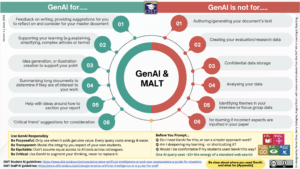
A 1-page guide, co-created by lecturers, tutors & students on DkIT's MA in Learning and Teaching, showing where GenAI can, and can't, support particular postgraduate research/skill development (*reflecting practice 2025-26). Includes student-informed prompts on responsible, sustainable use. An editable PowerPoint supports adaptation to own context.