Report: Commuter students: A student-centred, whole provider approach to improve student experiences and outcomes in technological higher education in Ireland

[favorite_button]

Creator(s) (alphabetical)

Liz Thomas

Organisation(s)

N-TUTTOR, University of York

Discipline(s)

Teaching and Learning

Topic(s)

Student Success

License

CC BY-NC-SA

Media Format

PDF

Date Submitted

Submitted by

Export Resource Data

Description

In Ireland around 40% of students remain in the family home – with their parents, partner or children – while participating in higher education (HE) and commute to their higher education institution (HEI). In 2024-25, the Technological Higher Education Association, now the Technological Universities Association (TUA) and the N-TUTORR Student Empowerment project leadership team, worked in partnership with Professor Liz Thomas, University of York. This resulted in an innovative project to explore commuter students’ experiences in Irish HEIs, and to consider changes that would improve the experience and outcomes for commuter students.

This Irish study builds on qualitative research undertaken in the UK (Thomas & Jones 2017). This found that commuter students are poorly defined, but self-identified commuters experienced commuting to be more tiring, stressful, and expensive than they imagined. They also reported lower engagement in some elements of the academic experience, and in the enhancement and social domains. Available secondary evidence finds that commuter student status is often correlated with not only poorer engagement but also lower outcomes, such as continuation, completion, attainment, and progression to graduate employment.

The study reported here addressed the following two questions:
i. How does being a commuter student impact on student experiences and outcomes in technological HEIs in Ireland
ii. How can technological HEIs improve the experience and outcomes of commuter students?

The study combined a semi-structured review and thematic analysis of the websites of the seven technological HEIs in Ireland, with two online ‘town hall focus groups’ (THFGs) involving 33 participants: six staff and 27 students, eight of whom were trained as facilitators and ‘jurors’ to reflect on the evidence heard. The THFGs addressed the key research questions, collecting individual responses via an online form; small groups discussed the topics and then a commuter student facilitator reported key points from their discussion into the main room. Ethical approval was secured from the University of York and participating HEIs.

Benefit of this resource and how to make the best use of it

The study was informed by a commitment to institutional change, rather than just expecting commuter students to change to fit into an unreformed HEI. Institutional change can be understood as a whole-provider approach (WPA). The whole-provider approach aims to support students to access, succeed in, and progress from HE through an inclusive student experience. This is facilitated by the institutional ‘enabling environment’, which involves aligning institutional policies, processes and organisation, and engaging stakeholders from senior leadership to staff and students, around the shared goal of an inclusive experience and equitable outcomes, underpinned by data and evidence.

Creative Commons Attribution-NonCommercial-ShareAlike (CC BY-NC-SA)

This work is licensed under a CC BY-NC-SA license, allowing sharing and adaptation for non-commercial use with proper attribution, provided derivative works use the same license.

https://creativecommons.org/licenses/by-nc-sa/4.0/
? This citation is automatically generated and may require adjustment. Always verify it against your style guide.
Thomas, L. (2025). Report: commuter students: a student-centred, whole provider approach to improve student experiences and outcomes in technological higher education in ireland. National Resource Hub (Ireland). Retrieved from: https://hub.teachingandlearning.ie/resource/report-commuter-students-a-student-centred-whole-provider-approach-to-improve-student-experiences-and-outcomes-in-technological-higher-education-in-ireland/ License: Creative Commons Attribution-NonCommercial-ShareAlike (CC BY-NC-SA).

Adapting this resource? Share your version!

If you have modified or adopted this resource, share your version here. Tracking adaptations helps us measure impact and connects others with useful updates.

Related OER

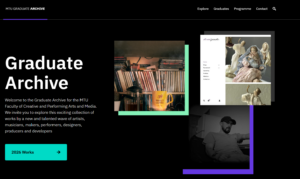
The Graduate Archive Website is a permanent collection of final year artworks and performances across the MTU Faculty of Creative and Performing Arts and Media.
The Archive showcases all works in full detail, which allows the works to function as high quality research material, and creates a key resource for teaching and learning.

What does success look like as a student?

In this short film, students in higher education across Ireland reflect on confidence, perseverance, first-time experiences, learning, and the small moments that can make a big difference.

The student voices featured here were gathered through the HEA Student Success Survey and Focus Groups in 2025 and are shared in their own words.

The animations are creative interpretations of those reflections, imagined and produced by second-year Animation students at Dún Laoghaire Institute of Art, Design and Technology (IADT).

From communicating in a second language to returning to education as a mature student, overcoming anxiety, and simply choosing not to quit, these stories explore the many ways success can be experienced.

Even small moments in college can be a success. What are yours?

Credits
Animation, Backgrounds & Compositing — Arantxa Vara
Animation & Backgrounds — Giada Randolfi
Animation — Zach Louis Ng Nocum
Animation & Backgrounds — Alex
Music composition & production — Darragh Winters

Special thanks
Karima Dillon
Eimhin Mc Namara
Rebecca Roper
The students who shared their experiences

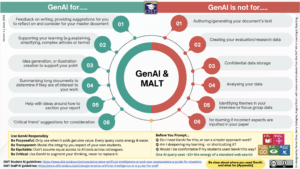
A 1-page guide, co-created by lecturers, tutors & students on DkIT's MA in Learning and Teaching, showing where GenAI can, and can't, support particular postgraduate research/skill development (*reflecting practice 2025-26). Includes student-informed prompts on responsible, sustainable use. An editable PowerPoint supports adaptation to own context.