National Forum

Filter by

Filters
Topic
Reset
Discipline(s)
Reset
Licence
Reset
Format
Reset
1 - 100 of 205 results

This landscape report provides an overview of Education for Sustainable Development (ESD) practice across the higher education sector in Ireland. It draws together publicly available institutional strategies, HEA Performance Framework Agreements 2024–2028, Climate Action Roadmaps and ESD to 2030 progress reports to outline current approaches to embedding ESD.

Structured as a series of institutional case studies, the report highlights how ESD is being addressed across teaching and learning, research, engagement and whole-institution practice, and identifies opportunities for collaboration and shared learning across the sector.

This discussion paper explores how student success in higher education is understood, defined and supported in contemporary Irish and international contexts. It brings together international research, national policy and insights from student focus groups conducted in Ireland in 2025 to examine success beyond traditional metrics such as retention, progression and completion.

The paper presents a holistic and relational view of student success, foregrounding belonging, mattering, agency and wellbeing alongside academic and outcomes-based measures. It situates student success as simultaneously student-defined, institution-enabled and outcomes-oriented, and considers the implications of this framing for teaching, learning, policy and system-level practice.

This report presents findings from the HEA Student Success Survey 2025, capturing how students across Ireland define, experience and achieve success in higher education. Based on responses from over 3,400 students across publicly funded higher education institutions, it provides a national, student-centred perspective on success.

The report explores students’ definitions of success, the supports and enablers that help them thrive, and the barriers that can hinder progress. It highlights the relational and holistic nature of student success, encompassing academic achievement alongside well-being, belonging, personal growth and future readiness.

Leading Change Together: Case Studies from the Teaching & Learning Conference 2025 is a collection of case studies showcasing practice-led examples from the HEA Teaching & Learning Conference 2025, held under the theme “Leading Change Together: Building the Future of Teaching and Learning in Higher Education”. The resource brings together institutional and practitioner contributions spanning topics such as inclusive learning design, education for sustainable development, professional learning, digital innovation and AI in teaching and learning. It illustrates how collaborative practice across Irish higher education is shaping future-focused approaches to enhancing teaching and learning.

This document sets out a detailed, values-led framework to support the ethical adoption of generative artificial intelligence (gen AI) in teaching and learning across Irish higher education. It builds on the HEA Generative AI Policy Framework by translating high-level principles into concrete provisions to guide institutional policy, governance and educational practice.

The principles address five core areas: academic integrity, equity and inclusion, critical engagement and AI literacy, privacy and data governance, and sustainable pedagogy. Together, they provide institutions with a practical reference for navigating the ethical, pedagogical and organisational challenges associated with generative AI, while safeguarding academic standards, student rights and institutional autonomy.

This policy framework provides national guidance for the responsible and values-based use of generative artificial intelligence (gen AI) in teaching and learning within Irish higher education. It is designed to support educators, academic leaders and professional staff in making informed decisions about the adoption and integration of gen AI technologies in educational practice.

The framework focuses specifically on teaching and learning, addressing issues such as academic integrity, assessment design, equity and inclusion, AI literacy, privacy and data governance, and sustainable pedagogy. It sets out five core principles to guide institutional policy development and practice, while allowing for local adaptation and institutional autonomy.

This resource captures key insights from a full-day workshop held on 8 May 2025, hosted by the Higher Education Authority (HEA) and led by internationally recognised expert Dr Alison Cook-Sather. The event focused on the transformative potential of authentic student-staff partnerships as a strategic approach to advancing student engagement, success, and institutional effectiveness.

Attended by academic staff, institutional leaders, student success professionals, and sector partners from across Ireland, the workshop featured a combination of keynote presentations, lightning talks, and interactive sessions. Through real-world examples and hands-on activities, participants explored how to build meaningful, inclusive, and sustainable collaboration between students and staff.

For the full event schedule and a complete list of lightning talk contributors to this slide deck, visit the workshop schedule.

This open course is designed to facilitate the development of your Artificial Intelligence (AI) literacy so that you can explore and innovate using Generative AI (GenAI) within your teaching, learning, and assessment practices.

In light of the potential opportunities and challenges of these technologies, this course will facilitate you in exploring the fundamentals of GenAI and AI Literacy, whilst focusing on an ethical practice. You will consider innovative ways in which you can respond to the challenges arising from the impact of these technologies in Higher Education.

Completion of this course will support you in developing a GenAI teaching strategy to apply to your own practice.

Simon Harris TD, Ireland’s Minister for Further & Higher Education, Research, Innovation & Science officially launches the report and findings from the national sectoral partnership project- Next Steps for Teaching and Learning: Moving Forward Together. The overarching aim of the ‘Next Steps’ project was to address the question, in the context of COVID-19, ‘What have we learnt and what does it mean for the future of teaching and learning in Irish higher education?’

This launch is the centre-piece of VIT&L Week events and activities. This event shares the findings from the project. These findings are discussed by a panel which includes student, staff, senior management, sector, system and international representatives. This Ministerial launch event is chaired and presented by Irish print and broadcast journalist Matt Cooper.

Presented by Grainne Seoige and featuring varied voices from the sector reflecting on what the whirlwind of recent months means for T&L

Mini Documentary: Next Steps

CC BY

This VIT&L Week podcast focuses on some of the National Forum’s Inaugural Teaching and Learning Research Fellows. Associate Professor Geraldine O’Neill, UCD, Assistant Professor Brett Becker, UCD, Dr Barry Ryan, TU Dublin and Professor Chris Lynch, UCC talk about why the fellowships are important and how they have shaped them as teaching and learning scholars.

This VIT&L Week podcast focuses on the Disciplinary Excellence in Learning, Teaching and Assessment (DELTA) Award. Dr Roisin Cahalan, UL, Dr Jerry Reen UCC and Dr Helen McGuirk , MTU explore what the DELTA Award means to them and discuss the Award’s importance to the Irish higher education sector.

Chaired by National Forum board member, Professor Paul McSweeney (Vice-president for Learning and Teaching at UCC) who introduces the fifth and final stage of our Gasta Marathon led by Gasta Master, Dr Tom Farrelly (MTU). The session also features our second poster showcase.

The final Scholarship Hour is followed by the closing session of VIT&L Week where participants were invited to review the week’s activities through exploring the visual note-taking developed in real-time during each day of VIT&L Week to capture and share ideas discussed and explored by the National Forum and its partners from the Irish higher education sector.

Chaired by National Forum board member, Professor Jacqueline McCormack (Vice President of Online Development at IT Sligo), the fourth Scholarship Hour opens with National Forum Teaching and Learning Research Fellow, Professor Chris Lynch (UCC), sharing his initial research findings on findings from his research into Working with Higher Education Institutions and Professional and Regulatory Bodies to Enhance the Competencies of Future Professionals.

This presentation is followed by the fourth stage of our Gasta Marathon led by Gasta Master, Dr Tom Farrelly (MTU).

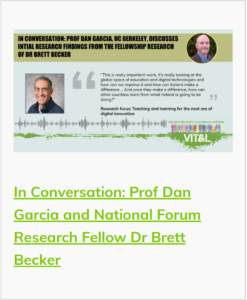
Chaired by National Forum board member, Dr Leo Casey (Director of Learning & Teaching and Education Programmes at NCI), the second Scholarship Hour opens with National Forum Teaching and Learning Research Fellow, Dr Brett Becker(UCD), sharing his initial findings from his research into Teaching and Learning for the Next Era of Digital Innovation.

This presentation is followed by the second stage of our Gasta Marathon led by Gasta Master, Dr Tom Farrelly (MTU).

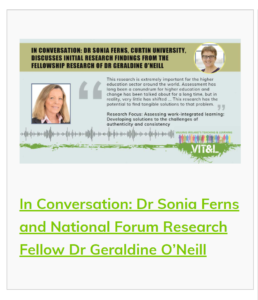
Chaired by National Forum board member Lewis Purser (Director, Learning & Teaching and Academic Affairs, at the IUA), the first Scholarship Hour opens with National Forum Teaching and Learning Research Fellow, Associate Professor Geraldine O’Neill (UCD), sharing her initial findings from her research into Work-based Assessment: Exploring Barriers and Solutions to an Emerging Assessment Challenge.

This presentation is followed by the first stage of our Gasta Marathon led by Gasta Master, Dr Tom Farrelly (MTU).

This document is an insight into USI’s contribution to the ‘Next Steps’ project. The Union of Students in Ireland (Aontas na Mac Léinn in Éirinn) is the national representative body for thirdlevel students in Ireland. USI represents more than 374,000 students in over thirty colleges across the island of Ireland. USI is represented on the Board of the National Forum by the Vice President for Academic Affairs.

Perspective of Students

CC BY

In this Next Steps Insight, we trace ideas for the future from those who teach in higher education. These are the voices of staff as reflected in the Next Steps partner contributions. This Insight has referenced the submissions from IUA, HECA, THEA and QQI. We have also drawn from previous National Forum research and consultations with National Forum Associates (NFAs), our Advisory Groups, and the Networks and Disciplines. We include priorities identified across consultations with students which have specific implications for teaching.

In two Next Steps Insights, we trace the voice of all those who teach, and their experiences during a pandemic which necessitated the closure of campuses across the country. Part 1 documents and reflects on practice during the initial stages of the pandemic. Part 2 shares messages for the future from the analyses of these experiences and in the words of those who teach. Both Insights reference the submissions from IUA, RCSI, HECA, THEA and QQI. We have also drawn from previous National Forum research and consultations with National Forum Associates (NFAs), our Advisory Groups, and the Networks and Disciplines.

This Next Steps Insight provides a brief overview of the digital dimension of the pre-2020 teaching and learning context, and the views and priorities of institutional senior managers in the years leading up to the pandemic. A summary is then presented of the perspectives of senior managers across Irish higher education in 2021 with respect to what they have learned through the shift to online/remote teaching and learning and what needs to prioritised into the future.

This Forum Insight provides an overview of the teaching and learning policy context at European and national levels, with particular attention paid to digitisation and the pandemic recovery. It then proposes related next steps for the future of teaching and learning from a policy perspective.

This Forum Insight examines assessment practices in light of the Covid-19 pandemic and closure of campuses in 2020, foregrounding assessment principles previously developed in collaboration with sectoral partners and stakeholders, and reflecting the outcomes of two National Webinar series events in spring 2021 on the future of assessment in a changed higher education landscape. We thank the webinar presenters and participants including representatives of disciplines, agencies and networks from across Ireland and capture their contributions as Ten Things We Have Learned About Assessment.
This Insight outlines key themes in online and blended learning scholarship in the period 2010-2020, before the Covid-19 pandemic. The review begins with definitions of key terms and then outlines several major themes in online and blended learning as well as recent critical approaches.

Chair of the National Forum, Lynn Ramsey officially opens VIT&L Week. The keynote speaker is Prof Frank Coton (Senior Vice Principal and Deputy Vice Chancellor (Academic) at University of Glasgow and international advisor to the Board of the National Forum. Prof Coton shares his thoughts on Why Valuing Teaching and Learning is VITAL.

This session leads into VIT&L Week’s first Scholarship Hour.

VIT&L Week Opening Event

CC BY

Since March 2020 higher education has experienced one of the most disruptive phases in its recent history. In a sector typified by considered, researched and incremental change, overnight everyone began emergency remote teaching, learning and assessing. The dramatic shift resulted in positives and negatives, and posed a series of questions for students, staff and other stakeholders. Though still living through the pandemic, in March 2021 fifteen partners from a range of stakeholders across the sector agreed to work together to answer one shared persistent and urgent question: In the context of Covid-19, what have we learnt and what does it mean for the future of teaching and learning in Irish higher education?

The National Forum for the Enhancement of Teaching and Learning in Higher Education in partnership with the Higher Education Authority hosts an online launch of a new resource ‘Seven Cs for Embedding Student Success: A Toolkit for Higher Education Institutions’ designed to support the sustainable enhancement of student success across the sector. We are delighted to have Minister for Further and Higher Education, Research, Innovation and Science, Simon Harris TD formally launch the resource. 

This infographic is derived from the National Forum Open Licensing Toolkit, a document that outlines the National Forum’s commitment to open licensing, which enables the creation and sharing of open…
How to Choose an Open Licence is an infographic based on a guide of the same name published in the National Forum OER/OEP Series: Open Educational Resources and Open Educational…
This resource can be used as part of an individual’s engagement with the PD Framework for all who teach in Higher Education. It can be used to reflect on professional…
This resource can be used as part of an individual’s engagement with the PD Framework for all who teach in Higher Education. It is especially useful for gathering evidence in…
Guiding Framework for Embedding Student Success
The National Forum has developed this one-page guiding framework to inform conversations at institutional level in the development of approaches to embedding student success. The framework identifies three key pillars…
INDEx Survey: Final Summary Report

This INDEx Survey Final Summary Report outlines how INDEx Survey findings provided a source of evidence for the initial response to the COVID crisis, have supported data-informed decision-making in multiple ways, and represent an important baseline of pre-COVID teaching, learning and digital experience.

How to Choose an Open Licence

How to Choose an Open Licence is the second guide in the National Forum OER/OEP Series: Open Educational Resources and Open Educational Practices. The first guide in the series was the National Forum Open Licensing Toolkit, published in 2019.

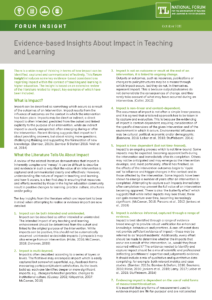
There is a wide range of thinking in terms of how impact can be identified, captured and communicated effectively. This Forum Insight introduces some key evidence-based considerations regarding impact within the context of teaching and learning in higher education. The Insight is based on an extensive review of the literature related to impact, key examples of which have been included.

The 40 sources summarised in this document each have an explicit focus on impact and provide useful insights for those wishing to explore the topic. The majority of sources focus on teaching and learning impact in a higher education context. A small number focus on impact in other contexts (research or post- primary contexts) and these were included due to their potential relevance to those interested in higher education teaching and learning impact.

Learning Analytics Features in Canvas

This document provides an overview of the Canvas LMS analytics features currently available to staff who teach as well as some future developments in the area.

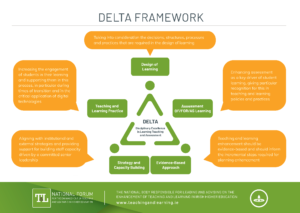
DELTA Framework Overview

The DELTA Framework provides a structure which can be used by institutions, disciplinary groups or institutions to plan and prioritise their efforts to enrich understandings and practices within disciplinary contexts.

DELTA Framework Overview

CC BY
The National Forum Open Licensing Toolkit outlines the National Forum’s commitment to open licensing, which enables the creation and sharing of open educational resources. The toolkit provides a detailed description…
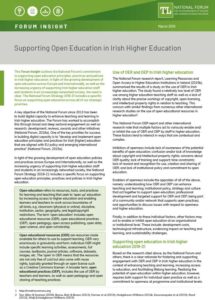
Supporting Open Education in Irish Higher Education
This Forum Insight outlines the National Forum’s commitment to supporting open education principles, practices and policies in Irish higher education. In light of the growing development of open education across…
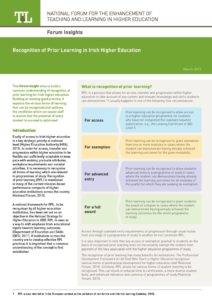
Recognition of Prior Learning in Irish Higher Education

This insight aims to build a common understanding of recognition of prior learning for Irish higher education. Building on existing good practice, it explains the various forms of learning that can be recognised and outlines the conditions which can assist staff to ensure that the potential of every student to succeed is optimised.

Profile of Assessment Practices in Irish Higher Education

This report aims to inform the current enhancement theme of the National Forum by profiling documented assessment practices across a sample of 30 undergraduate degree programmes. Further, the study aims to explore whether and how assessment practices differ between fields of study and to share insights regarding students’ experiences of assessment across Irish higher education.

Transition from Further Education and Training to Higher Education

The National Forum, in partnership with the Further Education and Training (FET) sector, conducted a survey and interviews in 2016 of FET learners’ experiences of transition to higher education. A Forum Insight on Transition from Further Education and Training to Higher Education can be accessed here.