

This Open Educational Resource (OER) provides a clear, step-by-step infographic explaining how to set up Mastery Paths in Canvas LMS to support personalised learning. Designed for educators and instructional designers, it includes practical setup instructions, examples of differentiated learning pathways, and a QR code linking to a video demonstrat
Resource
Competencies, Expectations and Learning Contracts in Work-Based Assessment: How are they related?
Description
Benefit of this resource and how to make the best use of it
The National Forum, in partnership with Quality and Qualifications Ireland (QQI), host an online webinar entitled ‘Competencies, Expectations and Learning Contracts in Work-Based Assessment: How are they related?’ Assessment of work-integrated learning can be challenging in relation to the:
- Expectation of what is to be assessed in advance of the experience (the level and number of competencies),
- The diverse learning opportunities provided by the placement/experience for these competencies, and the
- Unique learning goals of the students.
Recent research, by Associate Professor Geraldine O’Neill as part of her National Forum Teaching and Learning (NFTL) Research Fellowship, has highlighted some initial findings that may help understand the relationship between these three challenges. For example, disciplinary groups in the research highlighted: a) the importance of the clarification of expectations in work-based assessment; b) the need to avoid over-specification of competencies; c) the value of inter-stakeholder dialogue; and d) the creation of context specific learning contracts.
This webinar presents some of the initial findings from this NFTL Research Fellowship and supports discussion around their implications for practice and policy.
People, communities and initiatives
Contributors
Geraldine O’Neill
Communities
Initiatives
Creative Commons Attribution (CC BY)
This work is licensed under a CC BY license, allowing sharing and adaptation with proper attribution.
https://creativecommons.org/licenses/by/4.0/
Access this resource
Links open in a new tab.
Additional resource information
Resource details
Share this resource
Report an issueAdapting this resource? Share your version!
If you have modified or adopted this resource, share your version here. Tracking adaptations helps us measure impact and connects others with useful updates.
More resources in these topics
Explore resources sharing the topics attached to this record.
Educator Checklist: Designing Gamified Learning Experiences in Canvas
This Open Educational Resource (OER) provides educators with a practical checklist for designing gamified learning experiences in Canvas. Grounded in Self-Determination Theory, it offers actionable strategies to enhance student motivation, engagement, and participation by supporting autonomy, competence, and relatedness within an inclusive, student-centred learning environment.
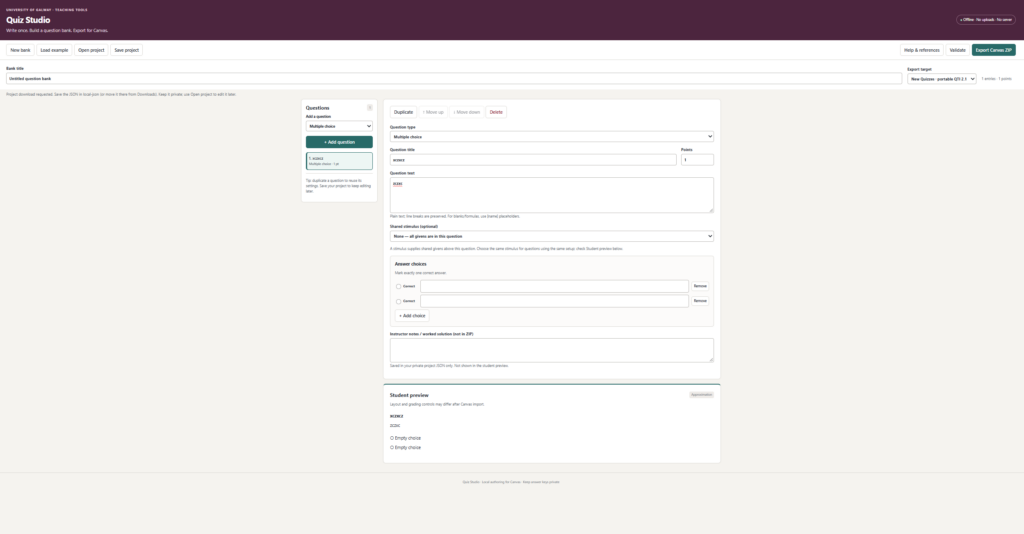
Canvas Question-Bank Conversion Toolkit: An Offline Editor and AI-Assisted Guide for Bulk-Loading Existing Questions
This offline Canvas question-bank editor helps instructors convert Word-based assessments into JSON, validate large banks, and bulk-load questions efficiently. Designed for faculty and instructional designers, it reduces manual entry, improves consistency, and supports faster course setup in higher education
Report an issue