

MTU researchers, together with national and international researchers, presented local, national, and global insights into the challenges and opportunities of assessment and feedback in work placement settings.
Filter by
Filter by
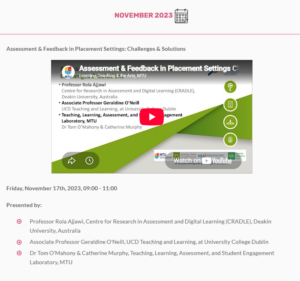
MTU researchers, together with national and international researchers, presented local, national, and global insights into the challenges and opportunities of assessment and feedback in work placement settings.
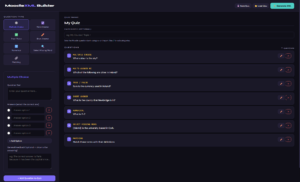
The purpose of this resource is to allow Moodle teachers to quickly create quizzes for Moodle. Users can quickly select between questions types through a single interface and export their questions as an XML file which can be imported into Moodle.
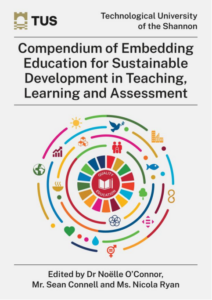
The Technological University of the Shannon (TUS) Compendium of Embedding Education for Sustainable Development (ESD) showcases the University’s commitment to integrating sustainability across teaching, learning and assessment. It is the first compendium of its kind in an Irish higher education institution.
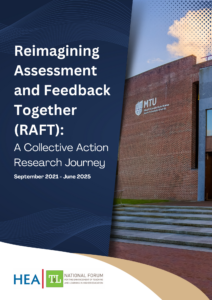
Reimagining Assessment & Feedback Together (RAFT) is MTU initiative developed to transforming assessment practices. This volume documents twenty-four situated, discipline-specific attempts to rethink assessment and feedback through student partnership and action research.

The HEA Education for Sustainable Development Spotlight Series 2025: Case Studies Compendium brings together 115 case studies from higher education institutions across Ireland. It showcases how universities and colleges are integrating sustainability and the UN Sustainable Development Goals into teaching, research, curriculum design, assessment practices and community engagement. It offers a comprehensive picture of national ESD activity and provides an accessible resource for educators and policymakers seeking examples of practice-based innovation.

It is with great pleasure that we present the proceedings from the
“Enhancing Academic Integrity: From Ideas to Action” conference, hosted
by CCT College Dublin on 3rd and 4th September 2024. This collection
represents the culmination of thoughtful discourse, innovative research, and
collaborative spirit that defined our gathering.

We were both impressed and worried to witness the rapid escalation in the ability of tools like ChatGPT to conjure credible-seeming scholarly prose ex-nihilo. Rather than leaving the assessment strategy in MEEN3010 exposed to AI plagiarism, we decided to shift the focus towards a more authentic and interactive learning activity; a poster session.

This OER is from a collection of ‘MU: UDL & U’ Plus One resources created by Maynooth University colleagues with the support of HEA PATH4 funding.

The Toolkit includes an introduction to generative AI and lexicon of terms, guidelines for ethical use, recommended adjustments to common modes of assessment to mitigate against the potential risk of unethical use, and discipline-specific case studies of good practice that share innovative forms of learning, teaching and/or assessment.

This practitioner guide is designed to offer an overall framework for successfully developing and facilitating group work processes. It guides the novice practitioner through each stage of the process. It signposts associated challenges and provides suggestions for helpful responses.

This is a short introduction to ChatGPT for people teaching in higher education, created in January 2023 and updated until this version was saved in February 2023. The resource is a slide deck which you are free to modify and update (since this is a fast-moving topic). No prior knowledge of AI or chatbots is necessary to use the slides.


Since March 2020 higher education has experienced one of the most disruptive phases in its recent history. In a sector typified by considered, researched and incremental change, overnight everyone began emergency remote teaching, learning and assessing. The dramatic shift resulted in positives and negatives, and posed a series of questions for students, staff and other stakeholders. Though still living through the pandemic, in March 2021 fifteen partners from a range of stakeholders across the sector agreed to work together to answer one shared persistent and urgent question: In the context of Covid-19, what have we learnt and what does it mean for the future of teaching and learning in Irish higher education?


This report aims to inform the current enhancement theme of the National Forum by profiling documented assessment practices across a sample of 30 undergraduate degree programmes. Further, the study aims to explore whether and how assessment practices differ between fields of study and to share insights regarding students’ experiences of assessment across Irish higher education.

Report to the European Commission on New Modes of Learning and Teaching in Higher Education: Insight for Teachers

Insight: Staff Use of Technology-Enhanced Assessment in Higher Education: A Systematic Review

Report to the European Commission on New Modes of Learning and Teaching in Higher Education: Insight for Managers

Report to the European Commission on New Modes of Learning and Teaching in Higher Education: Insight for Students

Assessment OF, FOR and AS Learning: Continuing the Debate and Creating a Focus

Some Key European and National Teaching and Learning Policy and Practice Documents

Insight: Profile of Assessment Practices in Irish Higher Education

Expanding our Understanding of Assessment and Feedback in Irish Higher Education

Assessment OF/FOR/AS Learning Enhancement Theme 2016-18

Work-Based Assessment OF/FOR/AS Learning: Context, Purposes and Methods

Enabling Policies to Support Assessment OF/FOR/AS Learning in Irish Higher Education

This webinar begins a national conversation on how we understand the concept of an agile curriculum and what can be learned and shared across related projects and initiatives at national level.

This webinar shared and debated a range of perspectives from students, staff, senior managers and other stakeholders on assessment of learning through a final examination. Few areas of teaching and learning were more under the spotlight in recent months than assessment. Across institutional communities, the experience of selecting and designing alternative assessments had a number of impacts on attitudes and intentions for the future. This webinar shared and debated a range of perspectives from students, staff, senior managers and other stakeholders on assessment of learning through a final examination.

Using ISSE Data to Inform and Enhance Changes to Assessment OF/FOR and AS Learning

Case Study: Dr Cormac Quigley and Dr Etain Kiely of Galway-Mayo Institute of Technology show how they are using everyday tools to enable at-scale, personalised feedback to large student cohorts

Learning from the Evaluation of Assessment: How Faculty and Staff Can Use Results to Inform Practice

The EAT Framework: Considerations for Programme Leaders and their Students

The Wider Context of Programme-Level Enhancement of Assessment

Designing in Assessment OF/FOR/AS Learning Throughout the Programme

Head of Department’s Experience of Managing and Interrogating Programme-Level Assessment – Asking Questions

Enhancing Programme Approaches to Assessment and Feedback in Irish Higher Education: Case Studies, Commentaries and Tools

A Case for Slow Scholarship: Implications for Programme Assessment Design

An Introduction to Horizontal and Vertical Approaches to Programme Assessment Integration

This resource is an executive summary of a key literature review which stemmed from an interdisciplinary project that examines how qualitative and quantitative student feedback and evaluation of teaching methods, at module and programme level, can help to enhance student learning and contribute to the continuing professional development of staff who teach.

This resource stems from an interdisciplinary project that examines how qualitative and quantitative student feedback and evaluation of teaching methods, at module and programme level, can help to enhance student learning and contribute to the continuing professional development of staff who teach.
![10 simple rules for supporting a temporary online pivot in higher education [Webinar]](https://hub.teachingandlearning.ie/wp-content/uploads/2021/06/10-simple-rules-for-supporting-a-temporary-online-pivot-in-higher-education-Webinar-2-300x126.png)
Webinar: 10 simple rules for supporting a temporary online pivot in higher education

During this session, Gearóid asks Lawrie questions about the emergent findings and trends he’s seen during the pandemic, and what he hopes might happen next.

This year saw the return of the highly popular “Gasta Goes Global” ed-tech event. “Gasta” is a high-energy, high-participation event format created and popularised by Dr Tom Farrelly of Munster Technological University.

This interactive session will explore the change in assessment in higher education due to the pandemic.

This resource has been developed to provide a framework for programme teams and lecturers to consider the role and place of group-work in their programmes and teaching and to plan and manage it in a way that enhances learning and promotes a positive student experience.

Remote teaching: a practical guide with tools, tips, and techniques. Through each of the chapters that follow, this online pressbook walks you through the steps of converting to a remote courses.

An online blog from various members of the DigitalEd community helping to highlight and share reflections on important aspects to online teaching and learning.

An EDTL webinar providing some key points around assessment in an online era.

The IUA’s EDTL project have developed a popular and engaging webinar series, with each video hosted on their vimeo channel. Go to the channel now to view content that will certainly be of interest to you.

This guide has been developed in collaboration between the MU IUA Enhancing Digital Teaching and Learning Initiative and MU Library to provide an introduction to the benefits and challenges associated with finding, using and sharing OERs in Teaching, Learning and Assessment.

The Irish Universities Association has launched a three-year project to mainstream digital in teaching, learning and assessment through an ambitious professional development programme. The aim is to move away from individual champions, towards effective engagement of all staff with digital technologies. This includes attempts to diversify the assessment methods utilised across the university.

This Forum Insight aims to expand our understanding of the terms associated with assessment within the Irish higher education sector.

This resource is intended to prompt reflection on the breadth of potential assessment activity that can be used across the disciplines. Consider how your assessment strategy enables students to demonstrate their achievement of one or more learning outcomes and whether assessment activity is adequately aligned with workload.

Rethinking Assessment – An overview of alternative assessments to end of term exams

In the words of the authors, “this project sought to address a key issue in third level Teaching and Learning, that of assessment and assessment feedback. Assessment strategies have been shown to have a large impact on shaping how students learn and how they develop key employability skills. Learning from best practice nationally and internationally, and research from staff, students and quality documents, this project has developed a set of recommendations which will enhance practices in, and experiences of, assessments and feedback in TU Dublin”.

A resource developed to support the Irish higher education community in the initial weeks of the move to online/remote teaching and learning in March 2020

DCU has issued a set of guiding principles to inform the development and approval of alternative assessments. The authors unpack these principles here and link them to a set of actions to guide the choice of alternative assessments in the immediate term.

This resource is an introduction to multiple facets of the process involved in the development of multiple choice items and assessments, such as item writing, assessment blueprinting, standard setting and item analysis as they relate to multiple choice assessments

The foreword of this resource states the author “has put together a comprehensive collection of resources and tied these to tools and connections to open our thinking. Placed at the heart of this resource, is an exercise on the development of one’s own ‘Personal Philosophy of Teaching’”

The aim of the this workbook is to provide a series of resources; contextual information, methods and approaches, to the area of assessment construction and implementation.

The aim of the this workbook is to provide a series of resources; contextual information, methods and approaches to the area of self and peer assessment.

A workbook to support educators in reflecting on assessment issues, and planning around these.

This guide outlines some pedagogic considerations when designing take home offline exams or real-time online exams, both effectively ‘open book’ exams.
![10 simple rules for supporting a temporary online pivot in higher education [Pre-print Publication]](https://hub.teachingandlearning.ie/wp-content/uploads/2021/06/10-simple-rules-for-supporting-a-temporary-online-pivot-in-higher-education-Pre-print-Publication-1-208x300.png)
10 simple rules for supporting a temporary online pivot in higher education


