

Enhancing Programme Approaches to Assessment and Feedback in Irish Higher Education: Case Studies, Commentaries and Tools
Ancillary, supplementary or associated files…
Enhancing Programme Approaches to Assessment and Feedback in Irish Higher Education: Case Studies, Commentaries and Tools
This web-based collection contains case studies, commentaries and tools supporting the enhancement of assessment and feedback in Irish higher education programmes. The collection showcases the contribution of 31 staff and two students, from 14 national and five international institutions. The topics explored in this collection highlight the complexity of programme approaches to assessment and feedback, in particular:
– the drivers of programme assessment change
– leading change to programme assessment
– exploring the evidence for what’s going on in programme(s) and
– ideas to enhance changes in programme(s) assessment.
The collection should be valuable to a range of stakeholders in higher education, i.e. academic staff, senior administrators, programme teams, students, quality assurance officers, education developers/technologists, assessment unit staff, etc.
Creative Commons Attribution (CC BY)
This work is licensed under a CC BY license, allowing sharing and adaptation with proper attribution.
https://creativecommons.org/licenses/by/4.0/
Links open in a new tab.
If you have modified or adopted this resource, share your version here. Tracking adaptations helps us measure impact and connects others with useful updates.
Explore resources sharing the topics attached to this record.
Recording of the Higher Education Authority’s webinar held on 10 September 2026 to introduce its Education for Sustainable Development (ESD) Framework for Higher Education. The session explains the Framework’s five strategic enablers and the Self-Evaluation Tool for institutions reviewing their ESD work. A sector panel discusses opportunities, challenges and practical approaches to embedding ESD. Contributions include HEA and DFHERIS perspectives and speakers from ATU, UCC, SETU, University of Galway, AMLÉ and TU Dublin. Published by National Forum T&L.
A short animation about barriers to student success in Irish higher education, including financial pressures, travel, workload, isolation, confidence and communication. It considers how these challenges can overlap, and how accessible support, approachable lecturers, counselling, careers guidance, financial assistance, student representation and flexible institutional practices can help.
Published by National Forum T&L.
Credits
Director — Dylan Drea
Producer — Ciara O’Brien
Animation — Robin Bennett, Jack Cahill, Talitha Cole, Dylan Drea, Lumiere Lomingo, Ciara O’Brien, Daniel Ofracio, Tobias Zhang
Compositing — Robin Bennett, Jack Cahill, Dylan Drea, Ciara O’Brien
Sound — Robin Bennett, Dylan Drea
Script — Jack Cahill, Ciara O’Brien, Daniel Ofracio
Voice acting — David Carter, Es McLean
Editing — Jack Cahill, Dylan Drea
Special thanks — Rachel Fitzgerald, Eimhin McNamara, Rebecca Roper, Laura Venables
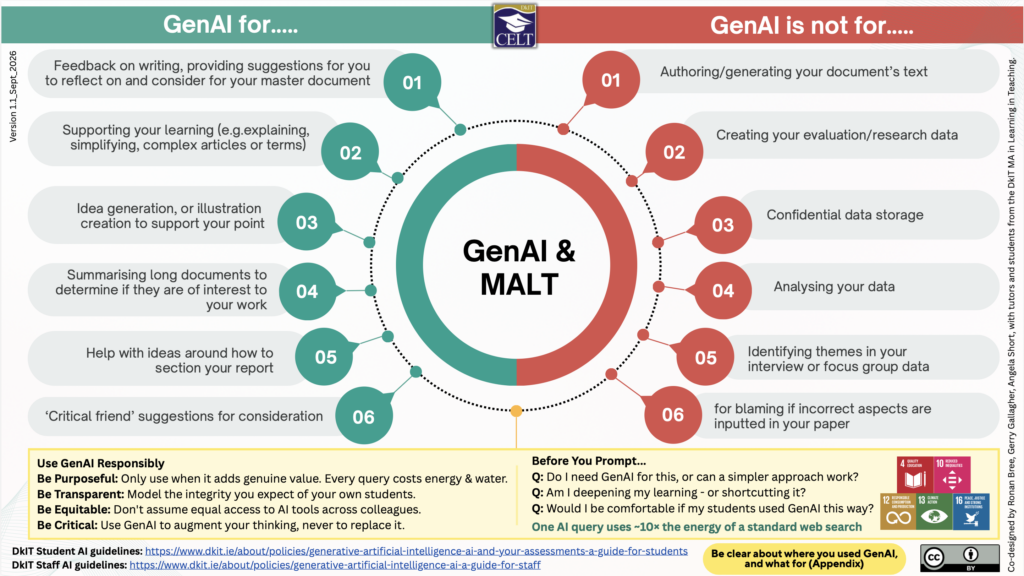
A 1-page guide, co-created by lecturers, tutors & students on DkIT's MA in Learning and Teaching, showing where GenAI can, and can't, support particular postgraduate research/skill development (*reflecting practice 2025-26). Includes student-informed prompts on responsible, sustainable use. An editable PowerPoint supports adaptation to own context.