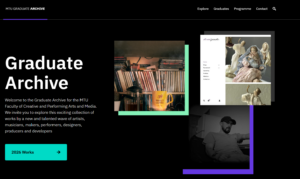
The Graduate Archive Website is a permanent collection of final year artworks and performances across the MTU Faculty of Creative and Performing Arts and Media.
The Archive showcases all works in full detail, which allows the works to function as high quality research material, and creates a key resource for teaching and learning.
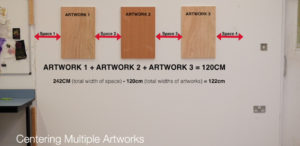
These video resources outline basic hanging and levelling methods used in the hanging and display of a variety of wall-based artworks, as well as demonstrating safe operation procedures for basic hand tools such as a drill, jigsaw, sander and nail gun.
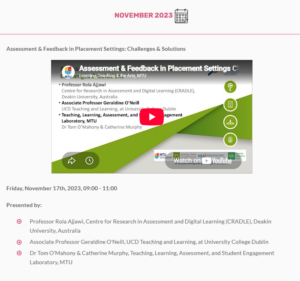
MTU researchers, together with national and international researchers, presented local, national, and global insights into the challenges and opportunities of assessment and feedback in work placement settings.
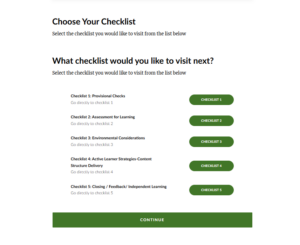
Teaching and Assessment for Learning Checklists aimed at early career & seasoned lecturers. The checklists provide guidance & reliable curated resources for lecturers who want to deliver an engaging and positive learning experience for their students. They act as a guide to check existing approaches, and help analyse how improvements can be made.
On Successful Completion of the event the students should be able to:
Critically evaluate design publication processes especially food styling for food photography and print.
Develop a professional e-publication suitable for wide spread distribution
Generate & adhere to a design brief.
As part of the Media & Visual Arts module on the 4th year of the Bachelor of Arts in Culinary Arts programme, students are working on food imagery, promotion and design.
As part of the Media & Visual Arts module on the 4th year of the Bachelor of Arts in Culinary Arts programme, students are working on food imagery, promotion and design.
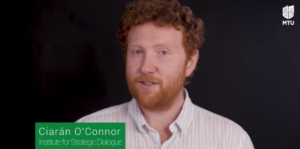
In this video Ciarán O’Connor for the Institute of Strategic Dialogue guides us through a case study of how false information was used to undermine confidence in the Irish local elections in June 2024.
In today’s digital age, information spreads fast—yet not all of it is true or trustworthy. Knowing the differences between misinformation, disinformation, and malinformation is key to thinking critically online.
In the video below Ciarán O’Connor from the Institute of Strategic Dialogue discusses the disinformation ecosystem in Ireland.
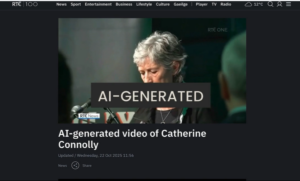
A video that discusses how Artificial Intelligence is impacting the way disinformation is created and spread to manipulate public opinion. It also outlines importance of Media Literacy education and regulatory measures, referencing Ireland’s Online Safety and Media Regulation Act and the EU’s Digital Services Act.
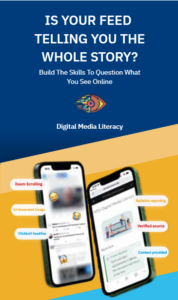
This interactive online resource is a set of eight units to support learners in their online information ecosystem. It is a mix of text, images, video, audio and interactive tasks. The resource can be accessed directly via the link provided or embedded in any Learning Management System compatible with SCORM files.
This resource showcases initiatives from both academic and professional support areas across DCU, which have been funded under SATLE – the Strategic Alignment of Teaching and Learning Enhancement Funding in Higher Education. Examples are provided under the themes of Education for Sustainable Development, Digital transformation & Academic Integrity
Reimagining Assessment & Feedback Together (RAFT) is MTU initiative developed to transforming assessment practices. This volume documents twenty-four situated, discipline-specific attempts to rethink assessment and feedback through student partnership and action research.
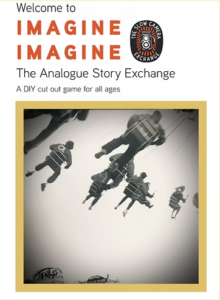
Imagine Imagine is a DIY cutout game for all ages made up of 192 photo cards. Using these cards, players are invited to create stories of their own. A downloadable pdf file of the game, instructions, and an image gallery can be found on the website.
This is a series of 10 instructional videos covering Standard Operating Procedures (SOP’s) for the safe use of equipment specifically designed for textiles.
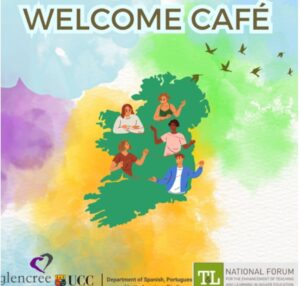
This toolkit draws on our experiences facilitating a SATLE-funded community-engaged learning project that brought students of the School of Languages, Literatures, and Cultures (UCC) together with people in Cork seeking international protection for a series of three wellbeing and creativity workshops.
BSEditor is a multi-platform software tool designed to aid educators in the creation of computer-based quiz questions. It provides a powerful editor to easily control every detail of a question, from integration of files and images, to elaborate scoring approaches.
Blender is a free and open-source 3D creation suite that supports Windows, macOS, Linux, and other platforms. It is widely used for creating animated films, visual effects, 3D models for printing, motion graphics, video games, and virtual reality content. This guide acts as an introduction to becoming familiar with Blender.
The Data Loom: Crafting Stories with Code, Yarn and Print is an open educational resource that reimagines data visualisation through tangible, artistic, and embodied practices. Instead of visualising numbers on screens, this project guides learners to materialise datasets using yarn, a miniature 3D-printed loom, and the art of weaving.
The resource is a template for surveying students about their timetabling experiences. The survey was deployed in MTU, but the template is free to be copied and adapted as needed.
Ideation Arcana is a visual ideation tool designed to assist learners—especially those new to open-ended creative projects—in generating and refining ideas. It does so by offering a structured yet playful approach to thinking, inspired by the layout and concept of tarot cards.
Ffrendi is an online, browser-based tool that makes it easier to learn and generate CSS visually. The name comes from the idea to provide a friendly frontend for learning and applying CSS.
The HTML & CSS Cheat Sheet is a quick-reference site designed to support first-year web development students. It gathers together all the key terminology and concepts introduced during the semester, making it easier to revise and apply them when building websites.
This e-book reports on a SATLE-funded project to explore the use of immersive technologies in Higher Education. It includes case studies, practical guidance and a brief review of the literature on immersive learning from the project team. It is intended for those considering using VR in their teaching, and for those who support learning.
The VISIEN Framework Document is a strategic guide for integrating immersive technologies (AR, VR, MR, XR) into higher education. It offers practical guidance on curriculum integration, accessibility, collaboration, skill development, institutional readiness, and more to support transformative teaching, learning, and research.
This Toolkit was created by students at University College Dublin, for students, to break down sustainability in a way that’s simple and easy to understand. Climate change is something that affects all of us—no matter what you’re studying, where you’re from, or what you do. It’s here, and it’s impacting our world—but many of us aren’t sure what we can do about it.
The purpose of this toolkit is a starting point for what students need to learn about living more sustainably on and off campus. We hope it’ll inspire students to take small steps that make a big impact, and they can do it all at their own pace. You can access the Moodle page to view the Toolkit. There are also Zip files of the SCORM packages used to create the Toolkit (Part 1 and Part 2) that can be downloaded and imported into a Virtual Learning Environment.
• Part 1: Climate Change → Watch short Youtube videos followed by a little quiz to brush up on your sustainability knowledge.
• Part 2: What Can You Do? → Find tips and tricks to incorporate sustainability into your day-to-day life, this is a resource tool to help you get started!
An experimental ‘eco-film’ workshop for staff and students to acquire skills and deeper knowledge of analogue photochemical film processes in a post-digital era.
The case studies highlight the excellent teaching and learning practices that are in place across MIC. Each case study provides a detailed description of the approaches implemented, the benefits and challenges of such approaches, and tips for those who wish to implement similar approaches in their own teaching.
This online tutorial introduces the fundamentals of Generative AI and LLMs, explaining their functionality, capabilities, and limitations. It explores key applications, ethical considerations, and practical examples, providing learners with a foundational understanding of how these technologies impact education and creativity.
The Facilitating Learning with Animation and Multimedia Engagement (FLAME) project provides a framework to easily design, author, produce and publish rich interactive 3D media to support teaching and learning. The media can be viewed on any device with a web browser.
Dr Ruth Hally received SATLE funding in 2023 to Document and Develop Community-engaged Learning (CEL) in the curriculum. She worked with four lecturers across UCC’s four Colleges to support them to embed CEL in existing modules. This video highlights work done with the UCC School of Applied Psychology.
Publication created by our 2024 summer interns in DkIT.
Stepping out in Dundalk! This book will be a useful resource for our cohort international students someone useful tips on life on and off campus.
Digital Skills for Success in the Workplace is a five-unit, self-paced online course which equips learners with key digital literacy skills that are essential to study and work in rapidly evolving online environments.
Publication created by our 2024 summer interns in DkIT.
Giving power back to class reps! This book will be a useful resource for all our student reps to use as a guide and for training purposes also.
This faculty guide aims to help educators navigate and understand GenAI’s potential role in higher education. Created for faculty who want to explore AI tools and their implications for teaching and learning, the resource allows educators to learn at their own pace about the opportunities and challenges of these technologies.
This project website enables students to champion the core values of academic integrity among their peers. These values comprise honesty, trust, fairness, respect, responsibility and courage, values to be cultivated in association with an ethos of compassion and concern.
We are delighted to welcome you to ‘You can UDL it!’ This collection brings together case studies from educators across DkIT, who have successfully implemented Universal Design for Learning (UDL) in their own practice. UDL provides a framework for making learning, teaching and assessment more inclusive, and helps to support all our learners.
This series of videos presents an abstract from the Croí process where individuals are guided to define their personal (or core) and professional values, and to identify actions they can take that will help them to develop a career that better aligns their personal and professional values and lives.
This project website aims to support students and teaching staff in UCD College of Arts and Humanities in navigating teaching, learning and assessment in the context of new developments in generative AI (e.g. OpenAI’s ChatGPT and Google Gemini).
Curricular approaches to well-being are important and impactful, as universal supports for all students. This OER is a padlet of resources and talks from the April 2024 jointly hosted UCC and MTU seminar on this critical area for teaching and learning enhancement in Irish higher education.
This report has been prepared for circulation across the Green-Campus Network, Higher Education Authority and the National Forum for the Enhancement of Teaching and Learning in Higher Education. It can also act as a resource for individuals who are interested in ESD and sustainability.
Future proof your curriculum by embedding sustainability into your teaching practice or further integrating the Sustainable Development Goals (SDGs) into your curriculum. The SDG digital toolkit project will give you concise actionable resources to achieve this result while providing insights into the underpinning theories.
This publication collects the posters shared at the 2023 Learning and Teaching Showcase at University College Cork, 5 December 2023. The posters are grouped into five themes: student engagement, inclusive teaching, academic integrity, digital education and education for sustainable development.
The Toolkit includes an introduction to generative AI and lexicon of terms, guidelines for ethical use, recommended adjustments to common modes of assessment to mitigate against the potential risk of unethical use, and discipline-specific case studies of good practice that share innovative forms of learning, teaching and/or assessment.
The Academic Integrity, Academic Misconduct, and Resources pages of the UCC Skills Centre website contain guidance for students on these topics, including a series of short videos, “The Minute Methods: Academic Integrity Skills” that cover a range of topics from the principles of academic integrity to the pitfalls of essay mills.
The “Recycling Art” project engages children in transforming waste into creative toys, fostering sustainable living habits and environmental consciousness in line with SDG 13, through imaginative and fun activities.
‘Introduction to Spanish Verb Tenses’ is an OER resource to help students past, present, and future to gain an understanding of how to conjugate Spanish verbs into their various tenses.
This lecture presents students, and professionals who are training in crime statistics reporting, with a concrete tutorial in how to critically evaluate government crime statistics with reference to public data collected from public surveys on their recounted experiences of crime.
This tutorial explicates three critical examples of how psychology informs legal professionals of the problems that human behaviour brings to law and its practice.
This workbook takes the student on a conceptual journey aiding their understanding of what is meant by the quantitative-qualitative research process in contemporary legal empirical research. Although, of interest to social science students, the particular worked examples relate to how to do research on law, legal policy and review.
This lecture addresses core issues in choosing a research topic for undergraduate and first time researchers to consider. Often final year undergraduate students find this task a difficult one. Step by step the the lecture connects the student to core concepts, pressure points and key readings to foster their idea and focus their decision.
The barriers to peace in terrorist societies can seem senseless to outside observers, and students of psychology and social sciences aim to gain knowledge to understand why. We present a role play exercise in which students take the perspective of terrorists or landowners based on the N. Ireland conflict, to promote their understanding.
Your Brainpower is a free, online, self-paced course, focusing on harnessing the power and potential of adolescent [age 10 – 24 years] brain and behaviour for enhanced learning, wellbeing, and student success in higher education.
Via the lens of graduate attribute development this toolkit highlights best examples of employability activities for higher education curriculum. Designed to enhance employability skills development as class activities and module assessments, namely via the Employability Superfoods, lecturers can enhance students’ employability learning with ease.
This seminar presented an overview of current policy, research and practice relating to student wellbeing in higher education and how the curriculum can be leveraged to enhance wellbeing. It showcased a range of innovative curricular wellbeing initiatives in UCC and MTU.
This is a recording of our National forum funded seminar entitled From Surviving
to Thriving – Negotiating the Post-Zoom Landscape and associated graphic harvesting.
A brief showcase of existing MTU Crawford initiatives that nurture wellness within teaching and learning, followed by an online talk and Q&A, delivered by Rhonda Schaller (Pratt Institute, Brooklyn). Rhonda is a Fulbright Specialist in contemplative and wellbeing pedagogy.
This VITAL event seeks to build upon previous National Forum seminars/webinar by further exploring the potential offered by new technologies to revitalise language teaching and broaden the skillset of Irish learners.
Drawing on this knowledge, and expertise in occupational science/therapy, psychology and neuroscience, the ‘DOTS – Developmental Opportunities for Transitions in Students’ seminar sought to inform stakeholders of the biobehavioural transitions that influence undergraduate wellbeing and academic achievement in the current socio-cultural climate.
This is a resource developed from the project: Re-Making the Creative Arts Canon, Re-Imagining the Creative Arts Curriculum.
This T&L initiative brought together more than 100 NUI Galway students working in Music, Film, Drama, English, and Digital Humanities, to work together to address the neglect of key figures from the Creative Arts Canon (as performed by arts organisation) and the Creative Arts Curriculum (as taught in universities).
‘AT Hive’ is a web based resource by AHEAD that aims to impart information about the large area of Assistive Technology that supports students students with disabilities. These technologies and tools help people who may have challenges with reading, writing, organisation, motivation as well as much more so explore the wide range of apps and tools.
Transform higher education and student learning. Open textbooks are licensed by authors and publishers to be freely used and adapted. Download, edit and distribute them at no cost.
Digilanguages is a project funded by Ireland’s National Forum for the Enhancement of Teaching & Learning, which aims to offer flexible support for language learners during various transition periods.
The Open Data listed in data.gov.ie is published by Government Departments and Public Bodies. Many datasets are individually published and updated by public organisations. Other datasets are harvested daily from existing, domain-specific data catalogues.
Visioning the Future focused on exploring the landscape of doctoral education in Performing Arts and Film / Screen Media in Ireland. This resource aims to support students, staff, and institutions to enhance their doctoral provision for Artistic Research PhDs [over 60 Creative Commons licensed resources are available on the site].
This Compendium of Active Learning Strategies for Student Engagement serves as a helpful collaborative resource with ideas for continuing to improve practice and enhancing student engagement.