

A review of published approaches to assessing competence in nutrition education.
Filter by
Filter by

A review of published approaches to assessing competence in nutrition education.
Printable assessment cards for exploring and discussing a range of assessment methods.
A project poster introducing a learning analytics dashboard that analyses weekly student reflections from SHLAM².
A conference poster paper explaining the Student Success Toolbox approach to digital readiness, flexible-learner transition and the use of eight preparation tools.
A research article using the project’s international-student survey to identify preparation needs around academic study, daily life and social adjustment in Ireland.
A conference paper presenting Y1Feedback findings on first-year feedback practice and outlining technology-enabled approaches for strengthening student transition.
Recording of the Higher Education Authority’s webinar held on 10 September 2026 to introduce its Education for Sustainable Development (ESD) Framework for Higher Education. The session explains the Framework’s five strategic enablers and the Self-Evaluation Tool for institutions reviewing their ESD work. A sector panel discusses opportunities, challenges and practical approaches to embedding ESD. Contributions include HEA and DFHERIS perspectives and speakers from ATU, UCC, SETU, University of Galway, AMLÉ and TU Dublin. Published by National Forum T&L.
A short animation about barriers to student success in Irish higher education, including financial pressures, travel, workload, isolation, confidence and communication. It considers how these challenges can overlap, and how accessible support, approachable lecturers, counselling, careers guidance, financial assistance, student representation and flexible institutional practices can help.
Published by National Forum T&L.
Credits
Director — Dylan Drea
Producer — Ciara O’Brien
Animation — Robin Bennett, Jack Cahill, Talitha Cole, Dylan Drea, Lumiere Lomingo, Ciara O’Brien, Daniel Ofracio, Tobias Zhang
Compositing — Robin Bennett, Jack Cahill, Dylan Drea, Ciara O’Brien
Sound — Robin Bennett, Dylan Drea
Script — Jack Cahill, Ciara O’Brien, Daniel Ofracio
Voice acting — David Carter, Es McLean
Editing — Jack Cahill, Dylan Drea
Special thanks — Rachel Fitzgerald, Eimhin McNamara, Rebecca Roper, Laura Venables
Unlocking Inclusion: Toolkit for Universal Design in Higher Education, is a practical step-by-step ‘how-to guide’ to assist the higher education sector to create inclusive institutions where all students belong. Predicated on the incremental nature of mainstreaming participation of under-represented students in higher education, this updated Toolkit uses the lens of student diversity to inform and guide the design of an inclusive educational experience that embraces all students equitably.

What does success look like as a student?
In this short film, students in higher education across Ireland reflect on confidence, perseverance, first-time experiences, learning, and the small moments that can make a big difference.
The student voices featured here were gathered through the HEA Student Success Survey and Focus Groups in 2025 and are shared in their own words.
The animations are creative interpretations of those reflections, imagined and produced by second-year Animation students at Dún Laoghaire Institute of Art, Design and Technology (IADT).
From communicating in a second language to returning to education as a mature student, overcoming anxiety, and simply choosing not to quit, these stories explore the many ways success can be experienced.
Even small moments in college can be a success. What are yours?
Credits
Animation, Backgrounds & Compositing — Arantxa Vara
Animation & Backgrounds — Giada Randolfi
Animation — Zach Louis Ng Nocum
Animation & Backgrounds — Alex
Music composition & production — Darragh Winters
Special thanks
Karima Dillon
Eimhin Mc Namara
Rebecca Roper
The students who shared their experiences
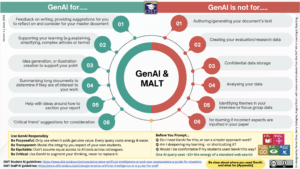
A 1-page guide, co-created by lecturers, tutors & students on DkIT's MA in Learning and Teaching, showing where GenAI can, and can't, support particular postgraduate research/skill development (*reflecting practice 2025-26). Includes student-informed prompts on responsible, sustainable use. An editable PowerPoint supports adaptation to own context.
The HEA ESD Self-Evaluation Tool is a voluntary, developmental resource that supports higher education institutions in reviewing and strengthening whole-of-institution Education for Sustainable Development. It helps institutions undertake structured reflection on current strengths, gaps and progression, identify local priorities and plan practical next steps.
The tool is organised around the five ESD to 2030 Priority Action Areas. For each area, it provides developmental descriptors across three broad stages of practice: Emerging, Established and Leading. It is intended to support dialogue, planning and quality enhancement.
This resource sets out five strategic enablers that can support the implementation of Education for Sustainable Development across all areas of a higher education institution:
1. Collaboration and commitment
2. Holistic and transformational practice, scholarship and leadership
3. Capacity-building and professional development
4. Student partnership, engagement and leadership
5. Reciprocal learning communities
The Enablers translate national and international ESD commitments into shared language, strategic direction and practical prompts for higher education. They address curriculum, pedagogy, assessment, campus operations, governance, leadership, professional learning, student partnership, research and reciprocal engagement with communities.
The resource is designed to support institutional reflection, planning and enhancement rather than prescribe a single model. It recognises institutional autonomy, diversity of mission and disciplinary differences.
This overview introduces the Higher Education Authority’s Education for Sustainable Development (ESD) Framework for Higher Education: a connected suite of resources supporting whole-of-institution ESD across Irish higher education. It explains the Framework’s purpose, its relationship to national and international ESD priorities, and how its component resources work together to provide strategic direction, sector evidence, structured reflection, thematic insight and opportunities for peer learning.
The Framework connects curriculum, campus operations, governance, research and community engagement. It is intended for institutional leaders, educators, professional staff, students and representative bodies, ESD and sustainability leads, teaching and learning units, quality and enhancement teams, community partners and policy stakeholders.
This OER is targeted at lecturers and describes an inclusive framework to integrate artificial intelligence (AI) learning design at third level.
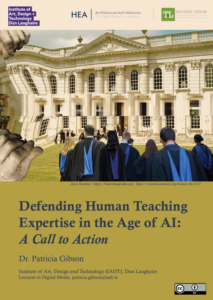
This report draws on Patricia Gibson’s research around critical approaches to Artificial Intelligence (AI) in Education and the increasing automation of Educational Technologies (EdTech).
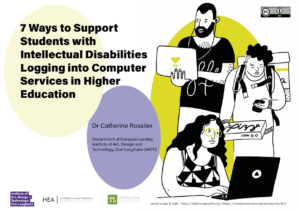
This resource was created to share the learning from teaching adults with intellectual disabilities (ID) in IADT college as part of a national suite of pilot projects.
Comparing student and educator perceptions of generative artificial intelligence for teaching, learning and assessment: results from two institutional surveys
Title: Gasta Talks – Open Education in Practice
Chaired by: Dr Tom Farrelly (MTU)
Short, high-energy 5-minute lightning talks designed to encourage broad participation and rapid sharing of ideas and experiences.
– Ken McCarthy (SETU)* – Open by Design: A Manifesto for Generative AI in Higher Education
– Angélica Rísquez (UL)* – Why Open Still Matters (Just Differently)
– Susan Horgan (MTU)* – Digital Inclusion in Online Learning
– Carina Ginty (ATU)* – Unlock Your Digital & Green Superpowers: Explore the AREA Discovery Tool
– Michael Costello (MTU)* – Partnership to Practice: Developing OER at MTU
Keynote Title: Opening the Future: Equity, Sustainability, and Promise in Higher Education
Speaker: Dr Robin DeRosa
Dr Robin DeRosa is the Executive Director of the Open Education Network , a global organization based out of the University of Minnesota that facilitates community care and collective action in open education to empower faculty, remove barriers to learning and knowledge-sharing, and enhance student success.
Sectoral panel exploring open education in Irish higher education featuring:
– Dr Pio Fenton*, Vice President People & Culture, Munster Technological University
– Liz Jolly*, University Librarian, University College Cork
– MJ Quill*, Vice President for Postgraduate Affairs, Aontas na Mac Léinn in Éirinn (AMLÉ)
– Dr Eamon Costello*, Associate Professor of Digital Learning, Dublin City University, President of the Irish Learning Technology Association (ILTA)
– Dr Leigh Graves Wolf*, Interim Director Of Teaching & Learning, University College Dublin
Through a thought-and-action mapping strategy known as interactive management, the current research modelled a unique, collaborative "pathway of impact influences" to describe such considerations from the perspectives of TUS higher management and external stakeholders.
Title: Open Education: Supporting Policy and Practice Welcome and Opening
Master of Ceremonies: Dr Gearóid Ó Súilleabháin (Head of Technology Enhanced Learning, Munster Technological University)
*Gearóid Ó Súilleabháin*, Head of Dept. of Technology Enhanced Learning, MTU
*Professor Christine Cross*, Vice President for Academic Affairs, Munster Technological University
*Tim Conlon*, Head of Policy and Strategic Planning, Higher Education Authority.
This project presents an innovative engineering assessment framework integrating generative AI through a poster portfolio, AI reflection, and oral interview. It supports critical thinking, validation skills, and ethical AI use, and is designed for undergraduate engineering educators and students in project-based learning contexts.
The work presented in this practice paper illustrates how the use of immersive 360o
video and photographs, viewed in virtual reality headsets or via 360o media players,
can enhance and broaden student knowledge and experience when undertaking
Project Based Learning (PBL) assignments.
This Podcast Series has been developed by CPID Staff involved in teaching and engaging in educational research. It consists of podcasts with well-known educational academics and experts, exploring various educational concepts/topics taught on programmes offered by the CPID, and on SATLE funded educational research projects.
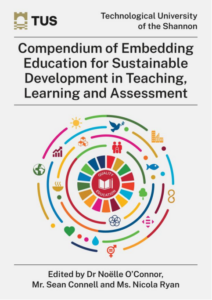
The Technological University of the Shannon (TUS) Compendium of Embedding Education for Sustainable Development (ESD) showcases the University’s commitment to integrating sustainability across teaching, learning and assessment. It is the first compendium of its kind in an Irish higher education institution.
In this research article we investigated possible correlations between
students’ discipline areas and their experiences of academic integrity in MTU.
This study explores student perceptions and behaviours concerning academic integrity and the use of Generative AI in the context of Munster Technological University (MTU). It draws insights from a comprehensive survey of 608 students across various faculties and academic stages.
This opinion article outlines the alignment between patient-clinician consultations in healthcare and student-investigator meetings focused on academic misconduct
This discussion paper explores how student success in higher education is understood, defined and supported in contemporary Irish and international contexts. It brings together international research, national policy and insights from student focus groups conducted in Ireland in 2025 to examine success beyond traditional metrics such as retention, progression and completion.
The paper presents a holistic and relational view of student success, foregrounding belonging, mattering, agency and wellbeing alongside academic and outcomes-based measures. It situates student success as simultaneously student-defined, institution-enabled and outcomes-oriented, and considers the implications of this framing for teaching, learning, policy and system-level practice.
Leading Change Together: Case Studies from the Teaching & Learning Conference 2025 is a collection of case studies showcasing practice-led examples from the HEA Teaching & Learning Conference 2025, held under the theme “Leading Change Together: Building the Future of Teaching and Learning in Higher Education”. The resource brings together institutional and practitioner contributions spanning topics such as inclusive learning design, education for sustainable development, professional learning, digital innovation and AI in teaching and learning. It illustrates how collaborative practice across Irish higher education is shaping future-focused approaches to enhancing teaching and learning.

In 2018, the Glucksman Library at the University of Limerick launched Leganto, a reading list management tool designed to streamline access to academic resources for students. Leganto ensures equitable access to academic content, helping students engage with reliable sources and easing their transition into university-level study.

The HEA Education for Sustainable Development Spotlight Series 2025: Case Studies Compendium brings together 115 case studies from higher education institutions across Ireland. It showcases how universities and colleges are integrating sustainability and the UN Sustainable Development Goals into teaching, research, curriculum design, assessment practices and community engagement. It offers a comprehensive picture of national ESD activity and provides an accessible resource for educators and policymakers seeking examples of practice-based innovation.
This case study collection presents an interdisciplinary University College Dublin initiative exploring how key competencies for Education for Sustainable Development (ESD) can be embedded in higher education teaching, learning and assessment. It introduces UNESCO’s sustainability competencies alongside metacognitive development and the I-SEE learning strategies: Introducing, Signposting, Enabling and Evaluating.
Four detailed case studies demonstrate how these approaches have been applied in clinical nutrition and dietetics, education, rural placemaking and public health nutrition. Using student-centred, collaborative, action-oriented and critically reflective approaches, the case studies engage learners with authentic, real-world problems. Each includes information on its context, intended learning outcomes, teaching and assessment strategies, impact and practical lessons, demonstrating how ESD can be made relevant across a wide range of disciplines, including subjects not traditionally associated with sustainability.
This lesson is designed to aid students in understanding how to engage generative AI in an academic setting without breaching academic integrity policy.
A collection of case studies of evidence-informed interventions implemented by higher education institutions in Ireland to support student retention and progression across the undergraduate lifecycle. These exemplars are presented here as a national evidence base of student progression initiatives.
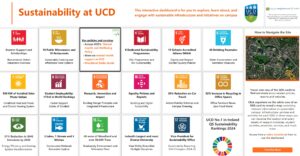
This scientific paper describes the co-creation of the UCD sustainability dashboard – the first transferable template to support geographically-specific SDG monitoring within HEIs. This paper contributes to debates on the need for spatial reporting of actions towards sustainability, to meaningfully recognise local SDG implementation progress.
This lesson is designed to teach students about academic integrity from understanding the principles and encouraging a perspective that they are equal partners in upholding academic integrity.

This curated collection includes key materials, toolkits, and reports from the Anti-Greenwash Education initiative, developed to support quality, transparency, and integrity in Education for Sustainable Development (ESD). It provides direct access to the education kit, training resources, worked examples, film series, sector review, and action guidance, along with related reports and international frameworks informing current ESD policy and practice.
The resource is designed for students, course representatives, and staff engaged in sustainability education and quality enhancement. It connects practical learning tools with wider evidence on ESD trends, student demand for sustainability, and institutional quality frameworks, offering an overview of current developments in the field.
This resource was shared as part of the Advancing Quality and Leadership in Sustainable Higher Education workshop hosted by the Higher Education Authority (HEA) and facilitated by Dr Alex Ryan. The workshop supported Irish higher education institutions in strategically implementing high-quality ESD in alignment with the Government of Ireland’s ESD to 2030 Strategy and the HEA’s ESD programme objectives.

This toolkit is designed to provide educators in Higher Education with practical, adaptable tools and strategies for fostering sustainable wellbeing in their teaching through curriculum, assessment and pedagogy.

The report – Generative AI in Higher Education Teaching and Learning: Sectoral Perspectives – was commissioned as part of the Higher Education Authority’s evidence-led approach to policy development.
The report captures the views of staff, students, and leaders across the Irish higher education system on the opportunities and challenges posed by artificial intelligence.
It brings together insights from ten thematic focus groups and a leadership summit, involving over 80 participants from across Ireland’s higher education institutions, alongside student representatives and sectoral stakeholders.

Ideation Arcana is a visual ideation tool designed to assist learners—especially those new to open-ended creative projects—in generating and refining ideas. It does so by offering a structured yet playful approach to thinking, inspired by the layout and concept of tarot cards.

The Higher Education Authority (HEA) is developing a National Professional Recognition Framework for Teaching and Learning to support the recognition of teaching excellence across the sector. The framework builds on the Professional Development Framework (2016) and aims to provide clear, nationally agreed benchmarks for effective teaching practice. It will help inform career development, support institutional processes, and promote a shared understanding of teaching quality in Irish higher education.

This report presents the findings and recommendations of the 2025 Expert Group review of the Irish National Framework for Student Success in Higher Education. Commissioned by the HEA, it explores how the framework and accompanying toolkit have been engaged with across the sector and outlines a renewed vision for student success that is inclusive, strategic, and evidence-informed.

This resource portal is dedicated to providing centralised access to policies, guidelines, and resources for teaching and learning in higher education in the context of generative artificial intelligence. The curated policies and frameworks offer authoritative guidance and practical support to inform and enhance institutional practice.

This compendium comprehensively brings together the components needed by higher education institutions (HEIs) when developing comprehensive frameworks for managing cases of academic misconduct. It serves as both a practical guide and a reflective resource, aimed at strengthening and promoting a culture of academic integrity.

This OER index provides a selection of recent, high quality OER of varying content types (including articles, podcasts, presentations and textbooks), which are potentially relevant to TUS staff and students.

This survey was adapted from a North American Faculty OER Survey Toolkit for use in the Irish Higher Education context. It was used across the DOERs project partner sites to audit staff Open Educational Resources and Open Educational Practices awareness and practices. We encourage other institutions to adapt this tool to meet their needs.

The following ‘ten considerations for generative AI adoption’ outline key issues identified through dialogue with stakeholders across Ireland’s higher education sector, industry, and associated agencies between September and December 2024

This open course is designed to facilitate the development of your Artificial Intelligence (AI) literacy so that you can explore and innovate using Generative AI (GenAI) within your teaching, learning, and assessment practices.
In light of the potential opportunities and challenges of these technologies, this course will facilitate you in exploring the fundamentals of GenAI and AI Literacy, whilst focusing on an ethical practice. You will consider innovative ways in which you can respond to the challenges arising from the impact of these technologies in Higher Education.
Completion of this course will support you in developing a GenAI teaching strategy to apply to your own practice.

Recognizing the transformative potential of AI, the ICDE Quality Network has developed this report as a key initiative to explore its application in teaching and learning globally. This endeavour underscores the Network’s commitment to advancing quality education by promoting the responsible integration of AI.

The HEART project explored the impact of generative AI on 3rd-level education in Ireland, using modules delivered in the UCD School of Biology and Environmental Science (SBES) at University College Dublin. We wish to thank the Strategic Alignment of Teaching and Learning Enhancement (SATLE) fund for making this project possible.

Science Literacy Competence Framework for Undergraduate and Postgraduate Curriculum

Science Literacy in the Post-Truth Era – Project Background

An interdisciplinary team of academic and professional services staff collaborated to create a quality framework to scaffold stakeholder engagement in the development of physical learning spaces within Munster Technological University.

This compendium captures examples of internationalisation of the home curriculum in TUS. It includes cases of internationalised modules; teaching and assessment practices that promote inclusive learning; collaborative learning and teaching projects involving international partners; and co-curricular intercultural competence initiatives.

This practitioner guide is designed to offer an overall framework for successfully developing and facilitating group work processes. It guides the novice practitioner through each stage of the process. It signposts associated challenges and provides suggestions for helpful responses.

The aim of this project was to explore the potential of Virtual Reality (VR) technology in business higher education for a faculty with low levels of current use of the technology.

The research literature on children’s testimony in the courtroom, and the factors that either help or hinder consistent and accurate accounts, is a vast one. This short booklet, will benefit child services training and self study.

This project explores the impact of AI text generation on 3rd-level education in Ireland, using modules delivered in the UCD School of Biology and Environmental Science (SBES) at University College Dublin. It was co-created by students and staff.

This lecture presents students, and professionals who are training in crime statistics reporting, with a concrete tutorial in how to critically evaluate government crime statistics with reference to public data collected from public surveys on their recounted experiences of crime.

This tutorial explicates three critical examples of how psychology informs legal professionals of the problems that human behaviour brings to law and its practice.

This workbook takes the student on a conceptual journey aiding their understanding of what is meant by the quantitative-qualitative research process in contemporary legal empirical research. Although, of interest to social science students, the particular worked examples relate to how to do research on law, legal policy and review.

This lecture addresses core issues in choosing a research topic for undergraduate and first time researchers to consider. Often final year undergraduate students find this task a difficult one. Step by step the the lecture connects the student to core concepts, pressure points and key readings to foster their idea and focus their decision.

The barriers to peace in terrorist societies can seem senseless to outside observers, and students of psychology and social sciences aim to gain knowledge to understand why. We present a role play exercise in which students take the perspective of terrorists or landowners based on the N. Ireland conflict, to promote their understanding.

This notebook presents an introductory overview to the cognitive perspective on the psychology of human behaviour for social science students.

This resource has been created by an interdisciplinary project team at Trinity College Dublin, the University of Dublin and was funded through the Strategic Alignment of Teaching and Learning Enhancement Fund 2020.

The use of AI systems can potentially enhance teaching, learning and assessment, provide better learning outcomes and help schools to operate more efficiently. However, if those same AI applications are not properly designed or used carelessly, this could lead to harmful consequences. Educators need to be aware and ask questions whether AI systems they are using are reliable, fair, safe and trustworthy and that the management of educational data is secure, protects the privacy of individuals and is used for the common good. “Ethical AI” is used to indicate the development, deployment and use of AI that ensures compliance with ethical norms, ethical principles and related core values.

This OER investigates the role of digital technology in the acquisition of practical skills in health sciences. While it is commonly accepted that theoretical knowledge can be imparted using technology, how best to use technology to support practical skill acquisition is a growing area which presents many opportunities.

Show your students maths at work outside the classroom in Maths Week
This October, show your students how maths is relevant to their everyday lives with I’m a Mathematician!
Connect your students with people working in a diverse range of careers which use maths in this student-led enrichment activity.
Explore more: https://imamathematician.ie

This is a recording of our National forum funded seminar entitled From Surviving
to Thriving – Negotiating the Post-Zoom Landscape and associated graphic harvesting.


The toolkit is a set of 8 modules, delivered and accessible asynchronously, online, incorporating elements of information literacy, critical thinking and academic writing skills to allow students prepare for and complete an assignment in line with best practice in academic integrity.

Recording of National Forum Seminar December 2021 with Lee O Farrell, UCD; Mary Loftus, IT Sligo; and, Prof James Pickering & Dr Bronwen Swinnerton, University of Leeds (UK), chaired by Damien Raftery, IT Carlow

Drawing on this knowledge, and expertise in occupational science/therapy, psychology and neuroscience, the ‘DOTS – Developmental Opportunities for Transitions in Students’ seminar sought to inform stakeholders of the biobehavioural transitions that influence undergraduate wellbeing and academic achievement in the current socio-cultural climate.

This National Forum Insight examines the concept of ‘Agile Curriculum’, emerging in tandem with changing modes of engagement with higher education.

This Forum Insight focuses on the national Open Courses initiative, established by the National Forum and sectoral colleagues in 2017.

PaPOR TRaIL is a free course on open research for Masters level and undergraduate students. It is a self-paced online course that students can
take independently and/or that can be embedded in exiting research curricula.

The goal of stimulating and promoting the creative capacity of both students and staff in higher education is at the core of this project. This initiative aims to foster a culture of creativity in higher education, building the capacity of staff so that they have greater awareness about the nature of creativity, how it applies in their particular discipline, and how they can actively cultivate it in their students.
The challenges stemming from our rapidly-changing, and increasingly unscripted world, demand that higher education institutions reflect upon the competencies which students will require in order to thrive in this context. Coupled with traditional discipline-specific knowledge, there is a growing demand for graduates to develop and demonstrate a variety of transversal competencies, among which is creativity; that is, the ability to generate ideas and outputs which are perceived as both novel and valuable within a given context. As such, educators have an important role to play in creating a culture which fosters creativity, including modelling creative practices and behaviours, establishing conditions which promote creativity, and developing students’ belief in their own creative potential. Indeed, this project is based on the principle that everyone has creative potential which can be actively fostered.

Tutors is an professional and intuitive platform for the creation of compelling educational content. It is open source, well documented and now used by upwards of 160 modules at Waterford Institute of Technology. The platform employs the latest thinking in the production of media-rich web content, with a focus on delivering a simple, easy to navigate, elegant and compelling student experience. A central goal of Tutors is to fostering the sense on an online community of learners. These interactions are promoted by a set of non-intrusive measurements (we call TutorsTime) which help students and educators understand the use of the student’s time on a module.
A book chapter was also published as part of the initiative, which can be found here https://reader.tutors.dev/#/talk/wit-hdip-comp-sci-showcase.netlify.app/unit-3/talk-1-course-philosophy/course-philosophy.pdf

This new interdisciplinary 10 ECTS module for PhD students responds to an identified need for careers and employability support and was developed with industry partners. It supports PhD students with career planning, critical reflection and decision-making, enabling them to establish networks and build readiness for future careers in academia and/or industry. The module is in three streams (Careers, Skills and Work-based Learning) and features many innovative aspects:
– a blended learning design and 5 ECTS module option to give a flexible learning experience
– 5 interactive online sessions which build student employability skills
– 4 face-to-face sessions to enhance collaboration and engagement
– An online Skills Audit which helps students to critically reflect on, develop and articulate the skillset developed during their PhD and an Interview Practice Exercise to apply their interview skills to a role-play scenario
– a work-based learning experience that creates real value for industry partners and offers students valuable learning experiences that are not readily available elsewhere
A range of supporting activities enhance the student experience by encouraging shared and self-directed learning: online journaling and discussion boards; podcasts; videos; skills webinars and industry events. A new Industry Mentoring Programme (IMPART) was designed to complement the module.

Visioning the Future: Artistic Doctorates in Ireland was a twelve-month research project based at University College Cork but with a national focus. Artistic Doctorates are practice-based PhDs that include artistic practice on an equal footing with critical writing. Visioning the Future focussed on Artistic Doctorates in Dance, Film /Screen Media, Music and Theatre. The project focussed on previous practice / research into the pedagogies and potential of the Artistic Doctorate and how this relates to the unique ecology of Ireland. It aimed to contribute to the development of national policy and protocol to support the establishment of best practices in the sector and to develop an Open Educational Resource (OER) for supervisors, students and examiners. We hosted an International Online Seminar Series (fifteen seminars over three months during summer 2020) with international / national experts and a broad spectrum of stakeholders including PhD students. This series is available as a digital resource. We also conducted research into policy / protocol related to the Artistic Doctorate in Irish HE as well as a series of interviews with staff / students in Ireland, this data as well as the archived seminar series contributed to the development of a lively integrated OER.

The aim of TEACH CoLab is to increase staff competency to engage in collaborative online learning across disciplines and beyond institutional and national boundaries to address societal challenges. The time has never been more opportune to examine the place of health in the lives of humanity and examine it from multiple perspectives, enabled by online technologies. Perhaps for the first time, health and people are at the heart of politics and at the centre of global debate in our COVID19 world and the landscape has changed forever, particularly in relation to the power of online learning. TEACH CoLab builds the capacity of staff in digital pedagogies to examine themes related to health, community, determinants of health, and human rights. It enables sharing within the School of Health Sciences, across the Institute and with community and academic partners in Ireland and the US.

This resource developed from the initiative “TUDublin IMPACT: Re-imagining a Multi-Disciplinary approach to programme design and development”.

The TU Dublin IMPACT initiative transformed teaching and learning (T&L) through:
1. A repository that collates new and existing quality open access educational resources (OER) was established, supported by a bespoke peer review model that encourages an evidence-based approach to T&L OER creation.
2, A teaching team culture within a University-wide engaged learning community was launched, recognising and encouraging best practice in programme design to enhance the student experience. Staff who teach were supported through continuous professional development (CPD) through an associated CDPD framework.
3. A rigorous ‘As Is’ review captured the breadth of University T&L projects (past, present and pipeline projects), explored areas of alignment to, and identified gaps within, the TU Dublin T&L strategy and the student experience.
4. A model to drive sustainable awareness of, and interest and enthusiasm in, T&L was established and included a communication strategy that showcases learning enhancement project findings across TU Dublin.
5. An operating model that supports the sustainable integration of ongoing T&L project outcomes into T&L policy, process and practice, was developed through consultation and collaboration across the initiative.
Ultimately the initiative galvanised our innovative T&L practice for student success through widening our community, enhancing our capacity and changing culture.

Developed from the initiative ” Enhancing Online Language Learning: Training the trainers and engaging the learners” the LILAC Project aims to help language teachers and learners to transform digital challenges into opportunities and acquire the digital proficiency needed to maximise the benefits afforded by e-learning.

Bookended by puberty and culturally defined adult roles, it is now established that adolescence extends from age 10 to age 24. Funded by the National Forum SATLE2019 scheme, and launched during VIT&L 2021 week, the new Canvas course Brainpower developed by Dr. Eithne Hunt (Occupational Science & Occupational Therapy / Graduate Attributes Programme, UCC); Dr. Samantha Dockray (Applied Psychology, UCC); and Professor Yvonne Nolan (Anatomy & Neuroscience, UCC) with input from students and higher education staff explores the ramifications of this research and gives participants an opportunity to reflect on what this information may mean for them within their work or role in higher education.
The inner workings of the adolescent brain and how these workings develop and are expressed in behaviours and engagement with the external world have been the focus of an explosion of research inquiry. Seated in the pre-frontal cortex of the brain, cognitive abilities such as decision-making, planning, self-control, social interaction and self-awareness are only fully developed by the mid-twenties. In addition, the brain regions governing risk-taking and reward are intensely active in adolescence, and so influence behaviour, which is also shaped by context and expectations of others.
To realise student success, higher education (HE) institutions must take into account that the majority of their students are still adolescents, without fully developed cognitive, social, emotional and self-regulatory capacities, living and learning in a socio-cultural environment that offers less external regulation than ever before. The knowledge that many students in higher education are in developmental transition spotlights opportunities to construct academic and campus contexts that supports this transition.
Brainpower is a free, online, self-paced course, focusing on harnessing the power and potential of adolescent brain and behaviour for enhanced learning, wellbeing and student success in higher education. Within each of the six modules (each approximately 60 minutes duration) there is a variety of instructive media, including recorded Panopto lectures, videos and short readings. Supplemental information in the form of suggested reading lists, podcasts, and videos is provided. The Brainpower modules are provided in a predefined sequence with content unlocked step by step. Modules will be unlocked once the previous module is completed.


FYMMO – Final Year Matters – Moving On is an initiative that supports students in their final and penultimate years in their undergraduate degree, as well as graduates. The purpose of the initiative is to provide information, guidance and advice to help transitioning students; it works in conjunction with our First Year initiative as a ‘bookend’ to the undergraduate student experience. Additionally, it supports the lecturing staff with resources that are available to them to utilise and reinforce their teaching.

The aim of this interdisciplinary initiative is to create a sustainable, long-term intervention to embed technology enhanced learning in research led teaching, ensuring that students have a highly developed awareness of the potential for proactive learning through digital methodologies, and to help teaching staff further develop their capacity to integrate our portfolio of digital resources and datasets into their teaching materials.

These resources – A web page “Short Guide 8: Reimagining Practicals” and article “The Use of Virtual Reality in the Teaching of Challenging Concepts in Virology, Cell Culture and Molecular Biology” (link below) – come from the initiative: Enhanced Active Learning in Virology, cell culture and molecular bio Technology (ELEVATE).
https://www.frontiersin.org/articles/10.3389/frvir.2021.670909/full
The ELEVATE initiative brought together disciplinary experts from the School of Microbiology, the School of Computer Science and IT, and the Centre for the Integration of Research, Teaching and Learning (CIRTL) at University College Cork. This initiative was built on a strong pedagogical foundation and it was guided by a vision to create and explore experiential and immersive learning approaches to teaching and learning, in partnership with students. In addition to co-creating innovative bespoke virtual simulations in Virology and Molecular/Cellular Biology, the team also applied active learning approaches to the study of abstract molecular concepts.
The successful development of bespoke virtual simulations was a significant breakthrough for the ELEVATE initiative and it provides a roadmap for future initiatives to follow. Multilingual realisation of abstract challenging concepts has been made possible and the knowledge gained through this experience will be shared openly with colleagues. It is important to note that while the technology underpinning virtual and augmented reality (VR/AR) has advanced at pace, knowledge around the integration of virtual simulations into teaching and learning practice remains scarce, particularly in the areas of virology and molecular/cellular biology. Dissemination through the ELEVATE initiative will therefore provide leading guidance to disciplinary and non-disciplinary experts.

In this special publication, colleagues from across the Connacht Ulster Alliance (CUA), including GMIT, IT Sligo and LYIT, share insights and innovations on their teaching and learning practice over the last 18 months. Many will touch on their experiences of adapting to remote learning and teaching during COVID, and also reflect on lessons learnt and plans for the future. The DigitalEd.ie Knowledge Platform forms part of the iNOTE project, funded by the Higher Education Authority (HEA) Ireland.


This is a Moodle alternative to tools like Trello, Padlet, wallwisher etc. The plugin has many advantages over the existing commercial alternatives including areas such as accessibility, data protection and the fact that the student contributions when they use this tool can be easily used for assessment. The plugin will be available for all Moodle users worldwide free of charge.

This is a resource developed from the project: Re-Making the Creative Arts Canon, Re-Imagining the Creative Arts Curriculum.
This T&L initiative brought together more than 100 NUI Galway students working in Music, Film, Drama, English, and Digital Humanities, to work together to address the neglect of key figures from the Creative Arts Canon (as performed by arts organisation) and the Creative Arts Curriculum (as taught in universities).

This resource is developed from the SATLE 2018 initiative: #OpenTeach: Professional development for open online educators