Case Study: Integrating Generative AI into Engineering Assessment: A Teaching and Learning Case in Mechanical Engineering

[favorite_button]

Creator(s) (alphabetical)

Reihaneh Aghamolaei

Organisation(s)

Dublin City University

Discipline(s)

Engineering, Manufacturing and Construction

Topic(s)

Assessment and Feedback, Curriculum Design

License

CC BY

Media Format

PDF

Date Submitted

Submitted by

Export Resource Data

Description

This project presents an innovative engineering assessment framework integrating generative AI through a poster portfolio, AI reflection, and oral interview. It supports critical thinking, validation skills, and ethical AI use, and is designed for undergraduate engineering educators and students in project-based learning contexts.
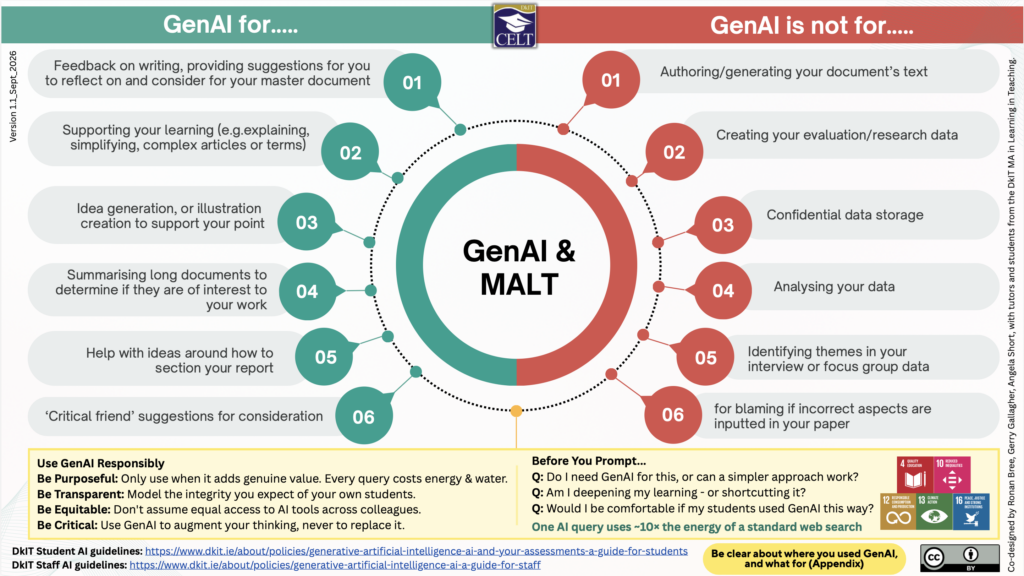
Benefit of this resource and how to make the best use of it

Creative Commons Attribution (CC BY)

This work is licensed under a CC BY license, allowing sharing and adaptation with proper attribution.

https://creativecommons.org/licenses/by/4.0/
? This citation is automatically generated and may require adjustment. Always verify it against your style guide.
Aghamolaei, R. (01/12/2025). Case study: integrating generative ai into engineering assessment: a teaching and learning case in mechanical engineering. National Resource Hub (Ireland). Retrieved from: https://hub.teachingandlearning.ie/resource/case-study/ License: Creative Commons Attribution (CC BY).

Adapting this resource? Share your version!

If you have modified or adopted this resource, share your version here. Tracking adaptations helps us measure impact and connects others with useful updates.

Related OER

This OER guides students through human-in-the-loop software development, demonstrating how AI tools can be effectively supervised, refined, and integrated across the Software Lifecycle. Designed for computing educators and learners, it combines agile practice, teamwork, DISC awareness, testing, and critical reflection on human–AI collaboration.

This OER introduces students to designing and developing AI-powered assistants for agile software development using Flowise (no code). Learners as a team explore Retrieval Augmented Generation (RAG) and agent-based systems, applying AI to real-world agile practices while considering technical design, evaluation, and cost-aware decision-making

As part of this project small workshops in linear algebra where held both nationally and internationally. The main workshop website is https://sites.google.com/view/tusdcu-linearalgebraworkshop/home

A one day workshop to help bring together early stage researchers to learn and discuss topics in Linear algebra.

The purpose of this resource is to allow Moodle teachers to quickly create quizzes for Moodle. Users can quickly select between questions types through a single interface and export their questions as an XML file which can be imported into Moodle.

Moodle Quiz XML Builder

CC 0