The Technological University of the Shannon (TUS) Compendium of Approaches to Integrating Digital Competencies into the Curriculum exemplifies the University’s commitment to embedding digital capability development across teaching, learning, and assessment.
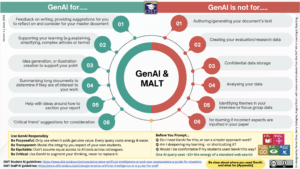
A 1-page guide, co-created by lecturers, tutors & students on DkIT's MA in Learning and Teaching, showing where GenAI can, and can't, support particular postgraduate research/skill development (*reflecting practice 2025-26). Includes student-informed prompts on responsible, sustainable use. An editable PowerPoint supports adaptation to own context.
This book is designed specifically for students studying at the Technological University of the Shannon – Midlands Midwest, Ireland. It presents a step-by-step practical guide to academic writing, referencing and presentation, with clear explanations and structured approaches with examples that support the development of clear and concise writing.
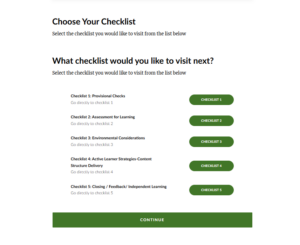
Teaching and Assessment for Learning Checklists aimed at early career & seasoned lecturers. The checklists provide guidance & reliable curated resources for lecturers who want to deliver an engaging and positive learning experience for their students. They act as a guide to check existing approaches, and help analyse how improvements can be made.
The HEA ESD Self-Evaluation Tool is a voluntary, developmental resource that supports higher education institutions in reviewing and strengthening whole-of-institution Education for Sustainable Development. It helps institutions undertake structured reflection on current strengths, gaps and progression, identify local priorities and plan practical next steps.
The tool is organised around the five ESD to 2030 Priority Action Areas. For each area, it provides developmental descriptors across three broad stages of practice: Emerging, Established and Leading. It is intended to support dialogue, planning and quality enhancement.
This resource sets out five strategic enablers that can support the implementation of Education for Sustainable Development across all areas of a higher education institution:
1. Collaboration and commitment
2. Holistic and transformational practice, scholarship and leadership
3. Capacity-building and professional development
4. Student partnership, engagement and leadership
5. Reciprocal learning communities
The Enablers translate national and international ESD commitments into shared language, strategic direction and practical prompts for higher education. They address curriculum, pedagogy, assessment, campus operations, governance, leadership, professional learning, student partnership, research and reciprocal engagement with communities.
The resource is designed to support institutional reflection, planning and enhancement rather than prescribe a single model. It recognises institutional autonomy, diversity of mission and disciplinary differences.
This overview introduces the Higher Education Authority’s Education for Sustainable Development (ESD) Framework for Higher Education: a connected suite of resources supporting whole-of-institution ESD across Irish higher education. It explains the Framework’s purpose, its relationship to national and international ESD priorities, and how its component resources work together to provide strategic direction, sector evidence, structured reflection, thematic insight and opportunities for peer learning.
The Framework connects curriculum, campus operations, governance, research and community engagement. It is intended for institutional leaders, educators, professional staff, students and representative bodies, ESD and sustainability leads, teaching and learning units, quality and enhancement teams, community partners and policy stakeholders.
Team Tool is an open educational resource (OER) designed to support equitable,
e ective teamwork in higher education. It was developed in response to persistent
challenges in collaborative work, including uneven contribution, lack of
accountability and student dislike and anxiety around group projects.
This report draws on Patricia Gibson’s research around critical approaches to Artificial Intelligence (AI) in Education and the increasing automation of Educational Technologies (EdTech).
This resource was created to share the learning from teaching adults with intellectual disabilities (ID) in IADT college as part of a national suite of pilot projects.
Comparing student and educator perceptions of generative artificial intelligence for teaching, learning and assessment: results from two institutional surveys
Enhancing Student Engagement and Belonging through Collaborative Partnership is a Higher Education Authority report prepared by a UCD research team led by Professor Barbara Dooley. The resource provides an evidence-informed framework for strengthening student belonging across Irish higher education institutions. Drawing on staff interviews, Healthy Campus survey responses, and analysis of Healthy Campus and NStEP case studies, it identifies practical approaches to improving student engagement, wellbeing and inclusion.
The report frames belonging as a multidimensional and co-constructed experience shaped by social, academic, personal and environmental factors. It highlights that student belonging is affected not only by relationships and participation, but also by structural issues such as housing, commuting, financial pressure, campus spaces, timetable design and access to supports.
The resource is particularly useful for staff and student partners working on Healthy Campus, student success, student engagement, access, inclusion, mental health promotion, orientation, peer support, student partnership and campus development initiatives.
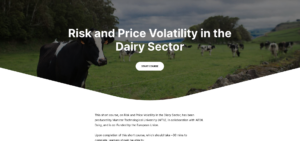
A video based course exploring dairy price volatility and risk management in the EU dairy sector. Developed through the Irish Dairy Centre of Vocational Excellence (Erasmus+), it covers causes, consequences, policy responses, and practical tools. Suitable for learners, industry professionals, and educators in agri-food and related disciplines.
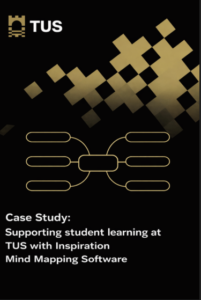
This OER explores the use of Inspiration Mind Mapping software to support student learning through demonstrations and training sessions with Applied Social Care and LSAD students.
This is an interactive multimedia open educational resource (OER), created using H5P, on the topic of Open Education. It has been developed by the Department of Technology Enhanced Learning at Munster Technological University.
The purpose of which is to give an overview of OEPs, using interactive features of H5P
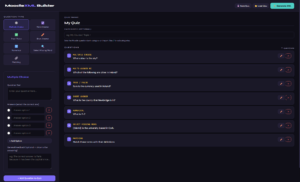
The purpose of this resource is to allow Moodle teachers to quickly create quizzes for Moodle. Users can quickly select between questions types through a single interface and export their questions as an XML file which can be imported into Moodle.
An open educational resource that supports academic, professional, and support staff to build more neuro-inclusive teaching, services, and policies in higher education. This resource was conceptualised & developed through the experiences of neurodivergent students in third-level education, with co-creation at the heart of every stage of the process
This OER presents an updated Assessment Redesign Framework for higher education in the age of GenAI. It supports educators and programme teams in designing valid, transparent, and scalable assessments, integrating AI literacy, process-focused approaches, and guidance on AI detection, large cohorts, and emerging agentic AI challenges.
This Pressbook features an interactive tool that helps you plan and structure your essay step by step. The book provides a clear starting point to reduce stress, prevent overwhelm, and support different learning preferences through examples, , quick guides, and PowerPoint videos with voiceover. This resource is a living document.
This resource showcases initiatives from both academic and professional support areas across DCU, which have been funded under SATLE – the Strategic Alignment of Teaching and Learning Enhancement Funding in Higher Education. Examples are provided under the themes of Education for Sustainable Development, Digital transformation & Academic Integrity
This Podcast Series has been developed by CPID Staff involved in teaching and engaging in educational research. It consists of podcasts with well-known educational academics and experts, exploring various educational concepts/topics taught on programmes offered by the CPID, and on SATLE funded educational research projects.
The Technological University of the Shannon (TUS) Compendium of Embedding Education for Sustainable Development (ESD) showcases the University’s commitment to integrating sustainability across teaching, learning and assessment. It is the first compendium of its kind in an Irish higher education institution.
The resource comprises of a literature review and an executive summary, developed as part of the Maynooth University Leadership and EducAtion Framework (LEAF) initiative. It explores how education frameworks can enhance teaching, learning and curriculum design in higher education, supporting inclusive, sustainable and values-led academic practice.
This resource describes the rational for, design of and implementation details associated with an initiative designed to support early career academic staff adopt evidence-based, active and inclusive learning strategies to enhance learning for ALL students.
This study explores student perceptions and behaviours concerning academic integrity and the use of Generative AI in the context of Munster Technological University (MTU). It draws insights from a comprehensive survey of 608 students across various faculties and academic stages.
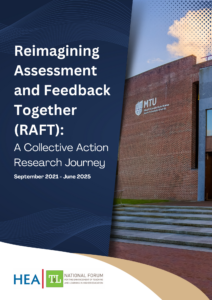
Reimagining Assessment & Feedback Together (RAFT) is MTU initiative developed to transforming assessment practices. This volume documents twenty-four situated, discipline-specific attempts to rethink assessment and feedback through student partnership and action research.
This video provides a step-by-step guide on how to submit your SATLE-funded Open Educational Resources (OER) to Ireland’s National Resource Hub. It outlines the submission process, key requirements, and best practices to ensure your resources are accessible, discoverable, and aligned with national open education goals. Whether you're new to the Hub
This opinion article outlines the alignment between patient-clinician consultations in healthcare and student-investigator meetings focused on academic misconduct
A self-paced resource introducing Articulate Rise 360, an authoring tool for creating interactive, mobile-responsive e-learning content. Covers content design principles, interaction types, accessibility features, and publishing workflows. Designed primarily for instructional designers, educators, and professionals new to Rise.
A self-study resource addressing healthy relationships with digital technology, addressing digital addiction, privacy concerns, work-life balance, and digital identity management. Includes scenarios exploring real wellbeing challenges. Emphasises positive and negative impacts of digital participation. The primary audience is university students.
An interactive resource on effective digital communication across synchronous and asynchronous platforms, netiquette principles, formal vs. informal contexts, and platform-specific communication norms. The primary intended audience is university students.
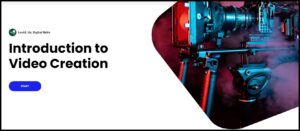
A self-paced resource teaching video planning (pre-production), recording (production), editing (post-production), and ethical considerations for academic video use. Covers accessibility in video (captions, descriptions), equipment options, and practical workflows suited to diverse contexts. The primary intended audience is students.
A 45-minute comprehensive foundational lesson on digital accessibility principles, inclusive content creation, and available assistive technologies at university level. Collaboration with Educational Assistive Technology Centre, UL, launched for Global Accessibility Awareness Day. The primary intended audience is students.
A foundational, interactive guide to spreadsheet essentials covering data entry, formatting, basic formulas, functions, and chart creation. Features keyboard navigation, accessibility options, and read-aloud functionality for inclusive learning. Designed for beginners and those seeking a refresher. The primary intended audience is students.
Practical self-paced lesson introducing effective prompt writing techniques for students new to genAI tools. Covers prompt structure, iteration, critical evaluation of output, and ethical considerations. Teaches effective genAI communication techniques. Primary intended audience is university students.
This paper entitled 'Developing an Academic Integrity Policy and Academic Misconduct Procedures in an Era of Generative Artificial Intelligence: Five Tips for Success' may be of interest to policy developers and educators in further and higher education and training organisations as they adapt to challenge of AI.
In 2018, the Glucksman Library at the University of Limerick launched Leganto, a reading list management tool designed to streamline access to academic resources for students. Leganto ensures equitable access to academic content, helping students engage with reliable sources and easing their transition into university-level study.
The HEA Education for Sustainable Development Spotlight Series 2025: Case Studies Compendium brings together 115 case studies from higher education institutions across Ireland. It showcases how universities and colleges are integrating sustainability and the UN Sustainable Development Goals into teaching, research, curriculum design, assessment practices and community engagement. It offers a comprehensive picture of national ESD activity and provides an accessible resource for educators and policymakers seeking examples of practice-based innovation.
A collection of case studies of evidence-informed interventions implemented by higher education institutions in Ireland to support student retention and progression across the undergraduate lifecycle. These exemplars are presented here as a national evidence base of student progression initiatives.
This OER provides a practical Grammar translation and TBLT toolkit for Mandarin teaching, including 15 lesson plans and 50+ task kits. It helps educators in low-time contexts enhance students’ oral proficiency and plurilingual awareness through ready-to-use, adaptable resources.
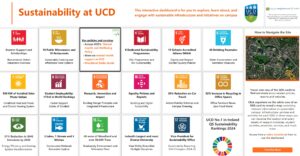
This scientific paper describes the co-creation of the UCD sustainability dashboard – the first transferable template to support geographically-specific SDG monitoring within HEIs. This paper contributes to debates on the need for spatial reporting of actions towards sustainability, to meaningfully recognise local SDG implementation progress.
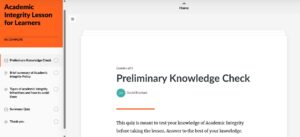
This lesson is designed to teach students about academic integrity from understanding the principles and encouraging a perspective that they are equal partners in upholding academic integrity.
BSEditor is a multi-platform software tool designed to aid educators in the creation of computer-based quiz questions. It provides a powerful editor to easily control every detail of a question, from integration of files and images, to elaborate scoring approaches.
The Manifesto for Generative AI in Higher Education is a living resource for educators, students, and institutions. It invites reflection and dialogue across thirty statements exploring teaching, ethics, and imagination – helping higher education navigate AI with curiosity, integrity, and humanity.
This resource presents AVINA, an automated visual novel generator using large language models to transform multiple-choice questions into interactive learning narratives. Designed for educators and students, it supports gamified training in academic integrity and ethical decision-making through adaptive storytelling and experiential learning.
The University of Limerick Academic Integrity and GenAI toolkit is a curated suite of resources developed to support ethical academic practices in the evolving landscape of Generative AI.
The resource is a template for surveying students about their timetabling experiences. The survey was deployed in MTU, but the template is free to be copied and adapted as needed.
The Higher Education Authority (HEA) is developing a National Professional Recognition Framework for Teaching and Learning to support the recognition of teaching excellence across the sector. The framework builds on the Professional Development Framework (2016) and aims to provide clear, nationally agreed benchmarks for effective teaching practice. It will help inform career development, support institutional processes, and promote a shared understanding of teaching quality in Irish higher education.
This paper describes the foundational principles and design details of the student-staff partnership initiative launched by the Co-creating Inclusive and Equitable Teaching & Learning project, led by Dr. Anna Santucci and situated within the Centre for the Integration of Research, Teaching and Learning (CIRTL) at University College Cork (UCC).
Cognitive Bias Lab is an interactive platform designed to help learners explore and practice recognizing cognitive biases. Through simulations, quizzes, and role-play scenarios, it supports critical thinking, decision-making skills, and classroom discussions in psychology, education, and media literacy.
This resource portal is dedicated to providing centralised access to policies, guidelines, and resources for teaching and learning in higher education in the context of generative artificial intelligence. The curated policies and frameworks offer authoritative guidance and practical support to inform and enhance institutional practice.
This 12 lesson open course provides an introduction to the AI Fluency Framework and the four competencies of Delegation, Description, Discernment, and Diligence. c. 70 mins videos plus ungraded exercises & projects and reference handouts. Co-developed by University College Cork, Ringling College and Anthropic with support by HEA.
The VISIEN Framework Document is a strategic guide for integrating immersive technologies (AR, VR, MR, XR) into higher education. It offers practical guidance on curriculum integration, accessibility, collaboration, skill development, institutional readiness, and more to support transformative teaching, learning, and research.
The course is targeted at senior leaders to support the implementation of universal design and the adoption of the national ALTITUDE Charter https://www.mtu.ie/universal-design/ and aims to complement the existing Digital Badge for Universal Design in Teaching & Learning https://www.ahead.ie/udl-digital-badge and the Digital Badge Universal Design Beyond the Classroom https://www.ahead.ie/journal/Launch-Universal-Design-Beyond-the-Classroom-Digital-Course-and-Digital-Badge
This resource captures key insights from a full-day workshop held on 8 May 2025, hosted by the Higher Education Authority (HEA) and led by internationally recognised expert Dr Alison Cook-Sather. The event focused on the transformative potential of authentic student-staff partnerships as a strategic approach to advancing student engagement, success, and institutional effectiveness.
Attended by academic staff, institutional leaders, student success professionals, and sector partners from across Ireland, the workshop featured a combination of keynote presentations, lightning talks, and interactive sessions. Through real-world examples and hands-on activities, participants explored how to build meaningful, inclusive, and sustainable collaboration between students and staff.
For the full event schedule and a complete list of lightning talk contributors to this slide deck, visit the workshop schedule.
TUS Sensory Awareness Guide delves into the often-overlooked challenges faced by individuals with sensory processing challenges, especially in academic settings. It focuses on creating sensory-friendly environments and offers actionable advice on everything from classroom settings to other student facing roles.
This ebook provides a selection of OER which align with teaching and learning within our university to showcase the flexibility, adaptability and potential of OER. Subject areas which are explored include: 3D printing; immersive technology; lightboard and team based learning.
This OER index provides a selection of recent, high quality OER of varying content types (including articles, podcasts, presentations and textbooks), which are potentially relevant to TUS staff and students.
This survey was adapted from a North American Faculty OER Survey Toolkit for use in the Irish Higher Education context. It was used across the DOERs project partner sites to audit staff Open Educational Resources and Open Educational Practices awareness and practices. We encourage other institutions to adapt this tool to meet their needs.
Two modules are available on this page one for educators and one for mentors to learn how to engage in mentoring sessions with students. The page also has access to the Community Mentoring Handbook (for mentors), Mentee Toolkit (for second-level students taking part in sessions) and the Adult Ed Handbook(for adult learners taking part in sessions).
This Toolkit was created by students at University College Dublin, for students, to break down sustainability in a way that’s simple and easy to understand. Climate change is something that affects all of us—no matter what you’re studying, where you’re from, or what you do. It’s here, and it’s impacting our world—but many of us aren’t sure what we can do about it.
The purpose of this toolkit is a starting point for what students need to learn about living more sustainably on and off campus. We hope it’ll inspire students to take small steps that make a big impact, and they can do it all at their own pace. You can access the Moodle page to view the Toolkit. There are also Zip files of the SCORM packages used to create the Toolkit (Part 1 and Part 2) that can be downloaded and imported into a Virtual Learning Environment.
• Part 1: Climate Change → Watch short Youtube videos followed by a little quiz to brush up on your sustainability knowledge.
• Part 2: What Can You Do? → Find tips and tricks to incorporate sustainability into your day-to-day life, this is a resource tool to help you get started!
The following ‘ten considerations for generative AI adoption’ outline key issues identified through dialogue with stakeholders across Ireland’s higher education sector, industry, and associated agencies between September and December 2024
This open course is designed to facilitate the development of your Artificial Intelligence (AI) literacy so that you can explore and innovate using Generative AI (GenAI) within your teaching, learning, and assessment practices.
In light of the potential opportunities and challenges of these technologies, this course will facilitate you in exploring the fundamentals of GenAI and AI Literacy, whilst focusing on an ethical practice. You will consider innovative ways in which you can respond to the challenges arising from the impact of these technologies in Higher Education.
Completion of this course will support you in developing a GenAI teaching strategy to apply to your own practice.
This report discusses the views of final year students and graduates who attended a TCD led, multi-institutional one-day workshop on what student success means to them, and what they identified as the facilitators of and barriers to achieving that success. The findings were based on the analysis of four types of inputs for the seminar: written submissions by students on the theme prior to the seminar, student talks, a panel discussion and workshop discussions on the day of the seminar. In order to have a framework to discuss the concept at the seminar, a thematic analysis was performed on the written submissions which students submitted prior to the seminar. Three broad categories of success were identified: academic, personal and social. While initially academic success features predominantly, as students progress through their studies, they develop a more holistic perspective where personal and social success become increasingly important to them. Student success is a broad concept. It is different for and personal to each student and changes with the student’s journey from initial entry to college through to graduation.
While Generative AI technologies have existed for many years, recent rapid advances in the field have pushed these technologies into mainstream use across society. As higher education institutions grappled with these new technologies, initial responses focused on potentially significant threats to academic integrity. However, as our understandings have evolved, there is an increasing awareness that these developing technologies also present opportunities for teaching, learning, assessment and research in higher education.
Against this rapidly evolving backdrop, we in the Centre for Academic Practice (Trinity College Dublin) found ourselves faced with new challenges. How could we best support our educators to respond to the challenges of GenAI? How might we influence and support strategic initiatives and policy development regarding GenAI for teaching, learning and assessment at the institutional level? Conscious that our colleagues across the sector were facing similar challenges, we decided to initiate a cross-institutional collaboration with teaching and learning leaders from across the sector, where we could tackle this together!
Conference posting using the game of snakes and ladders as a metaphor for the students as partners approach to research as presented the 2023 ISSOTL (International Society for the Scholarship of Teaching and Learning) conference.
An interactive learning tool that explains academic integrity at University College Dublin. The unit features short videos, quizzes, and scenarios designed to help students reflect on ethical learning.
The case studies highlight the excellent teaching and learning practices that are in place across MIC. Each case study provides a detailed description of the approaches implemented, the benefits and challenges of such approaches, and tips for those who wish to implement similar approaches in their own teaching.
This short guide provides an overview of GenAI and a longer discussion of how assessments can be (re)designed to integrate or limit the use of GenAI by students. It includes examples from teaching practice at University College Cork.
Recognizing the transformative potential of AI, the ICDE Quality Network has developed this report as a key initiative to explore its application in teaching and learning globally. This endeavour underscores the Network’s commitment to advancing quality education by promoting the responsible integration of AI.
A. Hickey, C. O’Faolain, J. Healy, K. Nolan, E. Doheny and P. Cuffe, “A Threat Assessment Framework for Screening the Integrity of University Assessments in the Era of Large Language Models”, presented at 8th IEEE International Forum on Research and Technologies for Society and Industry Innovation, Lecco, Italy, September 2024
This online tutorial introduces the fundamentals of Generative AI and LLMs, explaining their functionality, capabilities, and limitations. It explores key applications, ethical considerations, and practical examples, providing learners with a foundational understanding of how these technologies impact education and creativity.
The Facilitating Learning with Animation and Multimedia Engagement (FLAME) project provides a framework to easily design, author, produce and publish rich interactive 3D media to support teaching and learning. The media can be viewed on any device with a web browser.
Publication created by our 2024 summer interns in DkIT.
Stepping out in Dundalk! This book will be a useful resource for our cohort international students someone useful tips on life on and off campus.