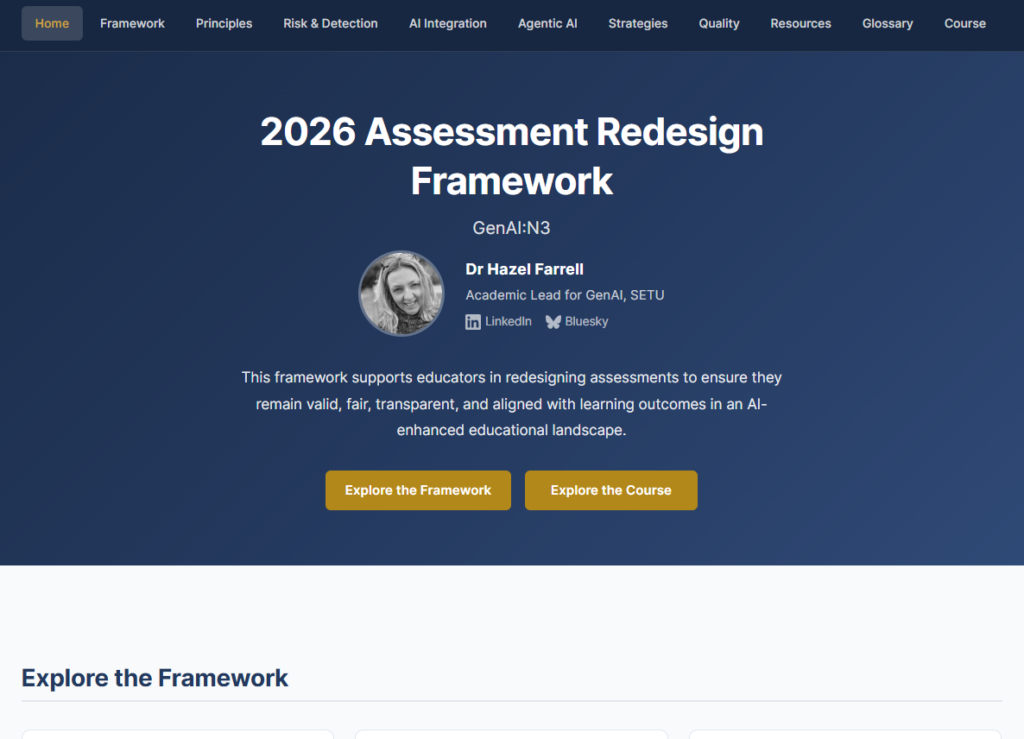
This OER presents an updated Assessment Redesign Framework for higher education in the age of GenAI. It supports educators and programme teams in designing valid, transparent, and scalable assessments, integrating AI literacy, process-focused approaches, and guidance on AI detection, large cohorts, and emerging agentic AI challenges.
Benefit of this resource and how to make the best use of it
This resource can be applied at module, programme, and institutional levels to support assessment redesign in AI-enhanced learning environments. Educators can use it to review existing assessments, introduce staged tasks, reflective elements, or oral components, and clarify expectations around AI use. Programme teams can apply it during curriculum review to balance AI-restricted and AI-integrated assessments and ensure alignment with learning outcomes and graduate attributes, including AI literacy.
Academic developers and instructional designers can integrate the framework into professional development workshops, curriculum design processes, and assessment policy discussions. It may also be adapted into checklists, templates, or review tools for programme validation, QA processes, and assessment mapping exercises, particularly in contexts involving large cohorts, anonymous marking, or evolving institutional AI guidelines.
This work is licensed under a CC BY-SA license, allowing adaptation and sharing with proper attribution, provided derivative works use the same license.
?
This citation is automatically generated and may require adjustment. Always verify it against your style guide.
Farrell, H. (09/02/2026). 2026 assessment redesign framework. National Resource Hub (Ireland). Retrieved from: https://hub.teachingandlearning.ie/resource/2026-assessment-redesign-framework/ License: Creative Commons Attribution-ShareAlike (CC BY-SA).
Adapting this resource? Share your version!
If you have modified or adopted this resource, share your version here. Tracking adaptations helps us measure impact and connects others with useful updates.
This OER explores the use of Inspiration Mind Mapping software to support student learning through demonstrations and training sessions with Applied Social Care and LSAD students.
This is an interactive multimedia open educational resource (OER), created using H5P, on the topic of Open Education. It has been developed by the Department of Technology Enhanced Learning at Munster Technological University.
The purpose of which is to give an overview of OEPs, using interactive features of H5P
The purpose of this resource is to allow Moodle teachers to quickly create quizzes for Moodle. Users can quickly select between questions types through a single interface and export their questions as an XML file which can be imported into Moodle.
This Pressbook features an interactive tool that helps you plan and structure your essay step by step. The book provides a clear starting point to reduce stress, prevent overwhelm, and support different learning preferences through examples, , quick guides, and PowerPoint videos with voiceover. This resource is a living document.