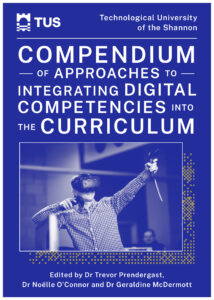
The Technological University of the Shannon (TUS) Compendium of Approaches to Integrating Digital Competencies into the Curriculum exemplifies the University’s commitment to embedding digital capability development across teaching, learning, and assessment.
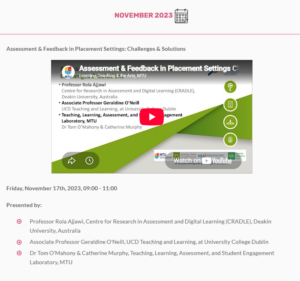
MTU researchers, together with national and international researchers, presented local, national, and global insights into the challenges and opportunities of assessment and feedback in work placement settings.
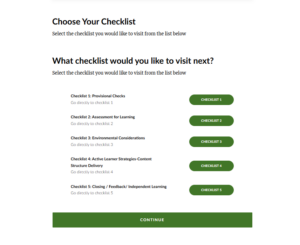
Teaching and Assessment for Learning Checklists aimed at early career & seasoned lecturers. The checklists provide guidance & reliable curated resources for lecturers who want to deliver an engaging and positive learning experience for their students. They act as a guide to check existing approaches, and help analyse how improvements can be made.
The video examines the impact of digital technology on the wellbeing of children and young people. It highlights ethics and legislation relating to social media platforms and Gen AI. It will be of interest to educators in third level, adult education and older school children. Content warning: it includes references to upsetting examples.
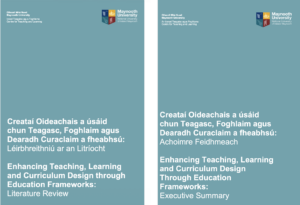
The resource comprises of a literature review and an executive summary, developed as part of the Maynooth University Leadership and EducAtion Framework (LEAF) initiative. It explores how education frameworks can enhance teaching, learning and curriculum design in higher education, supporting inclusive, sustainable and values-led academic practice.
BSEditor is a multi-platform software tool designed to aid educators in the creation of computer-based quiz questions. It provides a powerful editor to easily control every detail of a question, from integration of files and images, to elaborate scoring approaches.
This lightning talk for NORFest 2025 introduces researchers to the benefits and impact of using OE Practices to disseminate and promote Open Research outputs. It introduces key concepts in open education, and provides practical tips on how to apply OE practices with a focus on reusability; licensing and copyright; and content co-creation.
The Manifesto for Generative AI in Higher Education is a living resource for educators, students, and institutions. It invites reflection and dialogue across thirty statements exploring teaching, ethics, and imagination – helping higher education navigate AI with curiosity, integrity, and humanity.
The Data Loom: Crafting Stories with Code, Yarn and Print is an open educational resource that reimagines data visualisation through tangible, artistic, and embodied practices. Instead of visualising numbers on screens, this project guides learners to materialise datasets using yarn, a miniature 3D-printed loom, and the art of weaving.
The resource is a template for surveying students about their timetabling experiences. The survey was deployed in MTU, but the template is free to be copied and adapted as needed.
This GenAI Learning Hub was developed with students, for students, to support the responsible and effective use of generative AI. Topics are divided across three main sections to aid understanding of GenAI before use, during use, and in relation to assessment. While aimed at students, this resource will be useful to anyone using GenAI.
This paper describes the foundational principles and design details of the student-staff partnership initiative launched by the Co-creating Inclusive and Equitable Teaching & Learning project, led by Dr. Anna Santucci and situated within the Centre for the Integration of Research, Teaching and Learning (CIRTL) at University College Cork (UCC).
This 12 lesson open course provides an introduction to the AI Fluency Framework and the four competencies of Delegation, Description, Discernment, and Diligence. c. 70 mins videos plus ungraded exercises & projects and reference handouts. Co-developed by University College Cork, Ringling College and Anthropic with support by HEA.
The VISIEN Framework Document is a strategic guide for integrating immersive technologies (AR, VR, MR, XR) into higher education. It offers practical guidance on curriculum integration, accessibility, collaboration, skill development, institutional readiness, and more to support transformative teaching, learning, and research.
A. Hickey, C. O’Faolain, J. Healy, K. Nolan, E. Doheny and P. Cuffe, “A Threat Assessment Framework for Screening the Integrity of University Assessments in the Era of Large Language Models”, presented at 8th IEEE International Forum on Research and Technologies for Society and Industry Innovation, Lecco, Italy, September 2024
Publication created by our 2024 summer interns in DkIT.
Stepping out in Dundalk! This book will be a useful resource for our cohort international students someone useful tips on life on and off campus.
Digital Skills for Success in the Workplace is a five-unit, self-paced online course which equips learners with key digital literacy skills that are essential to study and work in rapidly evolving online environments.
Publication created by our 2024 summer interns in DkIT.
Giving power back to class reps! This book will be a useful resource for all our student reps to use as a guide and for training purposes also.
This faculty guide aims to help educators navigate and understand GenAI’s potential role in higher education. Created for faculty who want to explore AI tools and their implications for teaching and learning, the resource allows educators to learn at their own pace about the opportunities and challenges of these technologies.
We are delighted to welcome you to ‘You can UDL it!’ This collection brings together case studies from educators across DkIT, who have successfully implemented Universal Design for Learning (UDL) in their own practice. UDL provides a framework for making learning, teaching and assessment more inclusive, and helps to support all our learners.
This series of videos presents an abstract from the Croí process where individuals are guided to define their personal (or core) and professional values, and to identify actions they can take that will help them to develop a career that better aligns their personal and professional values and lives.
Curricular approaches to well-being are important and impactful, as universal supports for all students. This OER is a padlet of resources and talks from the April 2024 jointly hosted UCC and MTU seminar on this critical area for teaching and learning enhancement in Irish higher education.
This report has been prepared for circulation across the Green-Campus Network, Higher Education Authority and the National Forum for the Enhancement of Teaching and Learning in Higher Education. It can also act as a resource for individuals who are interested in ESD and sustainability.
Future proof your curriculum by embedding sustainability into your teaching practice or further integrating the Sustainable Development Goals (SDGs) into your curriculum. The SDG digital toolkit project will give you concise actionable resources to achieve this result while providing insights into the underpinning theories.
The Toolkit includes an introduction to generative AI and lexicon of terms, guidelines for ethical use, recommended adjustments to common modes of assessment to mitigate against the potential risk of unethical use, and discipline-specific case studies of good practice that share innovative forms of learning, teaching and/or assessment.
The Academic Integrity, Academic Misconduct, and Resources pages of the UCC Skills Centre website contain guidance for students on these topics, including a series of short videos, “The Minute Methods: Academic Integrity Skills” that cover a range of topics from the principles of academic integrity to the pitfalls of essay mills.
Your Brainpower is a free, online, self-paced course, focusing on harnessing the power and potential of adolescent [age 10 – 24 years] brain and behaviour for enhanced learning, wellbeing, and student success in higher education.
Throughout this workbook students are asked to engage with the PCs Graduate Attribute & Mindsets Framework via a suite of activities or exercises. This engagement will provide students with the language of skills and attributes best suited to job application and success.
Via the lens of graduate attribute development this toolkit highlights best examples of employability activities for higher education curriculum. Designed to enhance employability skills development as class activities and module assessments, namely via the Employability Superfoods, lecturers can enhance students’ employability learning with ease.
This seminar presented an overview of current policy, research and practice relating to student wellbeing in higher education and how the curriculum can be leveraged to enhance wellbeing. It showcased a range of innovative curricular wellbeing initiatives in UCC and MTU.
‘AT Hive’ is a web based resource by AHEAD that aims to impart information about the large area of Assistive Technology that supports students students with disabilities. These technologies and tools help people who may have challenges with reading, writing, organisation, motivation as well as much more so explore the wide range of apps and tools.
This guidebook and video resource provides detailed guidance on the development and implementation of a peer assisted student support (PASS) programme in a higher education setting
This resource has been developed to provide a framework for programme teams and lecturers to consider the role and place of group-work in their programmes and teaching and to plan and manage it in a way that enhances learning and promotes a positive student experience.
Transform higher education and student learning. Open textbooks are licensed by authors and publishers to be freely used and adapted. Download, edit and distribute them at no cost.
The Open Data listed in data.gov.ie is published by Government Departments and Public Bodies. Many datasets are individually published and updated by public organisations. Other datasets are harvested daily from existing, domain-specific data catalogues.
A flexible resource that supports learners to assess their current employability skills. Focus is given to a number of developmental areas that employers review and assess as part of a recruitment and selection processes.
This handbook offers you advice on how to approach your academic writing, especially in your transition from second to third level. It provides advice, strategies and writing activities to help you develop your academic writing, and to feel confident in expressing your own voice in your writing.
The aim of the Student Success Toolbox is to support transitions from thinking about study to the first weeks to increase retention and completion rates particularly for flexible learners (undergraduate adult, part-time and online/distance students) as this is a significant problem in the Irish Higher Education sector.
The Website has been developed as a resource for Parents, Students, Tutors and Teachers who would like to support and help others to develop their maths eyes.