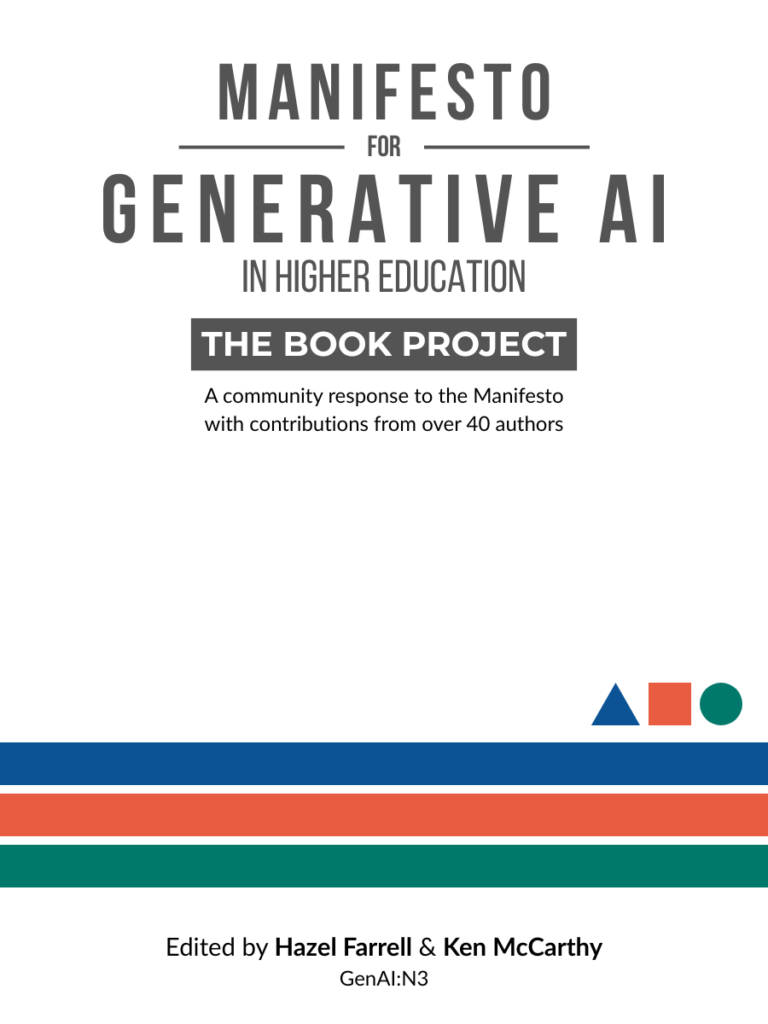
The Manifesto for Generative AI in Higher Education – The Book Project offers educators, academic developers, instructional designers and institutional leaders a resource for critically exploring the opportunities, challenges and implications of generative AI in higher education.
Bringing together contributions from over 40 authors, the book expands on the 30 statements of the original Manifesto through a diverse collection of perspectives, experiences and reflections. Organised around three themes – Rethinking Teaching and Learning; Responsibility, Ethics, and Power; and Imagination, Humanity, and the Future – it encourages readers to move beyond discussions about individual AI tools and consider the broader implications for education, professional practice and institutional culture.
The book is intended to stimulate reflection, discussion and action rather than prescribe a single approach to generative AI. Its chapters can be read independently, making it particularly suitable for use in a range of educational and professional development settings.
Practical applications include:
– Teaching and learning: Educators can select individual chapters to prompt classroom discussions, encourage students to critically evaluate generative AI, or explore questions about learning, creativity, academic integrity and human agency.
– Assessment design: Programme teams can use chapters addressing assessment, academic judgement and the changing nature of learning to inform discussions about assessment redesign and approaches that recognise the capabilities and limitations of generative AI.
– Academic professional development: Academic developers can incorporate selected statements and chapters into workshops, communities of practice, reading groups or professional learning activities. The contrasting perspectives provide opportunities for discussion and critical reflection.
– Curriculum and programme development: Programme teams can use the three themes to consider how AI literacy, ethical awareness, critical thinking and disciplinary perspectives might be embedded within curricula.
– Institutional policy and strategy: Academic leaders and professional services teams can draw on chapters addressing ethics, transparency, inclusion, privacy and sustainability to support conversations about responsible institutional approaches to generative AI.
– Instructional design: Learning designers can use individual statements as starting points for reflective activities, discussion prompts, case studies or collaborative learning experiences.
Making the best use of the resource
Readers do not need to work through the book sequentially. A useful starting point is to identify a statement or theme relevant to a particular teaching, learning or institutional challenge, read the corresponding chapter, and use its ideas to initiate discussion or inform practice.
The book can also be used alongside the original interactive Manifesto website (https://manifesto.genain3.ie/), where readers can explore the statements and contribute their own reflections. This provides an opportunity to extend conversations beyond the book and engage with perspectives from the wider higher education community.
Published by GenAI:N3 under a Creative Commons Attribution-ShareAlike 4.0 licence, the book is freely available to read, share and adapt with appropriate attribution. This makes it particularly suitable for integration into teaching materials, staff development activities and collaborative professional learning.
The central benefit of the resource is its invitation to engage critically and collectively with GenAI, recognising that its future role in higher education should be shaped by educational values, human judgement and the experiences of those who teach and learn.