

MTU researchers, together with national and international researchers, presented local, national, and global insights into the challenges and opportunities of assessment and feedback in work placement settings.
Filter by
Filter by
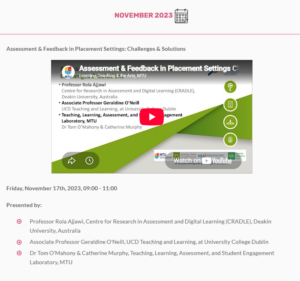
MTU researchers, together with national and international researchers, presented local, national, and global insights into the challenges and opportunities of assessment and feedback in work placement settings.
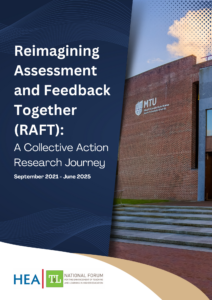
Reimagining Assessment & Feedback Together (RAFT) is MTU initiative developed to transforming assessment practices. This volume documents twenty-four situated, discipline-specific attempts to rethink assessment and feedback through student partnership and action research.

The Fledgling Project reviewed assessment and feedback strategies of a final year early childhood studies professional practice placement in which students create and run a community-based parent and toddler group. A student practical guide was developed which includes feedback/guidance from past students, graduates, parents and employers.


This report aims to inform the current enhancement theme of the National Forum by profiling documented assessment practices across a sample of 30 undergraduate degree programmes. Further, the study aims to explore whether and how assessment practices differ between fields of study and to share insights regarding students’ experiences of assessment across Irish higher education.

Insight: Profile of Assessment Practices in Irish Higher Education

The EAT Framework: Considerations for Programme Leaders and their Students

Case Study: Dr Cormac Quigley and Dr Etain Kiely of Galway-Mayo Institute of Technology show how they are using everyday tools to enable at-scale, personalised feedback to large student cohorts

This resource is an executive summary of a key literature review which stemmed from an interdisciplinary project that examines how qualitative and quantitative student feedback and evaluation of teaching methods, at module and programme level, can help to enhance student learning and contribute to the continuing professional development of staff who teach.

This resource stems from an interdisciplinary project that examines how qualitative and quantitative student feedback and evaluation of teaching methods, at module and programme level, can help to enhance student learning and contribute to the continuing professional development of staff who teach.

The IUA’s EDTL project have developed a popular and engaging webinar series, with each video hosted on their vimeo channel. Go to the channel now to view content that will certainly be of interest to you.

The Irish Universities Association has launched a three-year project to mainstream digital in teaching, learning and assessment through an ambitious professional development programme. The aim is to move away from individual champions, towards effective engagement of all staff with digital technologies. This includes attempts to diversify the assessment methods utilised across the university.

A concise guide which details the process of closing the Feedback Loop, presenting strategies for mid-semester.

An infograph guide highlighting the fact that student feedback matters.

This Forum Insight aims to expand our understanding of the terms associated with assessment within the Irish higher education sector.

In the words of the authors, “this project sought to address a key issue in third level Teaching and Learning, that of assessment and assessment feedback. Assessment strategies have been shown to have a large impact on shaping how students learn and how they develop key employability skills. Learning from best practice nationally and internationally, and research from staff, students and quality documents, this project has developed a set of recommendations which will enhance practices in, and experiences of, assessments and feedback in TU Dublin”.

In TBL the self-management of the team is a guiding principle and this is very much centred around peer review (Sibley, 2018). We must aim to give the students tools to be able to do this. This resource introduces some of these in a very helpful and concise way.

This resource presents several best practice tips to ensure successful discussion forums.

Best pratice tips for Supporting Online Students through engagement and understanding

This OER provides some helpful prompts and suggestions for creating a ‘social presence’ in online environments.

The aim of the this workbook is to provide a series of resources; contextual information, methods and approaches, to the area of assessment construction and implementation.

Student feedback is any information, formal or informal, that students provide about their university experiences. This guide discusses feedback that students communicate to university staff about their experiences of teaching and learning.

An infograph guide for students highlighting the fact that feedback on teaching and learning matters.

This guide considers approaches around seeking high quality feedback on online and blended modules and programmes.

This concise guide considers and details important elements and insights around gathering student feedback on laboratory classes, as well as presenting tips to help achieve this.

This concise guide considers and details the importance of embedding student partnership in feedback approaches, as well as presenting tips to help achieve this.

This concise guide considers and details the importance of embedding ongoing feedback approaches, as well as presenting tips to help achieve this.

