This resource supports inclusive teacher education through findings from the PREP-In project. It combines student and professional perspectives, placement portfolio insights, co-created classroom vignettes and practical recommendations. Designed for teacher educators, student teachers, school mentors and SEN professionals.
This technical report accompanies ALTITUDE, the National Charter for Universal Design in Tertiary Education. It explains the rationale for the Charter, its development and consultation process, its strategic enablers and four pillars, and its alignment with international, national and institutional policy. It also provides guidance for adoption and implementation across further and higher education.
Prepared by Dr Joanne Banks with direction and input from the ALTITUDE Working Group. Published by AHEAD Educational Press, 2024.
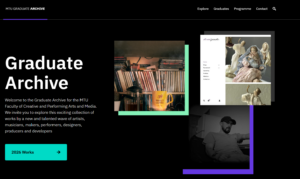
The Graduate Archive Website is a permanent collection of final year artworks and performances across the MTU Faculty of Creative and Performing Arts and Media.
The Archive showcases all works in full detail, which allows the works to function as high quality research material, and creates a key resource for teaching and learning.
The Technological University of the Shannon (TUS) Compendium of Approaches to Integrating Digital Competencies into the Curriculum exemplifies the University’s commitment to embedding digital capability development across teaching, learning, and assessment.
The HEA ESD Self-Evaluation Tool is a voluntary, developmental resource that supports higher education institutions in reviewing and strengthening whole-of-institution Education for Sustainable Development. It helps institutions undertake structured reflection on current strengths, gaps and progression, identify local priorities and plan practical next steps.
The tool is organised around the five ESD to 2030 Priority Action Areas. For each area, it provides developmental descriptors across three broad stages of practice: Emerging, Established and Leading. It is intended to support dialogue, planning and quality enhancement.
This overview introduces the Higher Education Authority’s Education for Sustainable Development (ESD) Framework for Higher Education: a connected suite of resources supporting whole-of-institution ESD across Irish higher education. It explains the Framework’s purpose, its relationship to national and international ESD priorities, and how its component resources work together to provide strategic direction, sector evidence, structured reflection, thematic insight and opportunities for peer learning.
The Framework connects curriculum, campus operations, governance, research and community engagement. It is intended for institutional leaders, educators, professional staff, students and representative bodies, ESD and sustainability leads, teaching and learning units, quality and enhancement teams, community partners and policy stakeholders.
This report draws on Patricia Gibson’s research around critical approaches to Artificial Intelligence (AI) in Education and the increasing automation of Educational Technologies (EdTech).
Comparing student and educator perceptions of generative artificial intelligence for teaching, learning and assessment: results from two institutional surveys
This case study outlines a first-year intervention at SETU Waterford using a timetabled weekly session to tackle common causes of academic failure such as time management, assessment planning. and study skills. It is intended for programme teams seeking practical, low-resource approaches to improving student progression and retention.
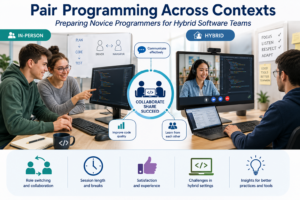
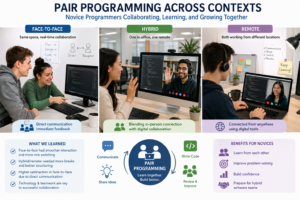
This OER presents findings from a comparative study of novice programmers engaging in face-to-face and hybrid pair programming. It explores collaboration patterns, role switching, satisfaction, and challenges, offering evidence-based insights for educators seeking to prepare students for effective teamwork in modern hybrid software development.
This OER explores novice programmers’ experiences of pair programming across face-to-face, hybrid, and remote settings. It provides insights into collaboration, role switching, satisfaction, and challenges, helping educators and students understand how to effectively prepare learners for modern hybrid software development environments.
Through a thought-and-action mapping strategy known as interactive management, the current research modelled a unique, collaborative "pathway of impact influences" to describe such considerations from the perspectives of TUS higher management and external stakeholders.
This book of abstracts presents an overview of the research summaries from students across the RUN-EU network who participated in the RUN-EU Student Research Colloquium 2025.This event brought together students, researchers, and academics from across Europe, creating a dynamic platform to showcase cutting-edge research.
Enhancing Student Engagement and Belonging through Collaborative Partnership is a Higher Education Authority report prepared by a UCD research team led by Professor Barbara Dooley. The resource provides an evidence-informed framework for strengthening student belonging across Irish higher education institutions. Drawing on staff interviews, Healthy Campus survey responses, and analysis of Healthy Campus and NStEP case studies, it identifies practical approaches to improving student engagement, wellbeing and inclusion.
The report frames belonging as a multidimensional and co-constructed experience shaped by social, academic, personal and environmental factors. It highlights that student belonging is affected not only by relationships and participation, but also by structural issues such as housing, commuting, financial pressure, campus spaces, timetable design and access to supports.
The resource is particularly useful for staff and student partners working on Healthy Campus, student success, student engagement, access, inclusion, mental health promotion, orientation, peer support, student partnership and campus development initiatives.
A video based course exploring dairy price volatility and risk management in the EU dairy sector. Developed through the Irish Dairy Centre of Vocational Excellence (Erasmus+), it covers causes, consequences, policy responses, and practical tools. Suitable for learners, industry professionals, and educators in agri-food and related disciplines.
This is an interactive multimedia open educational resource (OER), created using H5P, on the topic of Open Education. It has been developed by the Department of Technology Enhanced Learning at Munster Technological University.
The purpose of which is to give an overview of OEPs, using interactive features of H5P
Purpose of the MTU Student Guidelines
Supports Academic Integrity Principles and MTU’s Academic Integrity Policy by:
1. Explaining what academic integrity is.
2. Helping students avoid bad decisions during assessments.
3. Outlines and signposts supports available across MTU
The work presented in this practice paper illustrates how the use of immersive 360o
video and photographs, viewed in virtual reality headsets or via 360o media players,
can enhance and broaden student knowledge and experience when undertaking
Project Based Learning (PBL) assignments.
The Technological University of the Shannon (TUS) Compendium of Embedding Education for Sustainable Development (ESD) showcases the University’s commitment to integrating sustainability across teaching, learning and assessment. It is the first compendium of its kind in an Irish higher education institution.
The resource comprises of a literature review and an executive summary, developed as part of the Maynooth University Leadership and EducAtion Framework (LEAF) initiative. It explores how education frameworks can enhance teaching, learning and curriculum design in higher education, supporting inclusive, sustainable and values-led academic practice.
This study explores student perceptions and behaviours concerning academic integrity and the use of Generative AI in the context of Munster Technological University (MTU). It draws insights from a comprehensive survey of 608 students across various faculties and academic stages.
This opinion article outlines the alignment between patient-clinician consultations in healthcare and student-investigator meetings focused on academic misconduct
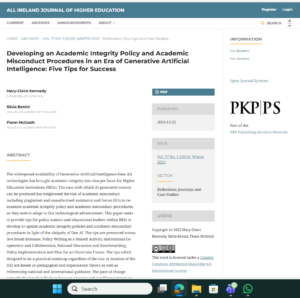
This paper entitled 'Developing an Academic Integrity Policy and Academic Misconduct Procedures in an Era of Generative Artificial Intelligence: Five Tips for Success' may be of interest to policy developers and educators in further and higher education and training organisations as they adapt to challenge of AI.
In 2018, the Glucksman Library at the University of Limerick launched Leganto, a reading list management tool designed to streamline access to academic resources for students. Leganto ensures equitable access to academic content, helping students engage with reliable sources and easing their transition into university-level study.
The HEA Education for Sustainable Development Spotlight Series 2025: Case Studies Compendium brings together 115 case studies from higher education institutions across Ireland. It showcases how universities and colleges are integrating sustainability and the UN Sustainable Development Goals into teaching, research, curriculum design, assessment practices and community engagement. It offers a comprehensive picture of national ESD activity and provides an accessible resource for educators and policymakers seeking examples of practice-based innovation.
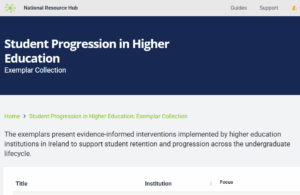
A collection of case studies of evidence-informed interventions implemented by higher education institutions in Ireland to support student retention and progression across the undergraduate lifecycle. These exemplars are presented here as a national evidence base of student progression initiatives.
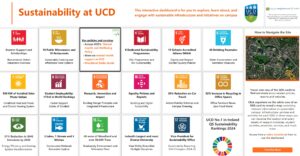
This scientific paper describes the co-creation of the UCD sustainability dashboard – the first transferable template to support geographically-specific SDG monitoring within HEIs. This paper contributes to debates on the need for spatial reporting of actions towards sustainability, to meaningfully recognise local SDG implementation progress.
The Manifesto for Generative AI in Higher Education is a living resource for educators, students, and institutions. It invites reflection and dialogue across thirty statements exploring teaching, ethics, and imagination – helping higher education navigate AI with curiosity, integrity, and humanity.
This open resource presents over 140 real-world academic integrity and ethical dilemma scenarios co-created by students and staff. Designed for educators, trainers, and learners, it supports interactive discussions, gamified learning, and scenario-based teaching in ethics and integrity education across disciplines.
This resource presents AVINA, an automated visual novel generator using large language models to transform multiple-choice questions into interactive learning narratives. Designed for educators and students, it supports gamified training in academic integrity and ethical decision-making through adaptive storytelling and experiential learning.
The resource is a template for surveying students about their timetabling experiences. The survey was deployed in MTU, but the template is free to be copied and adapted as needed.
This toolkit is designed to provide educators in Higher Education with practical, adaptable tools and strategies for fostering sustainable wellbeing in their teaching through curriculum, assessment and pedagogy.
This paper describes the foundational principles and design details of the student-staff partnership initiative launched by the Co-creating Inclusive and Equitable Teaching & Learning project, led by Dr. Anna Santucci and situated within the Centre for the Integration of Research, Teaching and Learning (CIRTL) at University College Cork (UCC).
Dataset originating from collaborative autoethnographic study "What does researcher independence and the hidden curriculum mean for postdocs?". It comprises individual narratives written by the three authors, and the transcript of an online discussion.
This compendium comprehensively brings together the components needed by higher education institutions (HEIs) when developing comprehensive frameworks for managing cases of academic misconduct. It serves as both a practical guide and a reflective resource, aimed at strengthening and promoting a culture of academic integrity.
It is with great pleasure that we present the proceedings from the
“Enhancing Academic Integrity: From Ideas to Action” conference, hosted
by CCT College Dublin on 3rd and 4th September 2024. This collection
represents the culmination of thoughtful discourse, innovative research, and
collaborative spirit that defined our gathering.
The VISIEN Framework Document is a strategic guide for integrating immersive technologies (AR, VR, MR, XR) into higher education. It offers practical guidance on curriculum integration, accessibility, collaboration, skill development, institutional readiness, and more to support transformative teaching, learning, and research.
This literature review examines how alternative practical-class formats, assessment approaches and digital technologies can enhance learning in science and health disciplines. Written by Ronan T. Bree for the TEAM project, it explores practical learning environments, pre-practical resources, assessment and feedback, self-assessment and reflection, and digital capacity and literacy.
A 2016 Y1Feedback synthesis of research on effective feedback in higher education, with a particular focus on technology-enabled approaches that support students in their first year. It explores feedback dialogue, feedforward, self-regulation, assessment and feedback literacies, and practical features of effective feedback.
A 2016 Y1Feedback report examining first-year assessment and feedback practices across Maynooth University, Athlone Institute of Technology, Dublin City University and Dundalk Institute of Technology. It draws on a staff survey and student focus groups to examine feedback purposes, assessment approaches, timing, access, peer feedback and the use of technology.