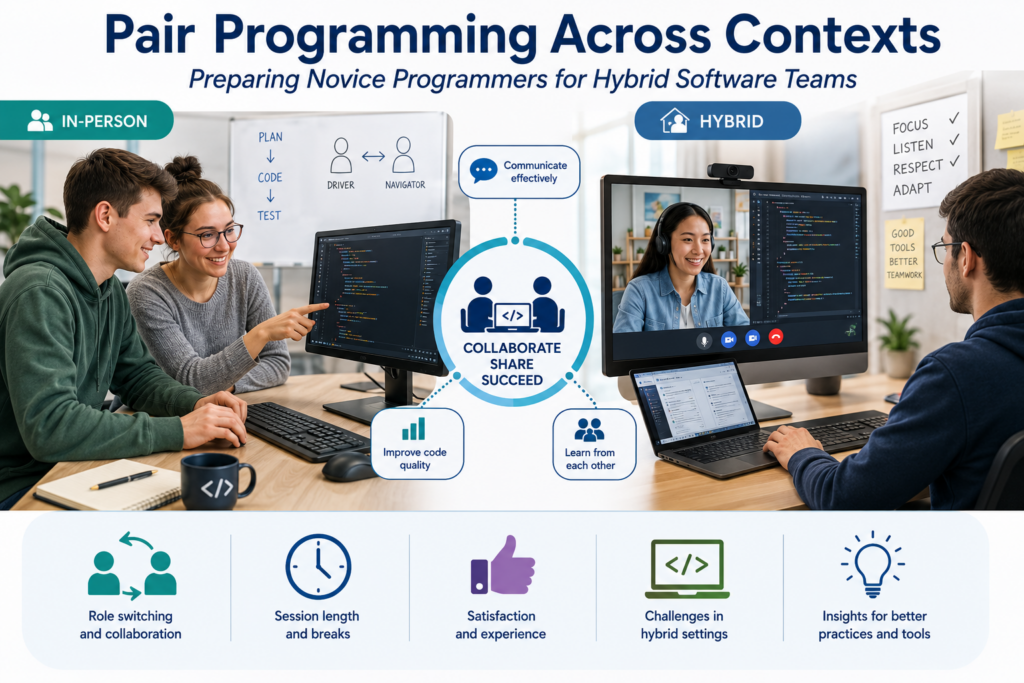
This OER presents findings from a comparative study of novice programmers engaging in face-to-face and hybrid pair programming. It explores collaboration patterns, role switching, satisfaction, and challenges, offering evidence-based insights for educators seeking to prepare students for effective teamwork in modern hybrid software development.
Benefit of this resource and how to make the best use of it
This resource provides educators with evidence-based insights into how novice programmers experience pair programming in both face-to-face and hybrid environments. As software development increasingly takes place across distributed and flexible teams, there is a growing need to prepare students for collaborative work that extends beyond traditional co-located settings. The OER addresses this need by examining how different modes of pair programming influence collaboration, communication, role switching, session management, and learner satisfaction.
A key benefit of the resource is that it is grounded in authentic experiences from novice software engineers participating in an industry-informed educational programme. Rather than presenting pair programming as a single pedagogical approach, it highlights the opportunities and challenges associated with different delivery modes. The findings help educators understand how hybrid collaboration can affect student engagement, participation, and learning experiences, while also identifying strategies that may improve outcomes in remote and mixed settings. Educators can use the accompanying paper and presentation materials to stimulate classroom discussions about effective teamwork, agile practices, and the realities of modern software development.
In academic settings, the OER can be integrated into modules on programming, software engineering, agile development, professional practice, or computing education. For example, instructors may ask students to complete pair programming activities in both face-to-face and hybrid configurations and analyse differences in communication, productivity, role switching, and satisfaction. The resource may also support reflective assignments in which learners propose strategies to improve hybrid collaboration using digital tools and structured team practices.
?
This citation is automatically generated and may require adjustment. Always verify it against your style guide.
Giblin, M., & Fallon, S. (2026). Preparing novice programmers for hybrid software teams: insights from pair programming experiences. National Resource Hub (Ireland). Retrieved from: https://hub.teachingandlearning.ie/resource/preparing-novice-programmers-for-hybrid-software-teams-insights-from-pair-programming-experiences/ License: Creative Commons Attribution-NonCommercial (CC BY-NC).
Adapting this resource? Share your version!
If you have modified or adopted this resource, share your version here. Tracking adaptations helps us measure impact and connects others with useful updates.
This OER explores novice programmers’ experiences of pair programming across face-to-face, hybrid, and remote settings. It provides insights into collaboration, role switching, satisfaction, and challenges, helping educators and students understand how to effectively prepare learners for modern hybrid software development environments.
This OER guides students through human-in-the-loop software development, demonstrating how AI tools can be effectively supervised, refined, and integrated across the Software Lifecycle. Designed for computing educators and learners, it combines agile practice, teamwork, DISC awareness, testing, and critical reflection on human–AI collaboration.
This OER introduces students to designing and developing AI-powered assistants for agile software development using Flowise (no code). Learners as a team explore Retrieval Augmented Generation (RAG) and agent-based systems, applying AI to real-world agile practices while considering technical design, evaluation, and cost-aware decision-making
As part of this project small workshops in linear algebra where held both nationally and internationally. The main workshop website is https://sites.google.com/view/tusdcu-linearalgebraworkshop/home
A one day workshop to help bring together early stage researchers to learn and discuss topics in Linear algebra.