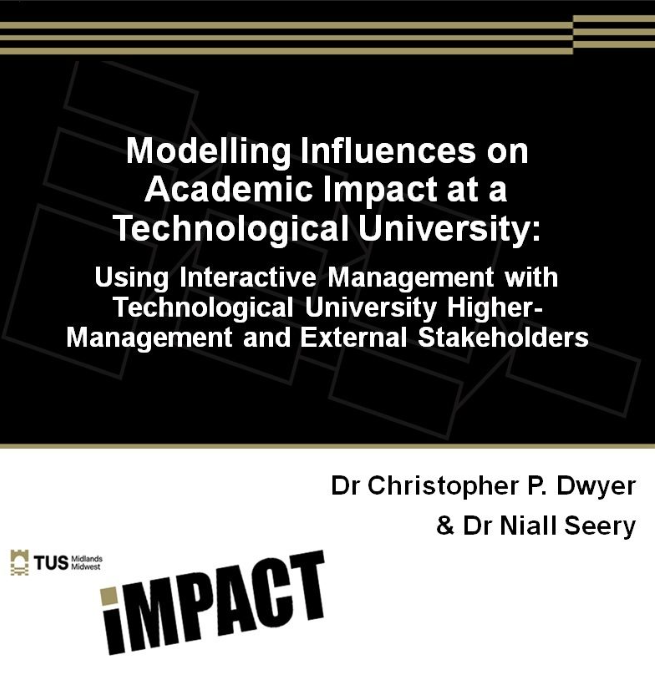
Through a thought-and-action mapping strategy known as interactive management, the current research modelled a unique, collaborative "pathway of impact influences" to describe such considerations from the perspectives of TUS higher management and external stakeholders.
Benefit of this resource and how to make the best use of it
The recent establishment of the Irish technological university sector represents an opportunity to carve out the sector’s own unique framework for what constitutes academic impact, despite barriers previously faced in doing so. Following recent research focused on understanding the nature and capture of TU impact from staff and student perspectives, the current research focuses on perspectives from one technological university’s higher-management and external stakeholders, the Technological University of the Shannon (TUS), via interactive management. Findings from two interactive management sessions (n= 12 per group) revealed a pathway of impact influence across (1) Funding & Resources, (2) Impact Considerations, (3) Accessibility & Relationship with Service Engagement, (4) Student Influences and (5) Morale & Motivation; and corroborate recent research and signals important considerations for the wider Irish technological university sector. Findings and implications are discussed in light of theory and recent research.
Creative Commons Attribution (CC BY)
This work is licensed under a CC BY license, allowing sharing and adaptation with proper attribution.
?
This citation is automatically generated and may require adjustment. Always verify it against your style guide.
Dwyer, C., & Seery, N. (10/06/2026). Modelling influences on academic impact at a technological university. National Resource Hub (Ireland). Retrieved from: https://hub.teachingandlearning.ie/resource/modelling-influences-on-academic-impact-at-a-technological-university/ License: Creative Commons Attribution (CC BY).
Adapting this resource? Share your version!
If you have modified or adopted this resource, share your version here. Tracking adaptations helps us measure impact and connects others with useful updates.
The purpose of these protocols is to assist student teachers and cooperating teachers in schools to have professional conversations together during regular tutorial meetings. Each document requires the use of GenAI but can generate insights or interactions that would be difficult to emulate in paired discussion.
The Graduate Archive Website is a permanent collection of final year artworks and performances across the MTU Faculty of Creative and Performing Arts and Media.
The Archive showcases all works in full detail, which allows the works to function as high quality research material, and creates a key resource for teaching and learning.
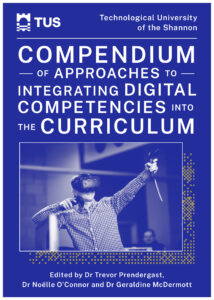
The Technological University of the Shannon (TUS) Compendium of Approaches to Integrating Digital Competencies into the Curriculum exemplifies the University’s commitment to embedding digital capability development across teaching, learning, and assessment.
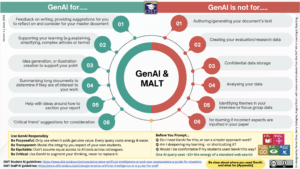
A 1-page guide, co-created by lecturers, tutors & students on DkIT's MA in Learning and Teaching, showing where GenAI can, and can't, support particular postgraduate research/skill development (*reflecting practice 2025-26). Includes student-informed prompts on responsible, sustainable use. An editable PowerPoint supports adaptation to own context.