Title: Gasta Talks – Open Education in Practice
Chaired by: Dr Tom Farrelly (MTU)
Short, high-energy 5-minute lightning talks designed to encourage broad participation and rapid sharing of ideas and experiences.
– Ken McCarthy (SETU)* – Open by Design: A Manifesto for Generative AI in Higher Education
– Angélica Rísquez (UL)* – Why Open Still Matters (Just Differently)
– Susan Horgan (MTU)* – Digital Inclusion in Online Learning
– Carina Ginty (ATU)* – Unlock Your Digital & Green Superpowers: Explore the AREA Discovery Tool
– Michael Costello (MTU)* – Partnership to Practice: Developing OER at MTU
Keynote Title: Opening the Future: Equity, Sustainability, and Promise in Higher Education
Speaker: Dr Robin DeRosa
Dr Robin DeRosa is the Executive Director of the Open Education Network , a global organization based out of the University of Minnesota that facilitates community care and collective action in open education to empower faculty, remove barriers to learning and knowledge-sharing, and enhance student success.
Sectoral panel exploring open education in Irish higher education featuring:
– Dr Pio Fenton*, Vice President People & Culture, Munster Technological University
– Liz Jolly*, University Librarian, University College Cork
– MJ Quill*, Vice President for Postgraduate Affairs, Aontas na Mac Léinn in Éirinn (AMLÉ)
– Dr Eamon Costello*, Associate Professor of Digital Learning, Dublin City University, President of the Irish Learning Technology Association (ILTA)
– Dr Leigh Graves Wolf*, Interim Director Of Teaching & Learning, University College Dublin
Title: Open Education: Supporting Policy and Practice Welcome and Opening
Master of Ceremonies: Dr Gearóid Ó Súilleabháin (Head of Technology Enhanced Learning, Munster Technological University)
*Gearóid Ó Súilleabháin*, Head of Dept. of Technology Enhanced Learning, MTU
*Professor Christine Cross*, Vice President for Academic Affairs, Munster Technological University
*Tim Conlon*, Head of Policy and Strategic Planning, Higher Education Authority.
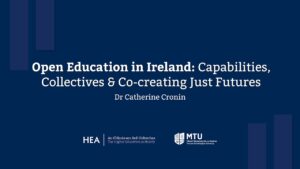
Keynote Title: Open education in Ireland: capabilities, collectivities, and co-creating just futures
Speaker: Dr Catherine Cronin
Dr Catherine Cronin an independent scholar focused on critical and social justice approaches in digital, open and higher education. Catherine is co-editor of the open-access book Higher Education for Good: Teaching and Learning Futures.
This is an interactive multimedia open educational resource (OER), created using H5P, on the topic of Open Education. It has been developed by the Department of Technology Enhanced Learning at Munster Technological University.
The purpose of which is to give an overview of OEPs, using interactive features of H5P
This video provides a step-by-step guide on how to submit your SATLE-funded Open Educational Resources (OER) to Ireland’s National Resource Hub. It outlines the submission process, key requirements, and best practices to ensure your resources are accessible, discoverable, and aligned with national open education goals. Whether you're new to the Hub
This lightning talk for NORFest 2025 introduces researchers to the benefits and impact of using OE Practices to disseminate and promote Open Research outputs. It introduces key concepts in open education, and provides practical tips on how to apply OE practices with a focus on reusability; licensing and copyright; and content co-creation.
Cognitive Bias Lab is an interactive platform designed to help learners explore and practice recognizing cognitive biases. Through simulations, quizzes, and role-play scenarios, it supports critical thinking, decision-making skills, and classroom discussions in psychology, education, and media literacy.
This survey was adapted from a North American Faculty OER Survey Toolkit for use in the Irish Higher Education context. It was used across the DOERs project partner sites to audit staff Open Educational Resources and Open Educational Practices awareness and practices. We encourage other institutions to adapt this tool to meet their needs.
These guides have been prepared by UNESCO, as part of its programme of support to governments and educational institutions in implementation of the UNESCO OER Recommendation.
The concept of open scholarship has radically altered the way in which academic research operates in Europe, providing as it does both opportunities and challenges for researchers. In addition, funders are increasingly demanding that researchers, must, as a pre-requisite to securing grant funding, have undertaken training in research ethics. Finally, there are increasing pressures on researchers to be aware of and comply with obligations under intellectual property and data protection law, and to ensure the proper management of their research data. This course seeks to provide researchers and research support staff with the tools necessary to navigate these issues.
This animation provides a short (2-minute) introduction to Open Education, focusing on the concepts of open educational resources (OER) and open educational practices (OEP) for teaching and learning. The animation provides a short introduction to the online resource ‘Using OER and OEP for Teaching and Learning’ available at https://hub.teachingandlearning.ie/resource/resource-using-oer-and-oep-for-teaching-and-learning/.
Open Education Now. The potential benefits of open education are often considered in three areas: expanding access to education, enhancing pedagogy, and advancing equity.
The potential benefits of using open educational resources and practices (OER and OEP) in higher education include improving access, furthering equity and enhancing teaching, learning and assessment. The National Forum supports the use of OER and OEP in a range of ways (see www.teachingandlearning.ie/open).
The Go Open project is a collaborative project based in Dublin City University (DCU) and comprises team members from DCU Library, Open Education Unit and the Digital Learning Design Unit. The project aims to support the DCU Community to engage with open education practices in their teaching, research and support activities.
If based in NUI Galway, there is a a suite of OER publishing tools and platforms to create and promote your own open, free, and reusable OER learning materials. The aim is to provide access to OER creation and publishing for NUI Galway students and staff.
#Openteach: Professional Development for Open Online Educators project website. The #Openteach project is based at DCU Connected part of the National Institute for Digital Learning at Dublin City University (DCU).
This guide has been developed in collaboration between the MU IUA Enhancing Digital Teaching and Learning Initiative and MU Library to provide an introduction to the benefits and challenges associated with finding, using and sharing OERs in Teaching, Learning and Assessment.
In this short guide, the authors aim to give you an introduction to the area of open education, so that you can engage with open education practices in your teaching and support activities and to Go Open!