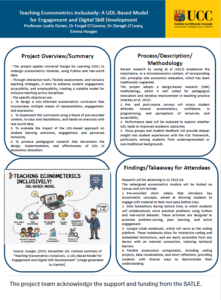
This research poster presents a Universal Design for Learning (UDL) framework for teaching econometrics using Python, Google Colab and Canvas. It highlights inclusive teaching strategies, including mini-hackathons, instructional videos and real-world datasets, aimed at enhancing student engagement, accessibility and digital skills. Intended for edu
An overview of stakeholder feedback that informed the renewed HEA teaching and learning strategy. The report analyses 58 online submissions and a consultation event attended by 46 stakeholders from 28 institutions and organisations, highlighting strategic leadership, funding, professional development and recognition, and collaboration.
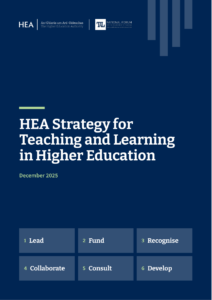
Published in December 2025, the Higher Education Authority’s strategy sets out six priorities for teaching and learning in Irish higher education: Lead, Fund, Recognise, Collaborate, Consult and Develop. Each priority is supported by strategic objectives and high-level actions to guide national policy and teaching and learning enhancement.
This Open Educational Resource (OER) provides a clear, step-by-step infographic explaining how to set up Mastery Paths in Canvas LMS to support personalised learning. Designed for educators and instructional designers, it includes practical setup instructions, examples of differentiated learning pathways, and a QR code linking to a video demonstrat
This Open Educational Resource (OER) provides educators with a practical checklist for designing gamified learning experiences in Canvas. Grounded in Self-Determination Theory, it offers actionable strategies to enhance student motivation, engagement, and participation by supporting autonomy, competence, and relatedness within an inclusive, student-centred learning environment.
A research report by Ciara O’Farrell, Lisa O’Regan and Gerry Gallagher examining how higher education institutions respond to students’ financial pressures, commuting and paid employment, with practical case studies and recommendations for institutional action.
The final report of UCC’s SATLE-funded Smart Support? AI-assisted school placement project. It examines how Professional Master of Education student teachers use generative AI during school placement, how their AI literacy and professional judgement develop, and the implications for teacher education and placement partnerships.
A four-page Active* Consent poster pack from the University of Galway, with two Irish-language posters and their English equivalents. The posters communicate that consent applies across relationships, genders and orientations, and direct readers to ConsentHub for further information.
A Y1Feedback case study describing automated, immediate feedback for novice programmers through Moodle’s Virtual Programming Lab, including implementation lessons and student responses.
A project reflection on using digital technologies to improve first-year feedback, describing early case studies, evaluation findings and implementation challenges.
This case study provides reflections on the WILLOW project at University College Cork (UCC), which is a strategic initiative to reimagine how work-integrated learning (WIL) can be embedded within postgraduate legal education, i.e. for students completing a Masters in Law (LLM) or graduate-entry LLB.
A conference poster paper explaining the Student Success Toolbox approach to digital readiness, flexible-learner transition and the use of eight preparation tools.
A Y1Feedback case study on designing a coherent assessment and feedback approach across a humanities programme, connecting module tasks, programme outcomes and first-year student support.
A research article using the project’s international-student survey to identify preparation needs around academic study, daily life and social adjustment in Ireland.
A conference paper presenting Y1Feedback findings on first-year feedback practice and outlining technology-enabled approaches for strengthening student transition.
This resource supports inclusive teacher education through findings from the PREP-In project. It combines student and professional perspectives, placement portfolio insights, co-created classroom vignettes and practical recommendations. Designed for teacher educators, student teachers, school mentors and SEN professionals.
Unlocking Inclusion: Toolkit for Universal Design in Higher Education, is a practical step-by-step ‘how-to guide’ to assist the higher education sector to create inclusive institutions where all students belong. Predicated on the incremental nature of mainstreaming participation of under-represented students in higher education, this updated Toolkit uses the lens of student diversity to inform and guide the design of an inclusive educational experience that embraces all students equitably.
This technical report accompanies ALTITUDE, the National Charter for Universal Design in Tertiary Education. It explains the rationale for the Charter, its development and consultation process, its strategic enablers and four pillars, and its alignment with international, national and institutional policy. It also provides guidance for adoption and implementation across further and higher education.
Prepared by Dr Joanne Banks with direction and input from the ALTITUDE Working Group. Published by AHEAD Educational Press, 2024.
The purpose of these protocols is to assist student teachers and cooperating teachers in schools to have professional conversations together during regular tutorial meetings. Each document requires the use of GenAI but can generate insights or interactions that would be difficult to emulate in paired discussion.
The HEA’s revised national framework for a whole-campus approach to student mental health, wellbeing and suicide prevention. Organised around Leading, Learning and Nurturing, it sets out stakeholder responsibilities and guidance for implementation, monitoring and evaluation.
Findings from Ireland’s EUROSTUDENT 9 survey of approximately 16,000 students, weighted to reflect the national student population. Covers access, finances, accommodation, employment, study experience, mobility, disability, wellbeing and discrimination.
An edited collection of 11 case studies from across University College Dublin exploring how employability can be developed through work-integrated, experiential and authentic learning. Includes approaches to curriculum design, assessment, reflection, inclusive participation, campus-based projects, professional placements and postgraduate career preparation.
A collection of higher education impact case studies demonstrating approaches to equity of access, participation and student success under the National Access Plan 2022–2028. Features initiatives from Trinity College Dublin, Maynooth University, TU Dublin and South East Technological University, with an appendix summarising all submitted case studies.
This open educational resource supports pre-service teachers in developing practical approaches to social justice in Physical Education. Through visual case studies, reflective prompts, and introductory concepts, it encourages critical reflection, collaborative discussion, and informed decision-making based on authentic school placement experiences
The HEA ESD Self-Evaluation Tool is a voluntary, developmental resource that supports higher education institutions in reviewing and strengthening whole-of-institution Education for Sustainable Development. It helps institutions undertake structured reflection on current strengths, gaps and progression, identify local priorities and plan practical next steps.
The tool is organised around the five ESD to 2030 Priority Action Areas. For each area, it provides developmental descriptors across three broad stages of practice: Emerging, Established and Leading. It is intended to support dialogue, planning and quality enhancement.
This resource sets out five strategic enablers that can support the implementation of Education for Sustainable Development across all areas of a higher education institution:
1. Collaboration and commitment
2. Holistic and transformational practice, scholarship and leadership
3. Capacity-building and professional development
4. Student partnership, engagement and leadership
5. Reciprocal learning communities
The Enablers translate national and international ESD commitments into shared language, strategic direction and practical prompts for higher education. They address curriculum, pedagogy, assessment, campus operations, governance, leadership, professional learning, student partnership, research and reciprocal engagement with communities.
The resource is designed to support institutional reflection, planning and enhancement rather than prescribe a single model. It recognises institutional autonomy, diversity of mission and disciplinary differences.
This overview introduces the Higher Education Authority’s Education for Sustainable Development (ESD) Framework for Higher Education: a connected suite of resources supporting whole-of-institution ESD across Irish higher education. It explains the Framework’s purpose, its relationship to national and international ESD priorities, and how its component resources work together to provide strategic direction, sector evidence, structured reflection, thematic insight and opportunities for peer learning.
The Framework connects curriculum, campus operations, governance, research and community engagement. It is intended for institutional leaders, educators, professional staff, students and representative bodies, ESD and sustainability leads, teaching and learning units, quality and enhancement teams, community partners and policy stakeholders.
This open educational resource provides a step-by-step guide to cataloguing three-dimensional physical objects — primarily material samples — in Koha, the open-source Library Management System.
This report draws on Patricia Gibson’s research around critical approaches to Artificial Intelligence (AI) in Education and the increasing automation of Educational Technologies (EdTech).
This resource was created to share the learning from teaching adults with intellectual disabilities (ID) in IADT college as part of a national suite of pilot projects.
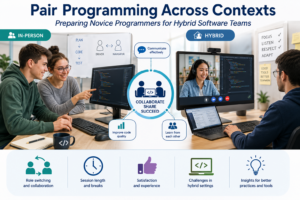
This OER presents findings from a comparative study of novice programmers engaging in face-to-face and hybrid pair programming. It explores collaboration patterns, role switching, satisfaction, and challenges, offering evidence-based insights for educators seeking to prepare students for effective teamwork in modern hybrid software development.
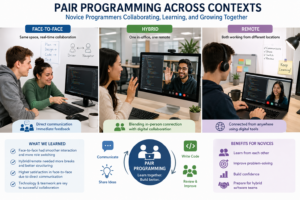
This OER explores novice programmers’ experiences of pair programming across face-to-face, hybrid, and remote settings. It provides insights into collaboration, role switching, satisfaction, and challenges, helping educators and students understand how to effectively prepare learners for modern hybrid software development environments.
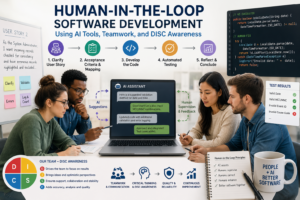
This OER guides students through human-in-the-loop software development, demonstrating how AI tools can be effectively supervised, refined, and integrated across the Software Lifecycle. Designed for computing educators and learners, it combines agile practice, teamwork, DISC awareness, testing, and critical reflection on human–AI collaboration.
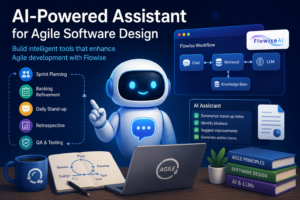
This OER introduces students to designing and developing AI-powered assistants for agile software development using Flowise (no code). Learners as a team explore Retrieval Augmented Generation (RAG) and agent-based systems, applying AI to real-world agile practices while considering technical design, evaluation, and cost-aware decision-making
A background paper by Professor Marie Clarke examining future challenges and strategic considerations for Irish higher education. Reviews global megatrends, future scenarios, changing work patterns, research, demographic change, financial sustainability and policy development to inform strategic discussion and consultation.
An independent mid-term review of Ireland’s National Access Plan 2022–2028, examining progress towards equity of access, participation and student success. Includes achievements, implementation challenges, national targets and indicators, recommendations and an implementation plan.
The May 2026 report of the HEA Policy Forum on Student Progression in Higher Education. Summarises the Forum’s programme of work, findings from its working groups, the development of good-practice exemplars, and recommendations for institutions, the sector and the HEA.
Enhancing Student Engagement and Belonging through Collaborative Partnership is a Higher Education Authority report prepared by a UCD research team led by Professor Barbara Dooley. The resource provides an evidence-informed framework for strengthening student belonging across Irish higher education institutions. Drawing on staff interviews, Healthy Campus survey responses, and analysis of Healthy Campus and NStEP case studies, it identifies practical approaches to improving student engagement, wellbeing and inclusion.
The report frames belonging as a multidimensional and co-constructed experience shaped by social, academic, personal and environmental factors. It highlights that student belonging is affected not only by relationships and participation, but also by structural issues such as housing, commuting, financial pressure, campus spaces, timetable design and access to supports.
The resource is particularly useful for staff and student partners working on Healthy Campus, student success, student engagement, access, inclusion, mental health promotion, orientation, peer support, student partnership and campus development initiatives.
This project presents an innovative engineering assessment framework integrating generative AI through a poster portfolio, AI reflection, and oral interview. It supports critical thinking, validation skills, and ethical AI use, and is designed for undergraduate engineering educators and students in project-based learning contexts.
Purpose of the MTU Student Guidelines
Supports Academic Integrity Principles and MTU’s Academic Integrity Policy by:
1. Explaining what academic integrity is.
2. Helping students avoid bad decisions during assessments.
3. Outlines and signposts supports available across MTU
The work presented in this practice paper illustrates how the use of immersive 360o
video and photographs, viewed in virtual reality headsets or via 360o media players,
can enhance and broaden student knowledge and experience when undertaking
Project Based Learning (PBL) assignments.
The resource comprises of a literature review and an executive summary, developed as part of the Maynooth University Leadership and EducAtion Framework (LEAF) initiative. It explores how education frameworks can enhance teaching, learning and curriculum design in higher education, supporting inclusive, sustainable and values-led academic practice.
This resource describes the rational for, design of and implementation details associated with an initiative designed to support early career academic staff adopt evidence-based, active and inclusive learning strategies to enhance learning for ALL students.
This guideline document seeks to support the implementation of MTU policies and procedures which underpin Academic Integrity and help to address the implications of Generative Artificial Intelligence on assessment practices.
This landscape report provides an overview of Education for Sustainable Development (ESD) practice across the higher education sector in Ireland. It draws together publicly available institutional strategies, HEA Performance Framework Agreements 2024–2028, Climate Action Roadmaps and ESD to 2030 progress reports to outline current approaches to embedding ESD.
Structured as a series of institutional case studies, the report highlights how ESD is being addressed across teaching and learning, research, engagement and whole-institution practice, and identifies opportunities for collaboration and shared learning across the sector.
Reimagining Assessment & Feedback Together (RAFT) is MTU initiative developed to transforming assessment practices. This volume documents twenty-four situated, discipline-specific attempts to rethink assessment and feedback through student partnership and action research.
This discussion paper explores how student success in higher education is understood, defined and supported in contemporary Irish and international contexts. It brings together international research, national policy and insights from student focus groups conducted in Ireland in 2025 to examine success beyond traditional metrics such as retention, progression and completion.
The paper presents a holistic and relational view of student success, foregrounding belonging, mattering, agency and wellbeing alongside academic and outcomes-based measures. It situates student success as simultaneously student-defined, institution-enabled and outcomes-oriented, and considers the implications of this framing for teaching, learning, policy and system-level practice.
This report presents findings from the HEA Student Success Survey 2025, capturing how students across Ireland define, experience and achieve success in higher education. Based on responses from over 3,400 students across publicly funded higher education institutions, it provides a national, student-centred perspective on success.
The report explores students’ definitions of success, the supports and enablers that help them thrive, and the barriers that can hinder progress. It highlights the relational and holistic nature of student success, encompassing academic achievement alongside well-being, belonging, personal growth and future readiness.
This document sets out a detailed, values-led framework to support the ethical adoption of generative artificial intelligence (gen AI) in teaching and learning across Irish higher education. It builds on the HEA Generative AI Policy Framework by translating high-level principles into concrete provisions to guide institutional policy, governance and educational practice.
The principles address five core areas: academic integrity, equity and inclusion, critical engagement and AI literacy, privacy and data governance, and sustainable pedagogy. Together, they provide institutions with a practical reference for navigating the ethical, pedagogical and organisational challenges associated with generative AI, while safeguarding academic standards, student rights and institutional autonomy.
This policy framework provides national guidance for the responsible and values-based use of generative artificial intelligence (gen AI) in teaching and learning within Irish higher education. It is designed to support educators, academic leaders and professional staff in making informed decisions about the adoption and integration of gen AI technologies in educational practice.
The framework focuses specifically on teaching and learning, addressing issues such as academic integrity, assessment design, equity and inclusion, AI literacy, privacy and data governance, and sustainable pedagogy. It sets out five core principles to guide institutional policy development and practice, while allowing for local adaptation and institutional autonomy.
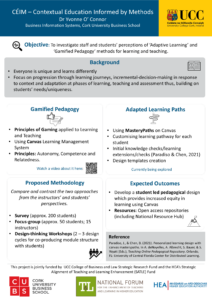
This poster offers educators an overview of designing a syllabus on the Canvas learning management system that supports personalised learning pathways. It highlights (1) a gamified pedagogy grounded in gaming principles and (2) adaptive learning strategies using MasteryPaths.
The HEA-published December 2025 version of Rick Dakan and Joseph Feller’s AI Fluency Framework (version 1.1). It presents a model of effective, ethical and safe human-AI interaction, organised around Delegation, Description, Discernment and Diligence, and examines automation, augmentation and agency.
Policy guidance exploring the implications of the EU AI Act for generative AI in Irish higher education teaching and learning. It considers institutions’ roles in procuring, deploying and developing AI systems, and the relationship between educational practice, transparency, institutional accountability and vendor governance. This December 2025 publication is policy guidance rather than legal advice.
Guidance on students’ responsibilities for ethical and transparent generative AI use in higher education. It addresses authorship and disclosure, responsibility for submitted work, engagement with AI literacy, differences between assessment contexts and student participation in institutional policy development.
Guidance for libraries, teaching and learning centres, disability and access services, academic integrity offices and other academic support units. It describes their role in coordinated AI literacy provision, equitable access, resource curation, student guidance and feedback into institutional governance.
Guidance on designing assessments that remain meaningful and credible in the presence of generative AI. It advocates assessment resilience through evidence of learning, process, contextual reasoning and reflective judgement, while considering academic integrity and the limitations of AI-detection-led approaches.
Guidance on teaching staff responsibilities for generative AI in curriculum design, assessment and academic practice. It addresses clear assessment-level expectations, informed professional judgement, ongoing AI literacy and transparent use of AI in teaching.
Guidance for institutional leadership teams on accountable, values-led generative AI adoption. It addresses governance structures, sustained investment, policy coherence, academic freedom and transparent institutional oversight.
An evidence review underpinning the HEA national policy framework for generative AI in teaching and learning. It brings together international policy, regulatory guidance and research to examine academic integrity, assessment, equity, AI literacy, governance and the wider implications of generative systems.
Recommendations for designing institutional AI literacy programmes for staff and students. The guidance combines technical understanding with ethical judgement and outlines learning outcomes, practical application, disciplinary relevance and arrangements for maintaining training as technologies and policies change.
Guidance on the complementary responsibilities of IT services and data protection officers in institutional generative AI governance. It covers secure infrastructure, approved tools, privacy by design, impact assessment, auditability, procurement and coordination with academic decision-making.
A governance guide for procuring, piloting and managing generative AI tools used in teaching, assessment and student support. It sets out responsibilities across academic governance, procurement, IT, data protection and accessibility, with attention to educational purpose, vendor evidence, institutional risk and ongoing review.
In 2018, the Glucksman Library at the University of Limerick launched Leganto, a reading list management tool designed to streamline access to academic resources for students. Leganto ensures equitable access to academic content, helping students engage with reliable sources and easing their transition into university-level study.
This case study collection presents an interdisciplinary University College Dublin initiative exploring how key competencies for Education for Sustainable Development (ESD) can be embedded in higher education teaching, learning and assessment. It introduces UNESCO’s sustainability competencies alongside metacognitive development and the I-SEE learning strategies: Introducing, Signposting, Enabling and Evaluating.
Four detailed case studies demonstrate how these approaches have been applied in clinical nutrition and dietetics, education, rural placemaking and public health nutrition. Using student-centred, collaborative, action-oriented and critically reflective approaches, the case studies engage learners with authentic, real-world problems. Each includes information on its context, intended learning outcomes, teaching and assessment strategies, impact and practical lessons, demonstrating how ESD can be made relevant across a wide range of disciplines, including subjects not traditionally associated with sustainability.
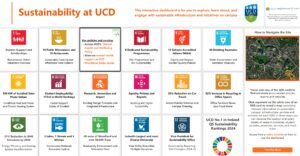
This scientific paper describes the co-creation of the UCD sustainability dashboard – the first transferable template to support geographically-specific SDG monitoring within HEIs. This paper contributes to debates on the need for spatial reporting of actions towards sustainability, to meaningfully recognise local SDG implementation progress.
The Manifesto for Generative AI in Higher Education is a living resource for educators, students, and institutions. It invites reflection and dialogue across thirty statements exploring teaching, ethics, and imagination – helping higher education navigate AI with curiosity, integrity, and humanity.