AI-Supported Software Development: A Human-in-the-Loop Approach

[favorite_button]

Creator(s) (alphabetical)

Mary Giblin, Sheila Fallon

Organisation(s)

Technological University of the Shannon

Discipline(s)

Information and Communication Technologies

Topic(s)

Assessment and Feedback, Digital Learning, Learning Analytics

License

CC BY-NC

Media Format

PDF

Date Submitted

Submitted by

Export Resource Data

Description

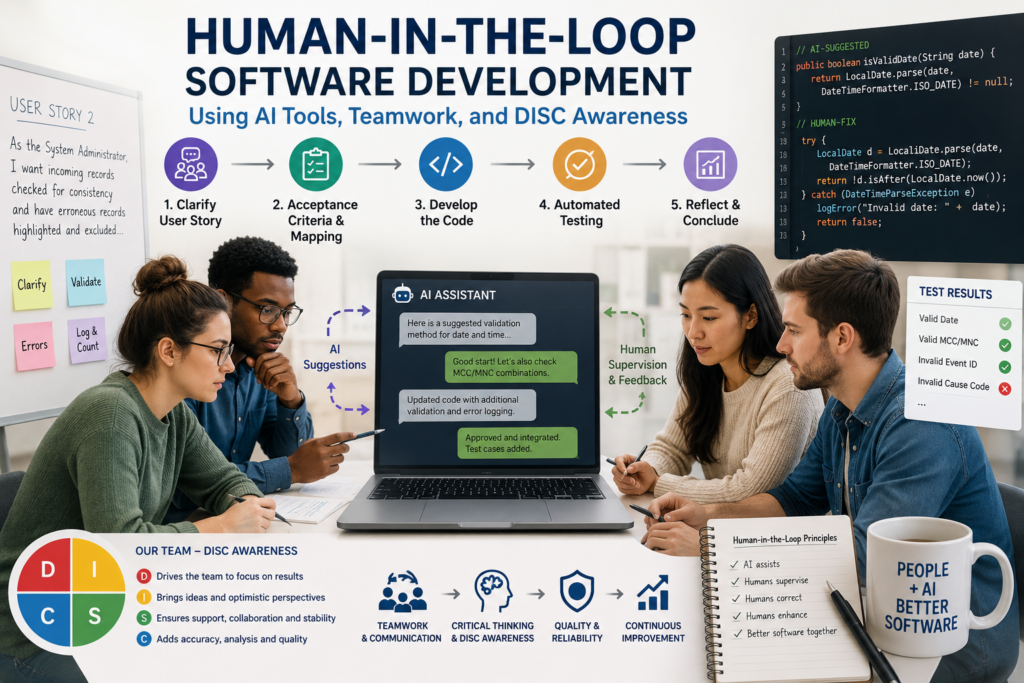
This OER guides students through human-in-the-loop software development, demonstrating how AI tools can be effectively supervised, refined, and integrated across the Software Lifecycle. Designed for computing educators and learners, it combines agile practice, teamwork, DISC awareness, testing, and critical reflection on human–AI collaboration.

Benefit of this resource and how to make the best use of it


This resource helps learners develop a critical understanding of how generative AI can be used responsibly and effectively throughout the software development lifecycle. Rather than treating AI as an autonomous solution, it emphasises the importance of human judgement, supervision, and collaboration in evaluating, refining, and improving AI-generated outputs. Students learn not only how to use AI tools to support software engineering tasks, but also when to challenge, correct, or reject AI suggestions.

A key benefit of the resource is its authentic, practice-based approach. Learners engage with a realistic software development scenario in which they clarify requirements, develop acceptance criteria, implement code, generate automated tests, and reflect on the role of AI in professional practice. By documenting instances where humans intervened to improve AI outputs, students develop critical thinking, debugging skills, ethical awareness, and confidence in exercising professional judgement. The inclusion of DISC personality reflection further encourages self-awareness, helping learners understand how different working styles influence teamwork, decision-making, testing approaches, and responses to AI recommendations.

In academic settings, this OER can be integrated into undergraduate or postgraduate modules in software engineering, agile development, requirements engineering, software testing, artificial intelligence, or professional practice. Educators may adopt it as a group assignment, capstone project, laboratory activity, or authentic assessment focused on responsible AI use. The structured stages of the assignment allow instructors to scaffold learning progressively, enabling students to experience the full cycle of human–AI collaboration.

Academic developers and instructional designers can adapt the resource to suit different contexts and levels of study. For example, introductory computing courses may focus on user story clarification and acceptance criteria, while advanced modules may emphasise AI-assisted coding, testing strategies, and critical evaluation of AI-generated artefacts. The DISC reflection activities can also be modified to support team formation, peer feedback, and discussions around inclusive collaboration.


Creative Commons Attribution-NonCommercial (CC BY-NC)

This work is licensed under a CC BY-NC license, permitting sharing and adaptation for non-commercial purposes with proper attribution.

https://creativecommons.org/licenses/by-nc/4.0/
? This citation is automatically generated and may require adjustment. Always verify it against your style guide.
Giblin, M., & Fallon, S. (2026). Ai-supported software development: a human-in-the-loop approach. National Resource Hub (Ireland). Retrieved from: https://hub.teachingandlearning.ie/resource/ai-supported-software-development-a-human-in-the-loop-approach/ License: Creative Commons Attribution-NonCommercial (CC BY-NC).

Adapting this resource? Share your version!

If you have modified or adopted this resource, share your version here. Tracking adaptations helps us measure impact and connects others with useful updates.

Related OER

This OER explores novice programmers’ experiences of pair programming across face-to-face, hybrid, and remote settings. It provides insights into collaboration, role switching, satisfaction, and challenges, helping educators and students understand how to effectively prepare learners for modern hybrid software development environments.

This OER introduces students to designing and developing AI-powered assistants for agile software development using Flowise (no code). Learners as a team explore Retrieval Augmented Generation (RAG) and agent-based systems, applying AI to real-world agile practices while considering technical design, evaluation, and cost-aware decision-making

As part of this project small workshops in linear algebra where held both nationally and internationally. The main workshop website is https://sites.google.com/view/tusdcu-linearalgebraworkshop/home

A one day workshop to help bring together early stage researchers to learn and discuss topics in Linear algebra.