Learning Social Justice in Physical Education through Visual Case Studies

[favorite_button]

Creator(s) (alphabetical)

Antonio Calderón, Briguitte Moody, Carmen Barquero-Ruiz, Ursula Freyne

Organisation(s)

Universidad de Murcia, University of Limerick

Discipline(s)

Education

Topic(s)

Education for Sustainable Development (ESD)

License

CC BY-NC-SA

Media Format

PDF

Date Submitted

Submitted by

Export Resource Data

Description

This open educational resource supports pre-service teachers in developing practical approaches to social justice in Physical Education. Through visual case studies, reflective prompts, and introductory concepts, it encourages critical reflection, collaborative discussion, and informed decision-making based on authentic school placement experiences

Benefit of this resource and how to make the best use of it

This resource is designed to support teacher educators in facilitating meaningful discussions about social justice with pre-service teachers through a structured, inquiry-based approach. The visuals are intended to act as catalysts for dialogue rather than provide predetermined answers, encouraging participants to question assumptions, consider multiple perspectives, and collaboratively develop responses to authentic (real based) professional dilemmas.

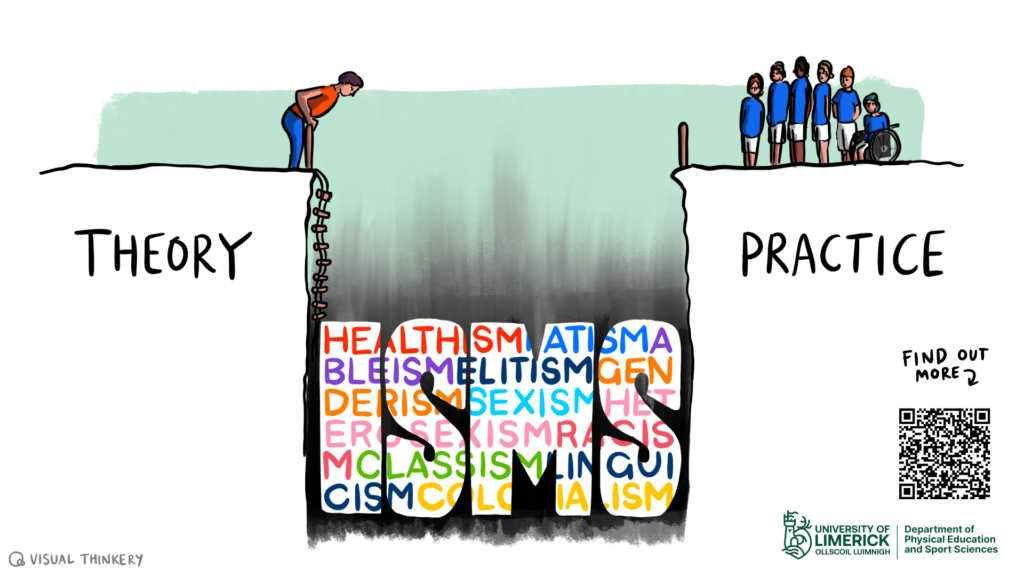
For the best learning experience, the resource should be used sequentially. Begin with the green-background “Setting the Scene visuals” to establish a shared understanding of key concepts, such as isms, privilege and intersectionality. Next, use the blue-background “Self-Reflection visuals” to prompt learners to critically examine their own identities, values, experiences, and potential biases before engaging with complex classroom situations. Finally, introduce the yellow-background “Case Studies visuals”, where small groups analyse authentic scenarios from Irish Physical Education, discuss the accompanying prompts, and consider possible courses of action. These discussions should be followed by a facilitated whole-group debrief in which participants compare perspectives, justify their decisions, and reflect on the implications of different responses for socially just teaching practice.

Each visual includes a QR code that links to an specific site of the project website where users can access the theoretical background and the complete case study. In the website they can also find additional background information, guiding questions, and related resources created by pre-service teachers.

Although the case studies are situated within the Irish Physical Education context, the visual format and pedagogical structure can also serve as a template for teacher educators wishing to design their own context-specific scenarios and discussion prompts. The resource is particularly well suited to university seminars, school placement preparation or professional learning workshops, that aim to bridge theory and practice through collaborative dialogue and critical reflection.


Creative Commons Attribution-NonCommercial-ShareAlike (CC BY-NC-SA)

This work is licensed under a CC BY-NC-SA license, allowing sharing and adaptation for non-commercial use with proper attribution, provided derivative works use the same license.

https://creativecommons.org/licenses/by-nc-sa/4.0/
? This citation is automatically generated and may require adjustment. Always verify it against your style guide.
Calderón, A., Moody, B., Barquero-Ruiz, C., & Freyne, U. (01/05/2025). Learning social justice in physical education through visual case studies. National Resource Hub (Ireland). Retrieved from: https://hub.teachingandlearning.ie/resource/learning-social-justice-in-physical-education-through-visual-case-studies/ License: Creative Commons Attribution-NonCommercial-ShareAlike (CC BY-NC-SA).

Adapting this resource? Share your version!

If you have modified or adopted this resource, share your version here. Tracking adaptations helps us measure impact and connects others with useful updates.

Related OER

The HEA ESD Self-Evaluation Tool is a voluntary, developmental resource that supports higher education institutions in reviewing and strengthening whole-of-institution Education for Sustainable Development. It helps institutions undertake structured reflection on current strengths, gaps and progression, identify local priorities and plan practical next steps.
The tool is organised around the five ESD to 2030 Priority Action Areas. For each area, it provides developmental descriptors across three broad stages of practice: Emerging, Established and Leading. It is intended to support dialogue, planning and quality enhancement.

This resource sets out five strategic enablers that can support the implementation of Education for Sustainable Development across all areas of a higher education institution:

1. Collaboration and commitment
2. Holistic and transformational practice, scholarship and leadership
3. Capacity-building and professional development
4. Student partnership, engagement and leadership
5. Reciprocal learning communities

The Enablers translate national and international ESD commitments into shared language, strategic direction and practical prompts for higher education. They address curriculum, pedagogy, assessment, campus operations, governance, leadership, professional learning, student partnership, research and reciprocal engagement with communities.

The resource is designed to support institutional reflection, planning and enhancement rather than prescribe a single model. It recognises institutional autonomy, diversity of mission and disciplinary differences.

This overview introduces the Higher Education Authority’s Education for Sustainable Development (ESD) Framework for Higher Education: a connected suite of resources supporting whole-of-institution ESD across Irish higher education. It explains the Framework’s purpose, its relationship to national and international ESD priorities, and how its component resources work together to provide strategic direction, sector evidence, structured reflection, thematic insight and opportunities for peer learning.

The Framework connects curriculum, campus operations, governance, research and community engagement. It is intended for institutional leaders, educators, professional staff, students and representative bodies, ESD and sustainability leads, teaching and learning units, quality and enhancement teams, community partners and policy stakeholders.