Via the lens of graduate attribute development this toolkit highlights best examples of employability activities for higher education curriculum. Designed to enhance employability skills development as class activities and module assessments, namely via the Employability Superfoods, lecturers can enhance students’ employability learning with ease.
Benefit of this resource and how to make the best use of it
Our Award-Winning Embedding Employability Toolkit has been designed to help you, the lecturer, create curricula beneficial to graduates’ employment health. Much like a nutrient-rich superfood considered to be especially beneficial for health and well-being, the 20+ Employability Superfoods activities developed for this toolkit will help you present a curriculum that is agile and adaptive to labour market trends and contemporary workplace requirements.
How to Use Superfoods:
The Employability Superfoods outline detailed stepwise workings, resources and downloads to ensure your preparation time is minimum when deciding to embed employability into curricula. Resources relate to links, library documents, and searchable and downloadable documents, webpages or videos. What’s more, they will show you how to embed employability via the lens of graduate attribute development in readily accessible and fun ways.
You may draw on the Employability Superfoods as classroom activities, assessments, and work-integrated learning preparation. The Employability Superfoods perform as templates to inspire you to adapt to the subject-specific knowledge required of your module and programme.
The Employability Superfoods are connected to our graduate attribute capstones and sub-attributes via our capstones: Practical, Communicative, Collaborative and Confident. At DkIT we have consulted a wide range of stakeholders and the consensus is that when twinned with innovative pedagogy, these graduate-attribute initiatives produce outstanding graduate employees.
Interactive Tools:
A set of employability tools are included in the toolkit. You may download the following interactive aids to help your workings: the 10-dot Matrix to measure employability embedding for an activity or assessment, and module; a Lecturer’s Graduate Attribute Tracker; a Career Guidance Counsellor’s tool set; and two Student Graduate Attribute Workbooks to aid you and your students in assessing how your learning outcomes and assessments enhance the development of capstone and sub-attributes more specific to employability. Indeed, the graduate attribute tracker may be directed for use for upcoming programme reviews.
We hope you enjoy the benefits of this toolkit and would encourage you to share your thoughts with our Community of Practice contacts that you’ll find there.
*AHECS 2022 National Award Winner – ‘Supporting Student & Graduate Employability’
?
This citation is automatically generated and may require adjustment. Always verify it against your style guide.
Staunton, C. (2022). Embedding employability toolkit: superfoods to boost your curriculum’s employability in higher education. National Resource Hub (Ireland). Retrieved from: https://hub.teachingandlearning.ie/resource/embedding-employability-toolkit-superfoods-to-boost-your-curriculums-employability-in-higher-education/ License: Creative Commons Attribution-NonCommercial (CC BY-NC).
Adapting this resource? Share your version!
If you have modified or adopted this resource, share your version here. Tracking adaptations helps us measure impact and connects others with useful updates.
This is an interactive multimedia open educational resource (OER), created using H5P, on the topic of Open Education. It has been developed by the Department of Technology Enhanced Learning at Munster Technological University.
The purpose of which is to give an overview of OEPs, using interactive features of H5P
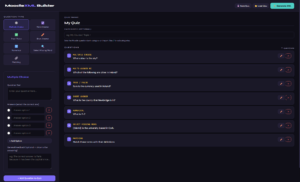
The purpose of this resource is to allow Moodle teachers to quickly create quizzes for Moodle. Users can quickly select between questions types through a single interface and export their questions as an XML file which can be imported into Moodle.
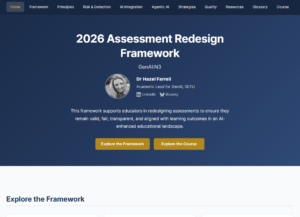
This OER presents an updated Assessment Redesign Framework for higher education in the age of GenAI. It supports educators and programme teams in designing valid, transparent, and scalable assessments, integrating AI literacy, process-focused approaches, and guidance on AI detection, large cohorts, and emerging agentic AI challenges.
This Pressbook features an interactive tool that helps you plan and structure your essay step by step. The book provides a clear starting point to reduce stress, prevent overwhelm, and support different learning preferences through examples, , quick guides, and PowerPoint videos with voiceover. This resource is a living document.