This seminar presented an overview of current policy, research and practice relating to student wellbeing in higher education and how the curriculum can be leveraged to enhance wellbeing. It showcased a range of innovative curricular wellbeing initiatives in UCC and MTU.
Benefit of this resource and how to make the best use of it
Concern for the increased levels of student mental ill health, mental distress and low wellbeing has been recognised nationally and internationally (Higher Education Authority, 2020; Worsley, Pennington & Corcoran, 2020; Thorley, 2017; USI, 2019), not least because it is known that three-quarters of all mental illnesses begin by the mid-20s (Kessler et al., 2005 as cited in Higher Education Authority, 2020). Poor mental health and wellbeing can affect students’ academic performance and desire to remain in higher education (Duffy et al., 2019). Against this backdrop, primary prevention and promotion of positive mental health is now widely accepted (Work Research Centre/LSE, 2017).
Hughes (2019) makes the case that the curriculum is the only guaranteed point of contact between a university and its students. As such, curricular approaches to wellbeing should be considered (Houghton & Anderson, 2017; Hill, Farrelly, Clarke & Cannon, 2020), while acknowledging that this is complex (Ecclestone, 2019). Staff (Hughes, Panjwani, Tulcida & Byrom, 2018) and students’ perspectives (Baik, Larcombe & Brooker, 2019) should inform such developments.
It is intended that the sharing of resources and information between HEIs, arising from this seminar, will lead to increased knowledge of curricular approaches to student wellbeing and in turn lead to improved mental health promotion and prevention across higher education.
This work is licensed under a CC BY-NC-ND license, permitting redistribution for non-commercial use with proper attribution but prohibiting modifications.
?
This citation is automatically generated and may require adjustment. Always verify it against your style guide.
Hunt, E., & O'Mahony, J. (2022). Curricular approaches to wellbeing in higher education. National Resource Hub (Ireland). Retrieved from: https://hub.teachingandlearning.ie/resource/curricular-approaches-to-wellbeing-in-higher-education/ License: Creative Commons Attribution-NonCommercial-NoDerivatives (CC BY-NC-ND).
Adapting this resource? Share your version!
If you have modified or adopted this resource, share your version here. Tracking adaptations helps us measure impact and connects others with useful updates.
This is an interactive multimedia open educational resource (OER), created using H5P, on the topic of Open Education. It has been developed by the Department of Technology Enhanced Learning at Munster Technological University.
The purpose of which is to give an overview of OEPs, using interactive features of H5P
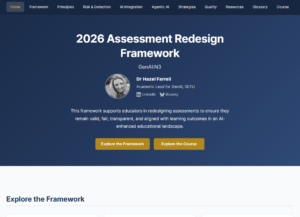
This OER presents an updated Assessment Redesign Framework for higher education in the age of GenAI. It supports educators and programme teams in designing valid, transparent, and scalable assessments, integrating AI literacy, process-focused approaches, and guidance on AI detection, large cohorts, and emerging agentic AI challenges.
This Pressbook features an interactive tool that helps you plan and structure your essay step by step. The book provides a clear starting point to reduce stress, prevent overwhelm, and support different learning preferences through examples, , quick guides, and PowerPoint videos with voiceover. This resource is a living document.
Purpose of the MTU Student Guidelines
Supports Academic Integrity Principles and MTU’s Academic Integrity Policy by:
1. Explaining what academic integrity is.
2. Helping students avoid bad decisions during assessments.
3. Outlines and signposts supports available across MTU