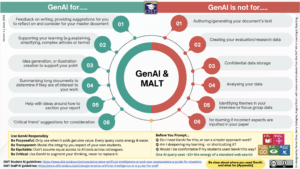
A 1-page guide, co-created by lecturers, tutors & students on DkIT's MA in Learning and Teaching, showing where GenAI can, and can't, support particular postgraduate research/skill development (*reflecting practice 2025-26). Includes student-informed prompts on responsible, sustainable use. An editable PowerPoint supports adaptation to own context.
Ireland’s Higher Education Authority (HEA) has been working with the sector to move from immediate responses to generative AI towards a more shared understanding of its implications for teaching and learning. This includes how students learn, how educators teach and how institutions approach assessment, integrity and inclusion. The HEA has brought together student representatives, staff, institutional leaders and wider stakeholders to consider how GenAI is influencing teaching, learning and assessment and what kinds of support, guidance and shared understanding are needed.
Speaker
Colin Lowry is Senior Manager for Teaching and Learning, Enhancement and Digital Innovation at Ireland’s Higher Education Authority. His work spans digital transformation, artificial intelligence, open education, professional development and education for sustainable development. He contributes to national teaching and learning initiatives, including Ireland’s National Resource Hub for Open Educational Resources, OpenCourses.ie and related professional development and recognition programmes. Colin has been closely involved in the Ireland’s national response on generative AI in higher education, supporting sectoral consultation, evidence-informed guidance and national dialogue on its implications for teaching, learning and assessment. His previous work includes research on technology acceptance and advisory roles in digital strategy, service design, change management and technology adoption.
The video examines the impact of digital technology on the wellbeing of children and young people. It highlights ethics and legislation relating to social media platforms and Gen AI. It will be of interest to educators in third level, adult education and older school children. Content warning: it includes references to upsetting examples.
Practical self-paced lesson introducing effective prompt writing techniques for students new to genAI tools. Covers prompt structure, iteration, critical evaluation of output, and ethical considerations. Teaches effective genAI communication techniques. Primary intended audience is university students.
An interactive, beginner-level, asynchronous resource designed to equip students with foundational knowledge on genAI ethics, applications, and academic use. It covers genAI fundamentals, responsible use, academic integrity considerations, and practical scenarios. The primary intended audience is university students.
The University of Limerick Academic Integrity and GenAI toolkit is a curated suite of resources developed to support ethical academic practices in the evolving landscape of Generative AI.
The report – Generative AI in Higher Education Teaching and Learning: Sectoral Perspectives – was commissioned as part of the Higher Education Authority’s evidence-led approach to policy development.
The report captures the views of staff, students, and leaders across the Irish higher education system on the opportunities and challenges posed by artificial intelligence.
It brings together insights from ten thematic focus groups and a leadership summit, involving over 80 participants from across Ireland’s higher education institutions, alongside student representatives and sectoral stakeholders.
This GenAI Learning Hub was developed with students, for students, to support the responsible and effective use of generative AI. Topics are divided across three main sections to aid understanding of GenAI before use, during use, and in relation to assessment. While aimed at students, this resource will be useful to anyone using GenAI.
This 12 lesson open course provides an introduction to the AI Fluency Framework and the four competencies of Delegation, Description, Discernment, and Diligence. c. 70 mins videos plus ungraded exercises & projects and reference handouts. Co-developed by University College Cork, Ringling College and Anthropic with support by HEA.
While Generative AI technologies have existed for many years, recent rapid advances in the field have pushed these technologies into mainstream use across society. As higher education institutions grappled with these new technologies, initial responses focused on potentially significant threats to academic integrity. However, as our understandings have evolved, there is an increasing awareness that these developing technologies also present opportunities for teaching, learning, assessment and research in higher education.
Against this rapidly evolving backdrop, we in the Centre for Academic Practice (Trinity College Dublin) found ourselves faced with new challenges. How could we best support our educators to respond to the challenges of GenAI? How might we influence and support strategic initiatives and policy development regarding GenAI for teaching, learning and assessment at the institutional level? Conscious that our colleagues across the sector were facing similar challenges, we decided to initiate a cross-institutional collaboration with teaching and learning leaders from across the sector, where we could tackle this together!
This online tutorial introduces the fundamentals of Generative AI and LLMs, explaining their functionality, capabilities, and limitations. It explores key applications, ethical considerations, and practical examples, providing learners with a foundational understanding of how these technologies impact education and creativity.
This project website aims to support students and teaching staff in UCD College of Arts and Humanities in navigating teaching, learning and assessment in the context of new developments in generative AI (e.g. OpenAI’s ChatGPT and Google Gemini).