Curricular approaches to well-being are important and impactful, as universal supports for all students. This OER is a padlet of resources and talks from the April 2024 jointly hosted UCC and MTU seminar on this critical area for teaching and learning enhancement in Irish higher education.
Benefit of this resource and how to make the best use of it
The curriculum is the only guaranteed point of contact between a university and its students (Hughes, 2018). Therefore, curricular approaches to well-being are particularly important and impactful, as universal supports for all students. These include both explicit curricular and co-curricular content and broader teaching and learning approaches and structures, for both undergraduate and postgraduate students.
Within and across higher education institutions, collaboration is critical to avoid unnecessary duplication of resources and expertise, and the voices of staff and students are essential.
This seminar aligned with university policies on student success and healthy campuses and national and international priorities and brought together academic and professional services staff, student representatives and policy makers with a range of contributions from national and international speakers, including:
• Professor Cate Denial, Bright Distinguished Professor of American History and Director of the Bright Institute at Knox College in Galesburg, Illinois, USA
• Professor Peter Felten, Executive Director Center for Engaged Learning, Elon University, North Carolina, USA
• Dr. Ross Woods, Senior Manager, Teaching and Learning, Student Success, Health and Wellbeing, Higher Education Authority (HEA)
• Ms Caroline Mahon, National Healthy Campus Coordinator, Higher Education Authority
Building on our previously funded seminar NSS83UCC2021 Curricular Approaches to Wellbeing in Higher Education (May 2022), this 2024 seminar launched a national learning community on this important area for teaching and learning enhancement in Irish higher education. This learning community is one of the special interest groups within the newly formed Student Mental Health Research Network, affiliated with the Irish Research Council SFI-IRC Pathways Programme funded Student Mental Health and Wellbeing on the Island of Ireland U-Well Study.
This work is licensed under a CC BY-NC-ND license, permitting redistribution for non-commercial use with proper attribution but prohibiting modifications.
?
This citation is automatically generated and may require adjustment. Always verify it against your style guide.
Hunt, E., & Mahony, J. O. (2024). Embedding wellbeing in the curriculum – establishing a national learning community. National Resource Hub (Ireland). Retrieved from: https://hub.teachingandlearning.ie/resource/embedding-wellbeing-in-the-curriculum-establishing-a-national-learning-community/ License: Creative Commons Attribution-NonCommercial-NoDerivatives (CC BY-NC-ND).
Adapting this resource? Share your version!
If you have modified or adopted this resource, share your version here. Tracking adaptations helps us measure impact and connects others with useful updates.
This is an interactive multimedia open educational resource (OER), created using H5P, on the topic of Open Education. It has been developed by the Department of Technology Enhanced Learning at Munster Technological University.
The purpose of which is to give an overview of OEPs, using interactive features of H5P
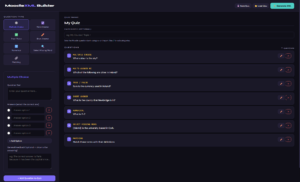
The purpose of this resource is to allow Moodle teachers to quickly create quizzes for Moodle. Users can quickly select between questions types through a single interface and export their questions as an XML file which can be imported into Moodle.
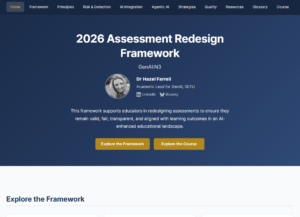
This OER presents an updated Assessment Redesign Framework for higher education in the age of GenAI. It supports educators and programme teams in designing valid, transparent, and scalable assessments, integrating AI literacy, process-focused approaches, and guidance on AI detection, large cohorts, and emerging agentic AI challenges.
This Pressbook features an interactive tool that helps you plan and structure your essay step by step. The book provides a clear starting point to reduce stress, prevent overwhelm, and support different learning preferences through examples, , quick guides, and PowerPoint videos with voiceover. This resource is a living document.