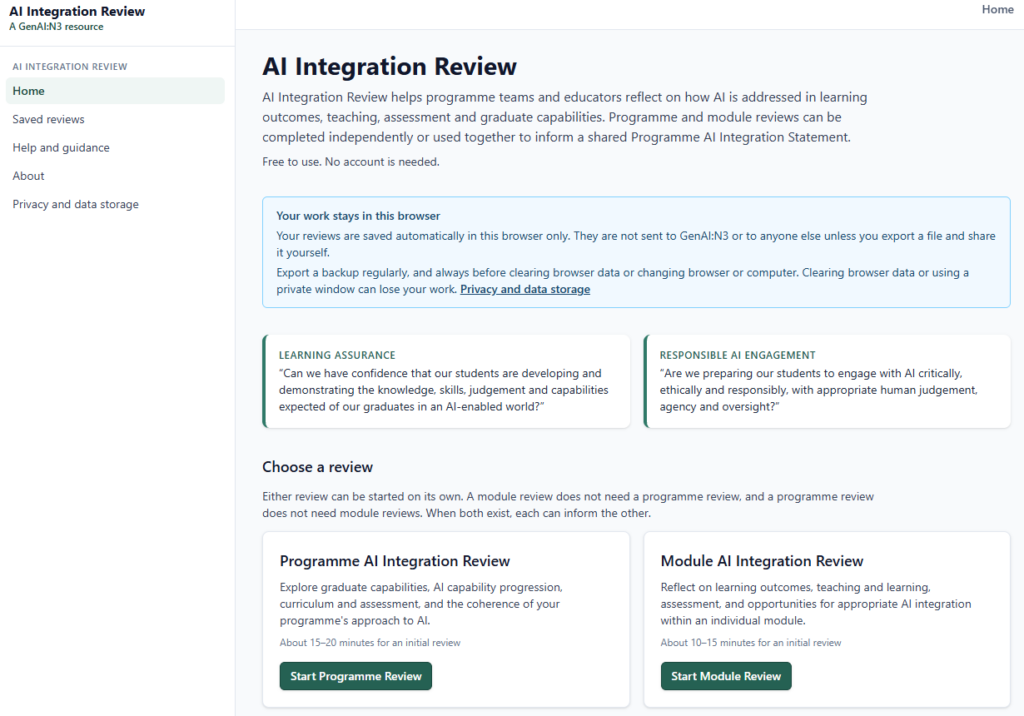
The AI Integration Review (AIR) is a free, web-based resource developed by GenAI:N3 to help educators and programme teams critically examine and plan how generative AI is integrated into higher education curricula. It provides structured, guided reviews at both module and programme level, supporting informed decisions about learning outcomes, teaching approaches, assessment practices and graduate capabilities.
How the resource can be used
At module level, educators can review how generative AI relates to their learning outcomes, teaching and learning activities, and assessment strategies. Guided questions encourage consideration of where AI use may be appropriate, how it might support student learning, and where changes to existing practices may be needed.
At programme level, teams can take a broader view, examining the AI capabilities graduates should develop, how these capabilities progress throughout a programme, and whether teaching and assessment approaches are coherent across modules. The review helps identify gaps, duplication and opportunities for more purposeful integration.
A particularly valuable feature is the connection between programme and module reviews. Programme teams can share priorities and questions with module coordinators, while module teams can contribute their findings to the wider programme review. This supports collaboration and helps ensure that decisions about AI integration are not made in isolation.
From review to action
AIR supports the development of a Programme AI Integration Statement, drawing on the findings of the programme review. This editable statement provides a way for programme teams to articulate their shared approach to generative AI, document their decisions and identify priorities for further development.
Benefits for educators and institutions
The resource supports curriculum development, programme review, assessment redesign and academic professional development. It can be used independently by lecturers, collaboratively by programme teams, or as part of facilitated workshops led by academic developers and instructional designers.
AIR encourages a considered, discipline-sensitive approach rather than prescribing particular technologies or assuming that generative AI should be used in every learning activity. Its focus is on making purposeful educational decisions that reflect the needs of students, programmes and disciplines.
Accessible and reusable
AIR is freely available, requires no account and stores review information locally in the user’s browser. Reviews can be saved, exported and imported, allowing individuals and teams to share work and revisit their decisions over time. Programme AI Integration Statements can also be copied or saved as PDFs.
Developed by Dr Hazel Farrell in collaboration with Ken McCarthy, AIR is an open educational resource designed to support practical, collaborative and pedagogically informed approaches to generative AI integration across higher education.