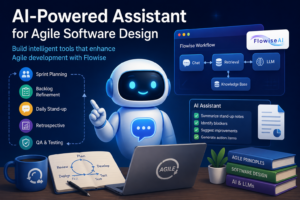
This OER introduces students to designing and developing AI-powered assistants for agile software development using Flowise (no code). Learners as a team explore Retrieval Augmented Generation (RAG) and agent-based systems, applying AI to real-world agile practices while considering technical design, evaluation, and cost-aware decision-making
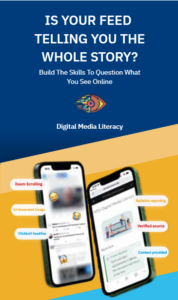
This interactive online resource is a set of eight units to support learners in their online information ecosystem. It is a mix of text, images, video, audio and interactive tasks. The resource can be accessed directly via the link provided or embedded in any Learning Management System compatible with SCORM files.
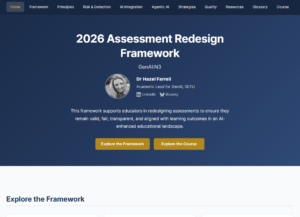
This OER presents an updated Assessment Redesign Framework for higher education in the age of GenAI. It supports educators and programme teams in designing valid, transparent, and scalable assessments, integrating AI literacy, process-focused approaches, and guidance on AI detection, large cohorts, and emerging agentic AI challenges.
The video examines the impact of digital technology on the wellbeing of children and young people. It highlights ethics and legislation relating to social media platforms and Gen AI. It will be of interest to educators in third level, adult education and older school children. Content warning: it includes references to upsetting examples.
This Podcast Series has been developed by CPID Staff involved in teaching and engaging in educational research. It consists of podcasts with well-known educational academics and experts, exploring various educational concepts/topics taught on programmes offered by the CPID, and on SATLE funded educational research projects.
This guideline document seeks to support the implementation of MTU policies and procedures which underpin Academic Integrity and help to address the implications of Generative Artificial Intelligence on assessment practices.
This document sets out a detailed, values-led framework to support the ethical adoption of generative artificial intelligence (gen AI) in teaching and learning across Irish higher education. It builds on the HEA Generative AI Policy Framework by translating high-level principles into concrete provisions to guide institutional policy, governance and educational practice.
The principles address five core areas: academic integrity, equity and inclusion, critical engagement and AI literacy, privacy and data governance, and sustainable pedagogy. Together, they provide institutions with a practical reference for navigating the ethical, pedagogical and organisational challenges associated with generative AI, while safeguarding academic standards, student rights and institutional autonomy.
This policy framework provides national guidance for the responsible and values-based use of generative artificial intelligence (gen AI) in teaching and learning within Irish higher education. It is designed to support educators, academic leaders and professional staff in making informed decisions about the adoption and integration of gen AI technologies in educational practice.
The framework focuses specifically on teaching and learning, addressing issues such as academic integrity, assessment design, equity and inclusion, AI literacy, privacy and data governance, and sustainable pedagogy. It sets out five core principles to guide institutional policy development and practice, while allowing for local adaptation and institutional autonomy.
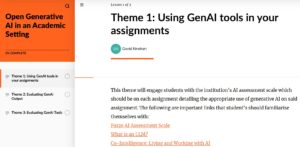
This lesson is designed to aid students in understanding how to engage generative AI in an academic setting without breaching academic integrity policy.
The Manifesto for Generative AI in Higher Education is a living resource for educators, students, and institutions. It invites reflection and dialogue across thirty statements exploring teaching, ethics, and imagination – helping higher education navigate AI with curiosity, integrity, and humanity.
The report – Generative AI in Higher Education Teaching and Learning: Sectoral Perspectives – was commissioned as part of the Higher Education Authority’s evidence-led approach to policy development.
The report captures the views of staff, students, and leaders across the Irish higher education system on the opportunities and challenges posed by artificial intelligence.
It brings together insights from ten thematic focus groups and a leadership summit, involving over 80 participants from across Ireland’s higher education institutions, alongside student representatives and sectoral stakeholders.
Generative AI Guidance Microsite provides resources and guidance to staff and students on the appropriate use of Generative AI in teaching and learning at MIC.
This resource portal is dedicated to providing centralised access to policies, guidelines, and resources for teaching and learning in higher education in the context of generative artificial intelligence. The curated policies and frameworks offer authoritative guidance and practical support to inform and enhance institutional practice.
This open course is designed to facilitate the development of your Artificial Intelligence (AI) literacy so that you can explore and innovate using Generative AI (GenAI) within your teaching, learning, and assessment practices.
In light of the potential opportunities and challenges of these technologies, this course will facilitate you in exploring the fundamentals of GenAI and AI Literacy, whilst focusing on an ethical practice. You will consider innovative ways in which you can respond to the challenges arising from the impact of these technologies in Higher Education.
Completion of this course will support you in developing a GenAI teaching strategy to apply to your own practice.
While Generative AI technologies have existed for many years, recent rapid advances in the field have pushed these technologies into mainstream use across society. As higher education institutions grappled with these new technologies, initial responses focused on potentially significant threats to academic integrity. However, as our understandings have evolved, there is an increasing awareness that these developing technologies also present opportunities for teaching, learning, assessment and research in higher education.
Against this rapidly evolving backdrop, we in the Centre for Academic Practice (Trinity College Dublin) found ourselves faced with new challenges. How could we best support our educators to respond to the challenges of GenAI? How might we influence and support strategic initiatives and policy development regarding GenAI for teaching, learning and assessment at the institutional level? Conscious that our colleagues across the sector were facing similar challenges, we decided to initiate a cross-institutional collaboration with teaching and learning leaders from across the sector, where we could tackle this together!
The HEART project explored the impact of generative AI on 3rd-level education in Ireland, using modules delivered in the UCD School of Biology and Environmental Science (SBES) at University College Dublin. We wish to thank the Strategic Alignment of Teaching and Learning Enhancement (SATLE) fund for making this project possible.
This faculty guide aims to help educators navigate and understand GenAI’s potential role in higher education. Created for faculty who want to explore AI tools and their implications for teaching and learning, the resource allows educators to learn at their own pace about the opportunities and challenges of these technologies.
This project website aims to support students and teaching staff in UCD College of Arts and Humanities in navigating teaching, learning and assessment in the context of new developments in generative AI (e.g. OpenAI’s ChatGPT and Google Gemini).
UNESCO’s first global guidance on GenAI in education aims to support countries to implement immediate actions, plan long-term policies and develop human capacity to ensure a human-centred vision of these new technologies. The Guidance presents an assessment of potential risks GenAI could pose to core humanistic values that promote human agency, inclusion, equity, gender equality, and linguistic and cultural diversities, as well as plural opinions and expressions. It proposes key steps for governmental agencies to regulate the use of GenAI tools including mandating the protection of data privacy and considering an age limit for their use. It outlines requirements for GenAI providers to enable their ethical and effective use in education.