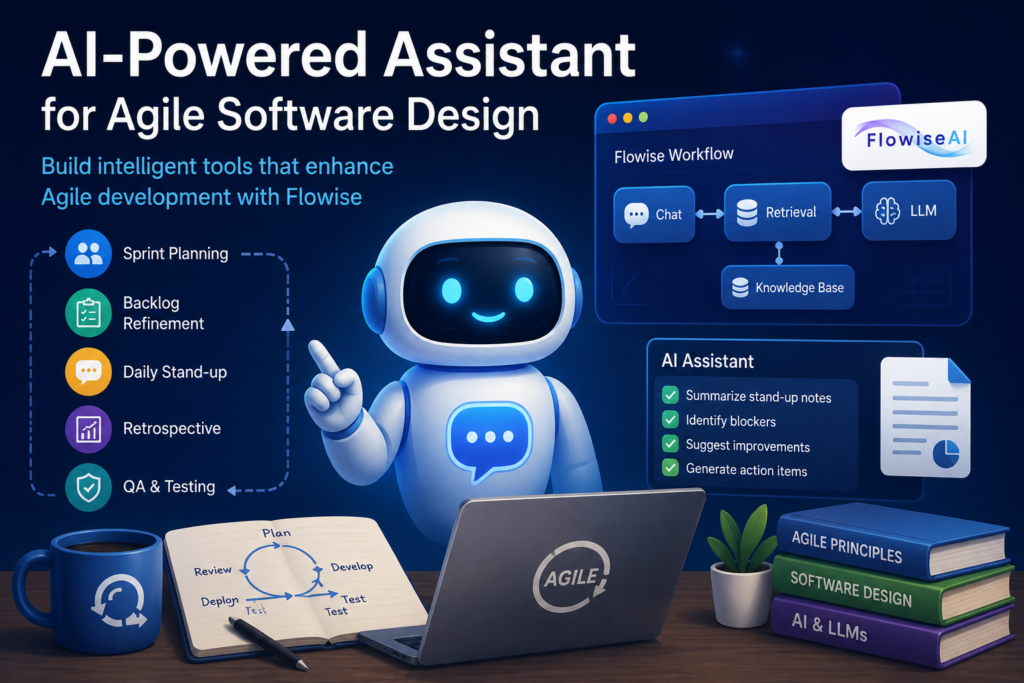
This OER introduces students to designing and developing AI-powered assistants for agile software development using Flowise (no code). Learners as a team explore Retrieval Augmented Generation (RAG) and agent-based systems, applying AI to real-world agile practices while considering technical design, evaluation, and cost-aware decision-making
Benefit of this resource and how to make the best use of it
This resource provides an authentic, project-based approach to learning how AI can support agile software development practices. It enables students to apply concepts such as Retrieval-Augmented Generation (RAG), AI agents, workflow design, and responsible AI adoption within realistic software engineering scenarios. By working within budget and technical constraints, learners also develop critical thinking, teamwork, and decision-making skills valued in industry.
In academic settings, educators can integrate the resource into software engineering, agile development, AI, or computing modules as a group project, capstone activity, or practical assessment. Academic developers and instructional designers may adapt the example use cases to suit different disciplines or institutional contexts, encouraging interdisciplinary collaboration and experimentation with emerging AI tools. The resource can also be modified to focus on specific agile activities, such as requirements engineering, quality assurance, or project management, allowing flexibility to align with diverse learning outcomes and levels of study.
?
This citation is automatically generated and may require adjustment. Always verify it against your style guide.
Giblin, M., & Fallon, S. (2026). Ai powered assisstant for agile software design. National Resource Hub (Ireland). Retrieved from: https://hub.teachingandlearning.ie/resource/ai-powered-assisstant-for-agile-software-design/ License: Creative Commons Attribution-NonCommercial (CC BY-NC).
Adapting this resource? Share your version!
If you have modified or adopted this resource, share your version here. Tracking adaptations helps us measure impact and connects others with useful updates.
This resource was created to share the learning from teaching adults with intellectual disabilities (ID) in IADT college as part of a national suite of pilot projects.
This OER presents findings from a comparative study of novice programmers engaging in face-to-face and hybrid pair programming. It explores collaboration patterns, role switching, satisfaction, and challenges, offering evidence-based insights for educators seeking to prepare students for effective teamwork in modern hybrid software development.
This OER explores novice programmers’ experiences of pair programming across face-to-face, hybrid, and remote settings. It provides insights into collaboration, role switching, satisfaction, and challenges, helping educators and students understand how to effectively prepare learners for modern hybrid software development environments.