Cognitive Bias Lab is an interactive platform designed to help learners explore and practice recognizing cognitive biases. Through simulations, quizzes, and role-play scenarios, it supports critical thinking, decision-making skills, and classroom discussions in psychology, education, and media literacy.
Benefit of this resource and how to make the best use of it
Cognitive Bias Lab offers an engaging, research-informed approach to teaching cognitive biases through interactive tools such as simulations, quizzes, and chatbot role-play. It enhances critical thinking and metacognitive skills by helping learners identify how biases shape judgment and decision-making in real-world scenarios.
Educators can use the platform as:
A flipped classroom activity, where students explore simulations before group discussion
An in-class exercise to provoke critical debate on reasoning and bias
A formative assessment tool, allowing learners to test and reflect on their understanding
A module supplement in psychology, behavioral economics, media literacy, or teacher training courses
A design thinking warm-up for product or UX design students to identify user-side bias risks
The platform is modular and adaptable, allowing instructors to embed individual exercises into LMSs, customize discussion prompts, or pair activities with academic readings. It supports accessibility through intuitive navigation and is freely available to promote equitable access to high-quality learning resources.
?
This citation is automatically generated and may require adjustment. Always verify it against your style guide.
Loginov, V. (2025). Cognitive bias lab: an interactive platform for exploring and practicing cognitive biases through simulations and learning tools. National Resource Hub (Ireland). Retrieved from: https://hub.teachingandlearning.ie/resource/cognitive-bias-lab-an-interactive-platform-for-exploring-and-practicing-cognitive-biases-through-simulations-and-learning-tools/ License: Creative Commons Attribution-NonCommercial (CC BY-NC).
Adapting this resource? Share your version!
If you have modified or adopted this resource, share your version here. Tracking adaptations helps us measure impact and connects others with useful updates.
This is an interactive multimedia open educational resource (OER), created using H5P, on the topic of Open Education. It has been developed by the Department of Technology Enhanced Learning at Munster Technological University.
The purpose of which is to give an overview of OEPs, using interactive features of H5P
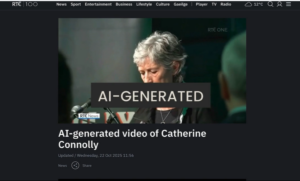
A video that discusses how Artificial Intelligence is impacting the way disinformation is created and spread to manipulate public opinion. It also outlines importance of Media Literacy education and regulatory measures, referencing Ireland’s Online Safety and Media Regulation Act and the EU’s Digital Services Act.
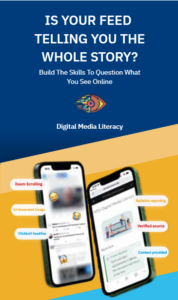
This interactive online resource is a set of eight units to support learners in their online information ecosystem. It is a mix of text, images, video, audio and interactive tasks. The resource can be accessed directly via the link provided or embedded in any Learning Management System compatible with SCORM files.
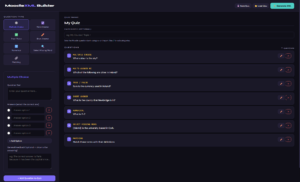
The purpose of this resource is to allow Moodle teachers to quickly create quizzes for Moodle. Users can quickly select between questions types through a single interface and export their questions as an XML file which can be imported into Moodle.