This resource presents AVINA, an automated visual novel generator using large language models to transform multiple-choice questions into interactive learning narratives. Designed for educators and students, it supports gamified training in academic integrity and ethical decision-making through adaptive storytelling and experiential learning.
Benefit of this resource and how to make the best use of it
The AVINA resource enables educators and academic developers to transform traditional multiple-choice assessments into interactive, story-based learning experiences. By converting question sets into narrative pathways, it supports deeper engagement with topics such as academic integrity, research ethics, and professional decision-making.
Educators can integrate AVINA into their modules to complement lectures or online training, offering students a dynamic way to explore ethical dilemmas and critical thinking. Instructional designers may adapt the framework to other domains—such as sustainability, data ethics, or digital literacy—by simply replacing the question bank and modifying the narrative context.
Used in workshops, tutorials, or self-directed learning environments, AVINA promotes reflective discussion, enhances digital fluency, and allows students to learn through consequences and scenario-based reasoning—making complex ethical concepts both relatable and memorable.
This work is licensed under a CC BY-NC-SA license, allowing sharing and adaptation for non-commercial use with proper attribution, provided derivative works use the same license.
?
This citation is automatically generated and may require adjustment. Always verify it against your style guide.
Campbell, A., Doyle, C., Killian, C., Macori, G., Wall, K., Idowu, O., Garg, P., Maillarbaux, T., Han, X., & Xu, X. (16/09/2025). Avina: automated visual novel generation using large language models — an interactive framework for gamified academic integrity and ethics training. National Resource Hub (Ireland). Retrieved from: https://hub.teachingandlearning.ie/resource/avina-automated-visual-novel-generation-using-large-language-models-an-interactive-framework-for-gamified-academic-integrity-and-ethics-training/ License: Creative Commons Attribution-NonCommercial-ShareAlike (CC BY-NC-SA).
Adapting this resource? Share your version!
If you have modified or adopted this resource, share your version here. Tracking adaptations helps us measure impact and connects others with useful updates.
This is an interactive multimedia open educational resource (OER), created using H5P, on the topic of Open Education. It has been developed by the Department of Technology Enhanced Learning at Munster Technological University.
The purpose of which is to give an overview of OEPs, using interactive features of H5P
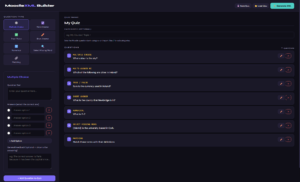
The purpose of this resource is to allow Moodle teachers to quickly create quizzes for Moodle. Users can quickly select between questions types through a single interface and export their questions as an XML file which can be imported into Moodle.
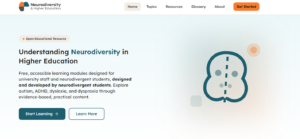
An open educational resource that supports academic, professional, and support staff to build more neuro-inclusive teaching, services, and policies in higher education. This resource was conceptualised & developed through the experiences of neurodivergent students in third-level education, with co-creation at the heart of every stage of the process
This Pressbook features an interactive tool that helps you plan and structure your essay step by step. The book provides a clear starting point to reduce stress, prevent overwhelm, and support different learning preferences through examples, , quick guides, and PowerPoint videos with voiceover. This resource is a living document.