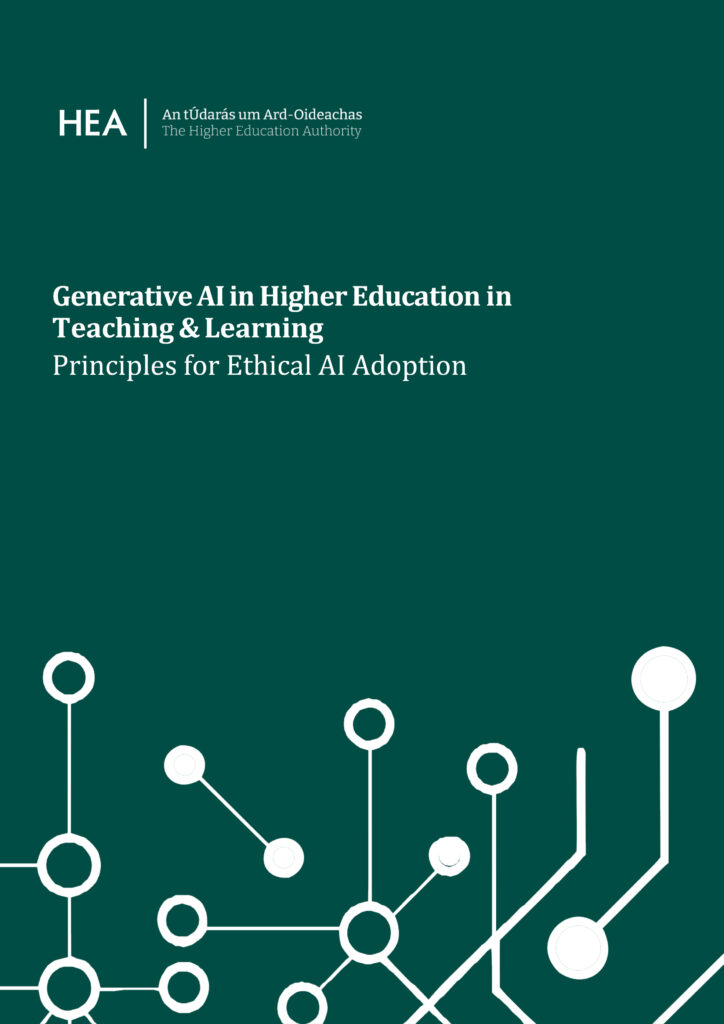
Generative AI in Higher Education Teaching & Learning: Principles for Ethical AI Adoption

Creator(s) (alphabetical)

Colin Lowry, James O'Sullivan, Ross Woods, Tim Conlon

Organisation(s)

Higher Education Authority, National Forum

Discipline(s)

Teaching and Learning

Topic(s)

Digital World, National Forum Publications, Teaching and Learning Practice

License

CC BY-SA

Media Format

PDF, Webpage

Date Submitted

PID https://doi.org/10.82110/qmt6-jw48

Submitted by

Export Resource Data

Description

This document sets out a detailed, values-led framework to support the ethical adoption of generative artificial intelligence (gen AI) in teaching and learning across Irish higher education. It builds on the HEA Generative AI Policy Framework by translating high-level principles into concrete provisions to guide institutional policy, governance and educational practice.

The principles address five core areas: academic integrity, equity and inclusion, critical engagement and AI literacy, privacy and data governance, and sustainable pedagogy. Together, they provide institutions with a practical reference for navigating the ethical, pedagogical and organisational challenges associated with generative AI, while safeguarding academic standards, student rights and institutional autonomy.
Benefit of this resource and how to make the best use of it

– Provides guidance to support ethical and responsible adoption of generative AI
– Supports institutions in translating values and principles into policies, practices and governance arrangements
– Helps safeguard academic integrity, fairness and student accountability in AI-enabled teaching and assessment
– Supports equitable access, inclusion and transparency in the use of generative AI tools
– Informs staff development, assessment design and AI literacy initiatives across disciplines

Creative Commons Attribution-ShareAlike (CC BY-SA)

This work is licensed under a CC BY-SA license, allowing adaptation and sharing with proper attribution, provided derivative works use the same license.

https://creativecommons.org/licenses/by-sa/4.0/
? This citation is automatically generated and may require adjustment. Always verify it against your style guide.
Lowry, C., O'Sullivan, J., Woods, R., & Conlon, T. (2025). Generative ai in higher education teaching & learning: principles for ethical ai adoption. National Resource Hub (Ireland). Retrieved from: https://hub.teachingandlearning.ie/resource/generative-ai-in-higher-education-teaching-learning-principles-for-ethical-ai-adoption/ License: Creative Commons Attribution-ShareAlike (CC BY-SA).

Adapting this resource? Share your version!

If you have modified or adopted this resource, share your version here. Tracking adaptations helps us measure impact and connects others with useful updates.

Related OER

This landscape report provides an overview of Education for Sustainable Development (ESD) practice across the higher education sector in Ireland. It draws together publicly available institutional strategies, HEA Performance Framework Agreements 2024–2028, Climate Action Roadmaps and ESD to 2030 progress reports to outline current approaches to embedding ESD.

Structured as a series of institutional case studies, the report highlights how ESD is being addressed across teaching and learning, research, engagement and whole-institution practice, and identifies opportunities for collaboration and shared learning across the sector.

A self-paced resource introducing Articulate Rise 360, an authoring tool for creating interactive, mobile-responsive e-learning content. Covers content design principles, interaction types, accessibility features, and publishing workflows. Designed primarily for instructional designers, educators, and professionals new to Rise.

This discussion paper explores how student success in higher education is understood, defined and supported in contemporary Irish and international contexts. It brings together international research, national policy and insights from student focus groups conducted in Ireland in 2025 to examine success beyond traditional metrics such as retention, progression and completion.

The paper presents a holistic and relational view of student success, foregrounding belonging, mattering, agency and wellbeing alongside academic and outcomes-based measures. It situates student success as simultaneously student-defined, institution-enabled and outcomes-oriented, and considers the implications of this framing for teaching, learning, policy and system-level practice.

This report presents findings from the HEA Student Success Survey 2025, capturing how students across Ireland define, experience and achieve success in higher education. Based on responses from over 3,400 students across publicly funded higher education institutions, it provides a national, student-centred perspective on success.

The report explores students’ definitions of success, the supports and enablers that help them thrive, and the barriers that can hinder progress. It highlights the relational and holistic nature of student success, encompassing academic achievement alongside well-being, belonging, personal growth and future readiness.