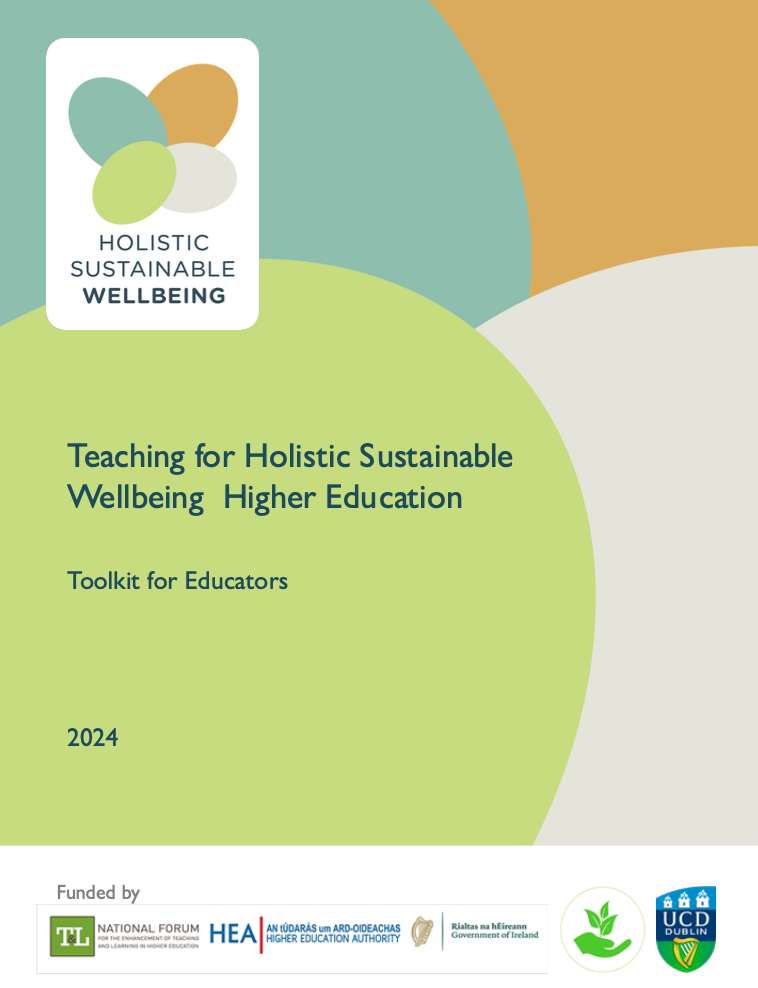
Teaching for Holistic Sustainable Wellbeing in Higher Education

[favorite_button]

Creator(s) (alphabetical)

Daniel Guigui, Gabriela Martinez Sainz, Jessica Surdey

Organisation(s)

University College Dublin

Discipline(s)

Education

Topic(s)

Assessment and Feedback, Curriculum Design, Education for Sustainable Development (ESD), Student Success, Teaching and Learning Practice

License

CC BY

Media Format

PDF

Date Submitted

Submitted by

Export Resource Data

Description

This toolkit is designed to provide educators in Higher Education with practical, adaptable tools and strategies for fostering sustainable wellbeing in their teaching through curriculum, assessment and pedagogy.
Benefit of this resource and how to make the best use of it

The framework and ideas in the toolkit recognise the importance of balancing academic achievement with the holistic development of students, focusing on their physical, mental, emotional, and social wellbeing while fostering among them a sense of planetary stewardship to prepare students for sustainable futures.

Creative Commons Attribution (CC BY)

This work is licensed under a CC BY license, allowing sharing and adaptation with proper attribution.

https://creativecommons.org/licenses/by/4.0/
? This citation is automatically generated and may require adjustment. Always verify it against your style guide.
Guigui, D., Sainz, G. M., & Surdey, J. (01/12/2024). Teaching for holistic sustainable wellbeing in higher education. National Resource Hub (Ireland). Retrieved from: https://hub.teachingandlearning.ie/resource/teaching-for-holistic-sustainable-wellbeing-in-higher-education/ License: Creative Commons Attribution (CC BY).

Adapting this resource? Share your version!

If you have modified or adopted this resource, share your version here. Tracking adaptations helps us measure impact and connects others with useful updates.

Related OER

This Pressbook features an interactive tool that helps you plan and structure your essay step by step. The book provides a clear starting point to reduce stress, prevent overwhelm, and support different learning preferences through examples, , quick guides, and PowerPoint videos with voiceover. This resource is a living document.

Purpose of the MTU Student Guidelines
Supports Academic Integrity Principles and MTU’s Academic Integrity Policy by:
1. Explaining what academic integrity is.
2. Helping students avoid bad decisions during assessments.
3. Outlines and signposts supports available across MTU

A video that explains how social media recommender algorithms work. It will help learners be more aware of how their social media content is delivered. The content is relevant to third level students, adult education and older secondary school students.

The video examines the impact of digital technology on the wellbeing of children and young people. It highlights ethics and legislation relating to social media platforms and Gen AI. It will be of interest to educators in third level, adult education and older school children. Content warning: it includes references to upsetting examples.