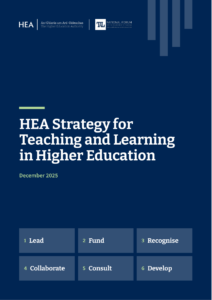
Published in December 2025, the Higher Education Authority’s strategy sets out six priorities for teaching and learning in Irish higher education: Lead, Fund, Recognise, Collaborate, Consult and Develop. Each priority is supported by strategic objectives and high-level actions to guide national policy and teaching and learning enhancement.
Ireland’s Higher Education Authority (HEA) has been working with the sector to move from immediate responses to generative AI towards a more shared understanding of its implications for teaching and learning. This includes how students learn, how educators teach and how institutions approach assessment, integrity and inclusion. The HEA has brought together student representatives, staff, institutional leaders and wider stakeholders to consider how GenAI is influencing teaching, learning and assessment and what kinds of support, guidance and shared understanding are needed.
Speaker
Colin Lowry is Senior Manager for Teaching and Learning, Enhancement, and Digital Innovation at the Higher Education Authority (HEA) / National Forum for the Enhancement of Teaching and Learning in Higher Education. His role spans digital transformation, artificial intelligence, open education, professional development and education for sustainable development. He leads the strategy and development of national digital platforms, including the National Resource Hub and OpenCourses.ie, alongside related professional development and awards initiatives, contributing to work recognised with UNESCO’s ICT in Education Prize. Colin leads the development of the HEA’s approach to generative AI in higher education through sectoral consultation, evidence-informed guidance and national dialogue on its implications for teaching, learning and assessment. His previous research examined technology acceptance, behavioural factors influencing adoption and predictive models of engagement with emerging technologies. He has also served as Director of Digital Strategy, advising organisations across sectors on digital transformation, service design, change management and technology adoption.
Keynote Title: Opening the Future: Equity, Sustainability, and Promise in Higher Education
Speaker: Dr Robin DeRosa
Dr Robin DeRosa is the Executive Director of the Open Education Network , a global organization based out of the University of Minnesota that facilitates community care and collective action in open education to empower faculty, remove barriers to learning and knowledge-sharing, and enhance student success.
Sectoral panel exploring open education in Irish higher education featuring:
– Dr Pio Fenton*, Vice President People & Culture, Munster Technological University
– Liz Jolly*, University Librarian, University College Cork
– MJ Quill*, Vice President for Postgraduate Affairs, Aontas na Mac Léinn in Éirinn (AMLÉ)
– Dr Eamon Costello*, Associate Professor of Digital Learning, Dublin City University, President of the Irish Learning Technology Association (ILTA)
– Dr Leigh Graves Wolf*, Interim Director Of Teaching & Learning, University College Dublin
This paper entitled 'Developing an Academic Integrity Policy and Academic Misconduct Procedures in an Era of Generative Artificial Intelligence: Five Tips for Success' may be of interest to policy developers and educators in further and higher education and training organisations as they adapt to challenge of AI.
The Higher Education Authority (HEA) is developing a National Professional Recognition Framework for Teaching and Learning to support the recognition of teaching excellence across the sector. The framework builds on the Professional Development Framework (2016) and aims to provide clear, nationally agreed benchmarks for effective teaching practice. It will help inform career development, support institutional processes, and promote a shared understanding of teaching quality in Irish higher education.
This compendium comprehensively brings together the components needed by higher education institutions (HEIs) when developing comprehensive frameworks for managing cases of academic misconduct. It serves as both a practical guide and a reflective resource, aimed at strengthening and promoting a culture of academic integrity.
Since March 2020 higher education has experienced one of the most disruptive phases in its recent history. In a sector typified by considered, researched and incremental change, overnight everyone began emergency remote teaching, learning and assessing. The dramatic shift resulted in positives and negatives, and posed a series of questions for students, staff and other stakeholders. Though still living through the pandemic, in March 2021 fifteen partners from a range of stakeholders across the sector agreed to work together to answer one shared persistent and urgent question: In the context of Covid-19, what have we learnt and what does it mean for the future of teaching and learning in Irish higher education?
This report looks at the major recurring themes in a number of exemplar international analytics policies and highlights the actions institutions may wish to take in developing their own policies and strategies
This report discusses the major policies and initiatives through which public authorities in 28 European higher education systems support the enhancement of learning and teaching. It is a follow up to Trends 2018.
The foreword of this resource states the author “has put together a comprehensive collection of resources and tied these to tools and connections to open our thinking. Placed at the heart of this resource, is an exercise on the development of one’s own ‘Personal Philosophy of Teaching’”