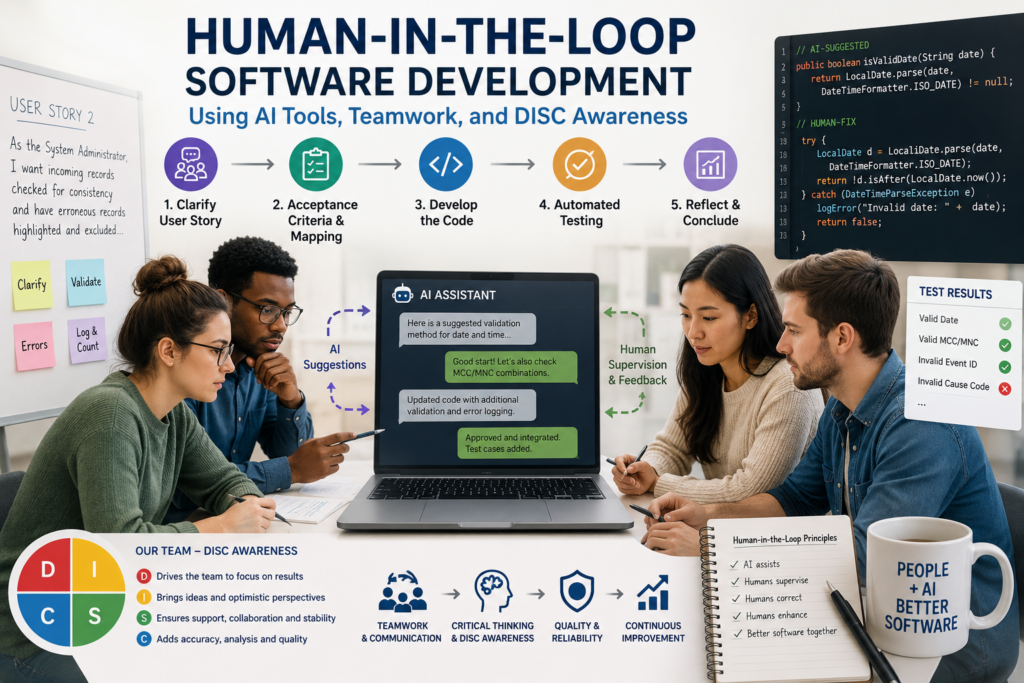
This resource helps learners develop a critical understanding of how generative AI can be used responsibly and effectively throughout the software development lifecycle. Rather than treating AI as an autonomous solution, it emphasises the importance of human judgement, supervision, and collaboration in evaluating, refining, and improving AI-generated outputs. Students learn not only how to use AI tools to support software engineering tasks, but also when to challenge, correct, or reject AI suggestions.
A key benefit of the resource is its authentic, practice-based approach. Learners engage with a realistic software development scenario in which they clarify requirements, develop acceptance criteria, implement code, generate automated tests, and reflect on the role of AI in professional practice. By documenting instances where humans intervened to improve AI outputs, students develop critical thinking, debugging skills, ethical awareness, and confidence in exercising professional judgement. The inclusion of DISC personality reflection further encourages self-awareness, helping learners understand how different working styles influence teamwork, decision-making, testing approaches, and responses to AI recommendations.
In academic settings, this OER can be integrated into undergraduate or postgraduate modules in software engineering, agile development, requirements engineering, software testing, artificial intelligence, or professional practice. Educators may adopt it as a group assignment, capstone project, laboratory activity, or authentic assessment focused on responsible AI use. The structured stages of the assignment allow instructors to scaffold learning progressively, enabling students to experience the full cycle of human–AI collaboration.
Academic developers and instructional designers can adapt the resource to suit different contexts and levels of study. For example, introductory computing courses may focus on user story clarification and acceptance criteria, while advanced modules may emphasise AI-assisted coding, testing strategies, and critical evaluation of AI-generated artefacts. The DISC reflection activities can also be modified to support team formation, peer feedback, and discussions around inclusive collaboration.