This is a short introduction to ChatGPT for people teaching in higher education, created in January 2023 and updated until this version was saved in February 2023. The resource is a slide deck which you are free to modify and update (since this is a fast-moving topic). No prior knowledge of AI or chatbots is necessary to use the slides.
Benefit of this resource and how to make the best use of it
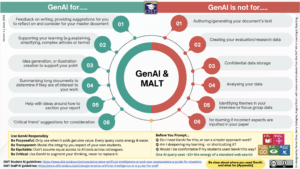
The resource may be helpful to any colleagues working with academics who are concerned about the arrival of artificial intelligence chat systems and their use in higher education. The resource includes some basic information but also links to useful additional resources and research if people wish to learn more. It is not a comprehensive guide to artificial intelligence but would work well as an introduction, and perhaps to allay immediate concerns about this topic. Some potential opportunities arising from apps like ChatGPT are highlighted, and also some ethical issues for consideration. The resource could supplement those of the National Forum and the National Academic Integrity Network (QQI) which are important to access also in relation to this topic.
?
This citation is automatically generated and may require adjustment. Always verify it against your style guide.
McAvinia, C. (2023). The hitchhiker’s guide to chat gpt (feb 2023). National Resource Hub (Ireland). Retrieved from: https://hub.teachingandlearning.ie/resource/the-hitchhikers-guide-to-chat-gpt-feb-2023/ License: Creative Commons Attribution-NonCommercial (CC BY-NC).
Adapting this resource? Share your version!
If you have modified or adopted this resource, share your version here. Tracking adaptations helps us measure impact and connects others with useful updates.
Project NOURISH is a campus-based nutrition and health intervention, originally designed for MTU staff. This was designed as part of a broader research study to investigate how to enable healthier dietary behaviours within university environments.
This OER explores the use of Inspiration Mind Mapping software to support student learning through demonstrations and training sessions with Applied Social Care and LSAD students.
This is an interactive multimedia open educational resource (OER), created using H5P, on the topic of Open Education. It has been developed by the Department of Technology Enhanced Learning at Munster Technological University.
The purpose of which is to give an overview of OEPs, using interactive features of H5P
The purpose of this resource is to allow Moodle teachers to quickly create quizzes for Moodle. Users can quickly select between questions types through a single interface and export their questions as an XML file which can be imported into Moodle.