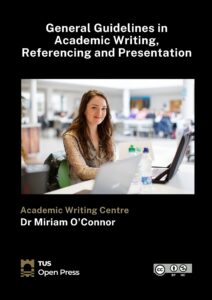
This book is designed specifically for students studying at the Technological University of the Shannon – Midlands Midwest, Ireland. It presents a step-by-step practical guide to academic writing, referencing and presentation, with clear explanations and structured approaches with examples that support the development of clear and concise writing.
Comparing student and educator perceptions of generative artificial intelligence for teaching, learning and assessment: results from two institutional surveys
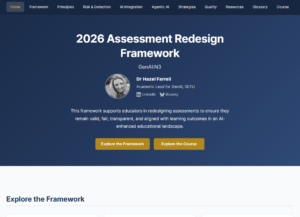
This OER presents an updated Assessment Redesign Framework for higher education in the age of GenAI. It supports educators and programme teams in designing valid, transparent, and scalable assessments, integrating AI literacy, process-focused approaches, and guidance on AI detection, large cohorts, and emerging agentic AI challenges.
Purpose of the MTU Student Guidelines
Supports Academic Integrity Principles and MTU’s Academic Integrity Policy by:
1. Explaining what academic integrity is.
2. Helping students avoid bad decisions during assessments.
3. Outlines and signposts supports available across MTU
This resource showcases initiatives from both academic and professional support areas across DCU, which have been funded under SATLE – the Strategic Alignment of Teaching and Learning Enhancement Funding in Higher Education. Examples are provided under the themes of Education for Sustainable Development, Digital transformation & Academic Integrity
This Podcast Series has been developed by CPID Staff involved in teaching and engaging in educational research. It consists of podcasts with well-known educational academics and experts, exploring various educational concepts/topics taught on programmes offered by the CPID, and on SATLE funded educational research projects.
This guideline document seeks to support the implementation of MTU policies and procedures which underpin Academic Integrity and help to address the implications of Generative Artificial Intelligence on assessment practices.
This study explores student perceptions and behaviours concerning academic integrity and the use of Generative AI in the context of Munster Technological University (MTU). It draws insights from a comprehensive survey of 608 students across various faculties and academic stages.
Reimagining Assessment & Feedback Together (RAFT) is MTU initiative developed to transforming assessment practices. This volume documents twenty-four situated, discipline-specific attempts to rethink assessment and feedback through student partnership and action research.
This opinion article outlines the alignment between patient-clinician consultations in healthcare and student-investigator meetings focused on academic misconduct
This paper entitled 'Developing an Academic Integrity Policy and Academic Misconduct Procedures in an Era of Generative Artificial Intelligence: Five Tips for Success' may be of interest to policy developers and educators in further and higher education and training organisations as they adapt to challenge of AI.
This document sets out a detailed, values-led framework to support the ethical adoption of generative artificial intelligence (gen AI) in teaching and learning across Irish higher education. It builds on the HEA Generative AI Policy Framework by translating high-level principles into concrete provisions to guide institutional policy, governance and educational practice.
The principles address five core areas: academic integrity, equity and inclusion, critical engagement and AI literacy, privacy and data governance, and sustainable pedagogy. Together, they provide institutions with a practical reference for navigating the ethical, pedagogical and organisational challenges associated with generative AI, while safeguarding academic standards, student rights and institutional autonomy.
This policy framework provides national guidance for the responsible and values-based use of generative artificial intelligence (gen AI) in teaching and learning within Irish higher education. It is designed to support educators, academic leaders and professional staff in making informed decisions about the adoption and integration of gen AI technologies in educational practice.
The framework focuses specifically on teaching and learning, addressing issues such as academic integrity, assessment design, equity and inclusion, AI literacy, privacy and data governance, and sustainable pedagogy. It sets out five core principles to guide institutional policy development and practice, while allowing for local adaptation and institutional autonomy.
This lesson is designed to aid students in understanding how to engage generative AI in an academic setting without breaching academic integrity policy.
This lesson is designed to teach students about academic integrity from understanding the principles and encouraging a perspective that they are equal partners in upholding academic integrity.
The Manifesto for Generative AI in Higher Education is a living resource for educators, students, and institutions. It invites reflection and dialogue across thirty statements exploring teaching, ethics, and imagination – helping higher education navigate AI with curiosity, integrity, and humanity.
This open resource presents over 140 real-world academic integrity and ethical dilemma scenarios co-created by students and staff. Designed for educators, trainers, and learners, it supports interactive discussions, gamified learning, and scenario-based teaching in ethics and integrity education across disciplines.
This resource presents AVINA, an automated visual novel generator using large language models to transform multiple-choice questions into interactive learning narratives. Designed for educators and students, it supports gamified training in academic integrity and ethical decision-making through adaptive storytelling and experiential learning.
The University of Limerick Academic Integrity and GenAI toolkit is a curated suite of resources developed to support ethical academic practices in the evolving landscape of Generative AI.
This GenAI Learning Hub was developed with students, for students, to support the responsible and effective use of generative AI. Topics are divided across three main sections to aid understanding of GenAI before use, during use, and in relation to assessment. While aimed at students, this resource will be useful to anyone using GenAI.
This resource portal is dedicated to providing centralised access to policies, guidelines, and resources for teaching and learning in higher education in the context of generative artificial intelligence. The curated policies and frameworks offer authoritative guidance and practical support to inform and enhance institutional practice.
It is with great pleasure that we present the proceedings from the
“Enhancing Academic Integrity: From Ideas to Action” conference, hosted
by CCT College Dublin on 3rd and 4th September 2024. This collection
represents the culmination of thoughtful discourse, innovative research, and
collaborative spirit that defined our gathering.
The HEART project explored the impact of generative AI on 3rd-level education in Ireland, using modules delivered in the UCD School of Biology and Environmental Science (SBES) at University College Dublin. We wish to thank the Strategic Alignment of Teaching and Learning Enhancement (SATLE) fund for making this project possible.
This publication collects the posters shared at the 2023 Learning and Teaching Showcase at University College Cork, 5 December 2023. The posters are grouped into five themes: student engagement, inclusive teaching, academic integrity, digital education and education for sustainable development.
The Toolkit includes an introduction to generative AI and lexicon of terms, guidelines for ethical use, recommended adjustments to common modes of assessment to mitigate against the potential risk of unethical use, and discipline-specific case studies of good practice that share innovative forms of learning, teaching and/or assessment.
The Academic Integrity, Academic Misconduct, and Resources pages of the UCC Skills Centre website contain guidance for students on these topics, including a series of short videos, “The Minute Methods: Academic Integrity Skills” that cover a range of topics from the principles of academic integrity to the pitfalls of essay mills.
Student interns explaining how the importance of academic integrity in group work.
This suite of short videos was created by our student interns in 2023. The videos are a useful resource for students and staff.
This is a short introduction to ChatGPT for people teaching in higher education, created in January 2023 and updated until this version was saved in February 2023. The resource is a slide deck which you are free to modify and update (since this is a fast-moving topic). No prior knowledge of AI or chatbots is necessary to use the slides.
This guide outlines some pedagogic considerations when designing take home offline exams or real-time online exams, both effectively ‘open book’ exams.