The HEART project explored the impact of generative AI on 3rd-level education in Ireland, using modules delivered in the UCD School of Biology and Environmental Science (SBES) at University College Dublin. We wish to thank the Strategic Alignment of Teaching and Learning Enhancement (SATLE) fund for making this project possible.
Benefit of this resource and how to make the best use of it
The HEART project was a collaborative work of faculty and admin staff, as well as undergraduate and postgraduate students. This way we ensured that diversity of perspectives on the use of generative AI in higher education was captured effectively. Two key aims of the project were (1) to explore strategies for responsible use of generative AI, and development of AI resilient assessment in science teaching at university level, (2) to explore the perceived impact of AI tools, such as ChatGPT in context of academic integrity among students and staff.
This report presents the key recommendations, sources and data collected during the HEART project (2023 to 2024), including mini surveys, questionnaires, and workshop plans that are free to use by anyone, as well as suggestions on how to improve the AI resilience of used assessment strategies. While the project was embedded in the SBES and focused on third level science teaching, we believe that some of the findings and recommendations may be of interest to the broad community of university level educators and students. Overall, the project highlighted the clear need for guidelines and training on how generative AI can be used in teaching and learning in third level education, in a way supporting student learning but at the same time ensuring that academic integrity is safeguarded.
Creative Commons Attribution (CC BY)
This work is licensed under a CC BY license, allowing sharing and adaptation with proper attribution.
?
This citation is automatically generated and may require adjustment. Always verify it against your style guide.
Campbell, A., Kane, A., Tuchszer, G., Kacprzyk, J., Jones, J., Duffy, K., Toscani, M., Magee, R., & Schilling, S. (2025). Heart: higher education and artificial intelligence responsive teaching (final project report with developed resources). National Resource Hub (Ireland). Retrieved from: https://hub.teachingandlearning.ie/resource/heart-higher-education-and-artificial-intelligence-responsive-teaching-final-project-report-with-developed-resources/ License: Creative Commons Attribution (CC BY).
Adapting this resource? Share your version!
If you have modified or adopted this resource, share your version here. Tracking adaptations helps us measure impact and connects others with useful updates.
This is an interactive multimedia open educational resource (OER), created using H5P, on the topic of Open Education. It has been developed by the Department of Technology Enhanced Learning at Munster Technological University.
The purpose of which is to give an overview of OEPs, using interactive features of H5P
The purpose of this resource is to allow Moodle teachers to quickly create quizzes for Moodle. Users can quickly select between questions types through a single interface and export their questions as an XML file which can be imported into Moodle.
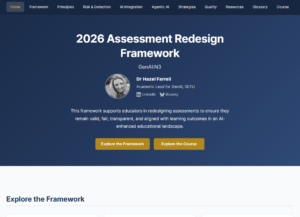
This OER presents an updated Assessment Redesign Framework for higher education in the age of GenAI. It supports educators and programme teams in designing valid, transparent, and scalable assessments, integrating AI literacy, process-focused approaches, and guidance on AI detection, large cohorts, and emerging agentic AI challenges.
This Pressbook features an interactive tool that helps you plan and structure your essay step by step. The book provides a clear starting point to reduce stress, prevent overwhelm, and support different learning preferences through examples, , quick guides, and PowerPoint videos with voiceover. This resource is a living document.