A resource providing guidance on enhancing team-based learning (TBL) with technology.
Benefit of this resource and how to make the best use of it
In the words of the authors, “TBL usually involves students and educators meeting in the same place at the same time. However, as technology has evolved, TBL practitioners have experimented with different ways of facilitating these stages outside of the physical classroom (Clark et al., 2018).
Such innovation has been necessitated by working with distance learning students (e.g. Palsole and Awalt, 2008) but also became more popular during the recent Covid-19 pandemic (e.g. Cross et al., 2020). Some authors (e.g. Gomez and Passerini, 2010) seek to use online technology to “continue the conversations” that occur beyond class time. Others have sought ways to make the most of live class time by running some TBL activities between classes. Here we share five tips to consider when planning for Online TBL. Further reading and links are also provided.””
This work is licensed under a CC BY-NC-SA license, allowing sharing and adaptation for non-commercial use with proper attribution, provided derivative works use the same license.
?
This citation is automatically generated and may require adjustment. Always verify it against your style guide.
Athlone Institute of Technology (2021). Enhancing tbl with technology- 5 tips: online tbl. National Resource Hub (Ireland). Retrieved from: https://hub.teachingandlearning.ie/resource/enhancing-tbl-with-technology-5-tips-online-tbl/ License: Creative Commons Attribution-NonCommercial-ShareAlike (CC BY-NC-SA).
Adapting this resource? Share your version!
If you have modified or adopted this resource, share your version here. Tracking adaptations helps us measure impact and connects others with useful updates.
This is an interactive multimedia open educational resource (OER), created using H5P, on the topic of Open Education. It has been developed by the Department of Technology Enhanced Learning at Munster Technological University.
The purpose of which is to give an overview of OEPs, using interactive features of H5P
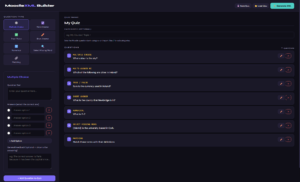
The purpose of this resource is to allow Moodle teachers to quickly create quizzes for Moodle. Users can quickly select between questions types through a single interface and export their questions as an XML file which can be imported into Moodle.
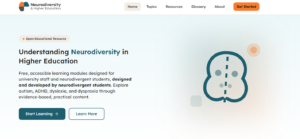
An open educational resource that supports academic, professional, and support staff to build more neuro-inclusive teaching, services, and policies in higher education. This resource was conceptualised & developed through the experiences of neurodivergent students in third-level education, with co-creation at the heart of every stage of the process
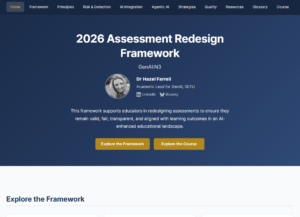
This OER presents an updated Assessment Redesign Framework for higher education in the age of GenAI. It supports educators and programme teams in designing valid, transparent, and scalable assessments, integrating AI literacy, process-focused approaches, and guidance on AI detection, large cohorts, and emerging agentic AI challenges.