

The Manifesto for Generative AI in Higher Education is a living resource for educators, students, and institutions. It invites reflection and dialogue across thirty statements exploring teaching, ethics, and imagination – helping higher education navigate AI with curiosity, integrity, and humanity.
Resource
Manifesto for Generative AI in Higher Education
Description
Benefit of this resource and how to make the best use of it
The Manifesto for Generative AI in Higher Education can be applied in a wide range of academic settings, as both a reflective compass and a practical framework for action. Its thirty concise statements lend themselves to multiple levels of engagement: from individual reflection to institutional strategy, from the redesign of a single assignment to the development of an entire module or staff development programme.
At its core, the Manifesto is a conversation starter. It gives educators, students, and leaders a shared vocabulary for discussing the opportunities and challenges that GenAI brings to higher education. Each statement is written to provoke dialogue rather than dictate solutions, making it especially suited to workshops, seminars, and communities of practice. Academic developers can use it as a foundation for reflective sessions, asking participants to choose one or two statements that resonate most with their teaching context and to discuss what those ideas might mean in practice. Such sessions can open up honest conversations about ethics, creativity, and the future of learning that move beyond compliance or technical skill.
In professional development programmes, the Manifesto can be integrated as a scaffold for exploring responsible and imaginative uses of GenAI tools. For example, academic developers might design a session around one of the three thematic areas – Rethinking Teaching and Learning, Responsibility, Ethics, and Power, or Imagination, Humanity, and the Future. Within each theme, educators can analyse case studies, review their assessment strategies, or co-create new activities that encourage authentic learning and critical thinking. In this way, the Manifesto becomes both a framework for professional reflection and a catalyst for curriculum innovation.
Instructional designers can draw directly on the Manifesto to guide the design of learning experiences that are purposeful, transparent, and human-centred. Statements such as “Detection chases the past; thoughtful design shapes the future” and “Prompting is pedagogy” can be used to frame design discussions about academic integrity, assessment authenticity, and the pedagogical role of AI tools. The Manifesto encourages designers to move beyond fear-based responses, such as AI detection, and instead to focus on creating assessments that value process, reasoning, and creativity. In this way, it aligns with contemporary frameworks such as Universal Design for Learning (UDL) and constructive alignment, offering a humanistic balance to technical implementation.
Educators can also use the Manifesto to engage students directly. Individual statements can form the basis for in-class debates, journal prompts, or collaborative projects that build AI literacy. For example, a teaching team might ask students to rewrite one statement from a disciplinary perspective – considering how GenAI “lives differently in every discipline.” This approach not only develops students’ critical understanding of AI but also models co-creation and shared responsibility in learning.
At the institutional level, the Manifesto can support strategic discussions about policy, ethics, and staff capacity. Its open and adaptable format allows leadership teams to use it as a diagnostic tool – identifying which values are already embedded in institutional culture and which require further attention. It can also serve as a bridge between policy documents and classroom practice, ensuring that AI strategies remain grounded in pedagogy and human purpose rather than technology alone.
Ultimately, the Manifesto for Generative AI in Higher Education invites ongoing reinterpretation. By using the Manifesto as a living, evolving resource, higher education can approach AI not simply as a challenge to manage but as an opportunity to reimagine what it means to teach, learn, and create with integrity in an age of abundance.
People, communities and initiatives
Collaborators
Hazel Farrell · Ken McCarthy
Communities
Initiatives
Creative Commons Attribution-ShareAlike (CC BY-SA)
This work is licensed under a CC BY-SA license, allowing adaptation and sharing with proper attribution, provided derivative works use the same license.
https://creativecommons.org/licenses/by-sa/4.0/
Access this resource
Links open in a new tab.
Additional resource information
Resource details
Share this resource
Report an issueAdapting this resource? Share your version!
If you have modified or adopted this resource, share your version here. Tracking adaptations helps us measure impact and connects others with useful updates.
More resources in these topics
Explore resources sharing the topics attached to this record.
PREP-In: Preparing Student Teachers for Inclusive Classrooms A Mixed-Methods Study of Perceptions, Reflections, and Practice
This resource supports inclusive teacher education through findings from the PREP-In project. It combines student and professional perspectives, placement portfolio insights, co-created classroom vignettes and practical recommendations. Designed for teacher educators, student teachers, school mentors and SEN professionals.
Protocols for professional conversations using AI in ITE: comparing lesson plans, planning a unit of learning, designing differentiated resources, exploring school policies in practice
The purpose of these protocols is to assist student teachers and cooperating teachers in schools to have professional conversations together during regular tutorial meetings. Each document requires the use of GenAI but can generate insights or interactions that would be difficult to emulate in paired discussion.
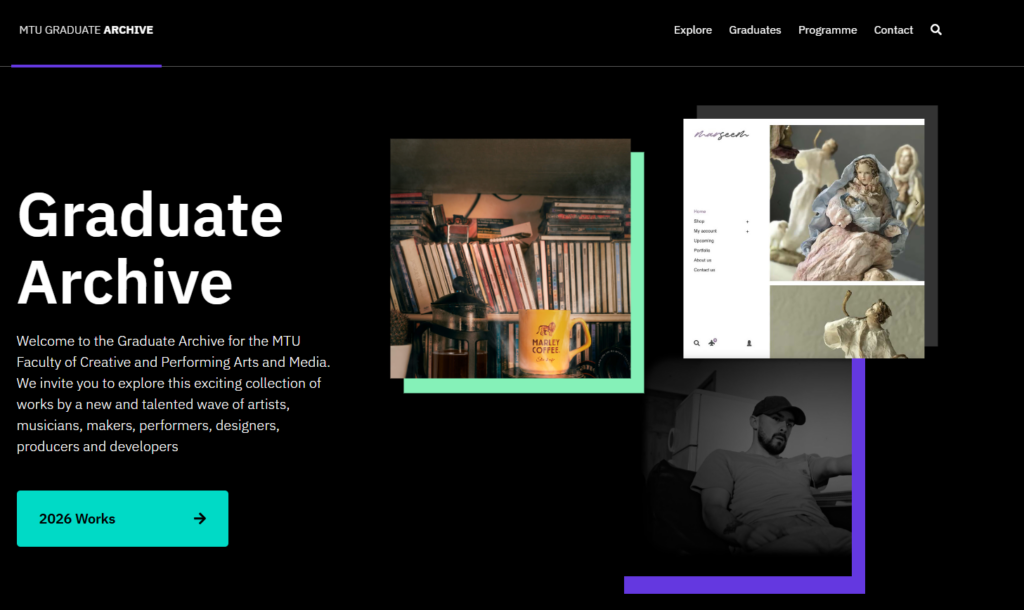
Graduate Archive for Faculty of Creative and Performing Arts and Media
The Graduate Archive Website is a permanent collection of final year artworks and performances across the MTU Faculty of Creative and Performing Arts and Media.
The Archive showcases all works in full detail, which allows the works to function as high quality research material, and creates a key resource for teaching and learning.
Report an issue