To help campuses ensure that their online courses are learner centered and well designed, a team of SUNY staff and campus stakeholders has designed the OSCQR rubric, a customizable and flexible tool for online course quality review.
Benefit of this resource and how to make the best use of it
The OSCQR rubric specifically targets online course design. The OSCQR rubric is unique and differs from other online course quality rubrics in several ways. It is not restricted to mature online courses. The rubric can be used formatively with new online faculty to help guide, inform, and influence the design of their new online courses, and, it is non-evaluative. Conceptually, the rubric and the online course review and refresh process are implemented as a professional development exercise designed to guide online faculty to use research-based effective practices and standards to improve the quality, effectiveness, and efficiency of their online course design, rather than as an online course evaluation, or quality assurance procedure.
Creative Commons Attribution (CC BY)
This work is licensed under a CC BY license, allowing sharing and adaptation with proper attribution.
?
This citation is automatically generated and may require adjustment. Always verify it against your style guide.
SUNY online, and The State University of New York (2021). Oscqr – suny online course quality review rubric. National Resource Hub (Ireland). Retrieved from: https://hub.teachingandlearning.ie/resource/oscqr-suny-online-course-quality-review-rubric/ License: Creative Commons Attribution (CC BY).
Adapting this resource? Share your version!
If you have modified or adopted this resource, share your version here. Tracking adaptations helps us measure impact and connects others with useful updates.
This OER explores the use of Inspiration Mind Mapping software to support student learning through demonstrations and training sessions with Applied Social Care and LSAD students.
This is an interactive multimedia open educational resource (OER), created using H5P, on the topic of Open Education. It has been developed by the Department of Technology Enhanced Learning at Munster Technological University.
The purpose of which is to give an overview of OEPs, using interactive features of H5P
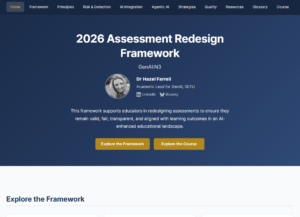
This OER presents an updated Assessment Redesign Framework for higher education in the age of GenAI. It supports educators and programme teams in designing valid, transparent, and scalable assessments, integrating AI literacy, process-focused approaches, and guidance on AI detection, large cohorts, and emerging agentic AI challenges.
This Pressbook features an interactive tool that helps you plan and structure your essay step by step. The book provides a clear starting point to reduce stress, prevent overwhelm, and support different learning preferences through examples, , quick guides, and PowerPoint videos with voiceover. This resource is a living document.