Embedding Employability Project

[favorite_button]

Creator(s) (alphabetical)

Catherine Staunton

Organisation(s)

Dundalk Institute of Technology

Discipline(s)

Education, Services, Teaching and Learning

Topic(s)

Student Success, Teaching and Learning Practice

License

CC BY-NC-ND

Media Format

Website

Date Submitted

Submitted by

Export Resource Data

Description

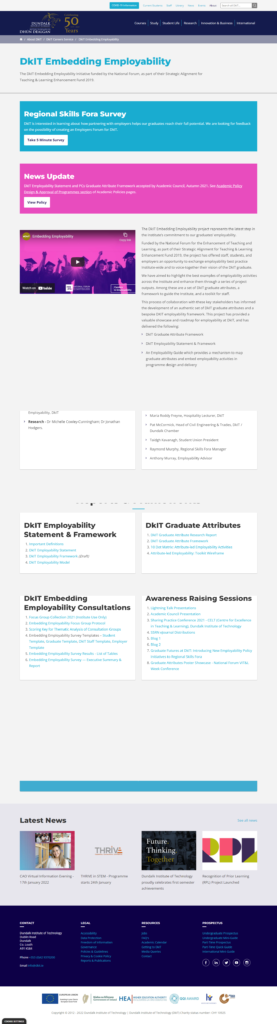
The DkIT Embedding Employability project represents the latest step in the Institute’s commitment to our graduates’ employability. Funded by the National Forum for the Enhancement of Teaching and Learning, as part of their SATLE Fund 2019, the project has offered staff, students, and employers an opportunity to exchange employability best practice.

Benefit of this resource and how to make the best use of it

The major benefit of this resource is that it records our documentation process in one place. Those documents include: institute policy reports and graduate attribute framework visuals; consultation tools including our focus group protocol, coding key, and employability survey tools; and awareness raising conference presentations. Other researchers may use our tools and replicate our report and conference presentations in their future projects with the National Forum.

Creative Commons Attribution-NonCommercial-NoDerivatives (CC BY-NC-ND)

This work is licensed under a CC BY-NC-ND license, permitting redistribution for non-commercial use with proper attribution but prohibiting modifications.

https://creativecommons.org/licenses/by-nc-nd/4.0/
? This citation is automatically generated and may require adjustment. Always verify it against your style guide.
Staunton, C. (2022). Embedding employability project. National Resource Hub (Ireland). Retrieved from: https://hub.teachingandlearning.ie/resource/embedding-employability-project/ License: Creative Commons Attribution-NonCommercial-NoDerivatives (CC BY-NC-ND).

Adapting this resource? Share your version!

If you have modified or adopted this resource, share your version here. Tracking adaptations helps us measure impact and connects others with useful updates.

Related OER

This case study outlines a first-year intervention at SETU Waterford using a timetabled weekly session to tackle common causes of academic failure such as time management, assessment planning. and study skills. It is intended for programme teams seeking practical, low-resource approaches to improving student progression and retention.

Enhancing Student Engagement and Belonging through Collaborative Partnership is a Higher Education Authority report prepared by a UCD research team led by Professor Barbara Dooley. The resource provides an evidence-informed framework for strengthening student belonging across Irish higher education institutions. Drawing on staff interviews, Healthy Campus survey responses, and analysis of Healthy Campus and NStEP case studies, it identifies practical approaches to improving student engagement, wellbeing and inclusion.

The report frames belonging as a multidimensional and co-constructed experience shaped by social, academic, personal and environmental factors. It highlights that student belonging is affected not only by relationships and participation, but also by structural issues such as housing, commuting, financial pressure, campus spaces, timetable design and access to supports.

The resource is particularly useful for staff and student partners working on Healthy Campus, student success, student engagement, access, inclusion, mental health promotion, orientation, peer support, student partnership and campus development initiatives.