EDTL Approach for Students: Online Exams

EDTL Approach for Students: Online Exams

Creator(s) (alphabetical)

Organisation(s)

Irish Universities Association, IUA Enhancing Digital Teaching and Learning in Irish Universities (EDTL project)

Discipline(s)

Teaching & Learning

Topic(s)

Assessment and Feedback, Digital Learning, Student Success

License

CC BY

Media Format

PDF

Date Submitted

Submitted by

Export Resource Data

Description

The EDTL student intern team has collaborated to produce advice for students for effective remote learning during Covid-19, to accompany the EDTL Approach for modules and programmes.

Benefit of this resource and how to make the best use of it

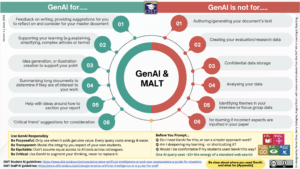
Engaging with the infograph provides a suite of helpful approaches collated by the EDTL project’s student intern team for other students around planning for online exams.

Creative Commons Attribution (CC BY)

This work is licensed under a CC BY license, allowing sharing and adaptation with proper attribution.

https://creativecommons.org/licenses/by/4.0/
? This citation is automatically generated and may require adjustment. Always verify it against your style guide.
Irish Universities Association, and IUA Enhancing Digital Teaching and Learning in Irish Universities (EDTL project) (2021). Edtl approach for students: online exams. National Resource Hub (Ireland). Retrieved from: https://hub.teachingandlearning.ie/resource/edtl-approach-for-students-online-exams/ License: Creative Commons Attribution (CC BY).

Adapting this resource? Share your version!

If you have modified or adopted this resource, share your version here. Tracking adaptations helps us measure impact and connects others with useful updates.

Related OER

This case study outlines a first-year intervention at SETU Waterford using a timetabled weekly session to tackle common causes of academic failure such as time management, assessment planning. and study skills. It is intended for programme teams seeking practical, low-resource approaches to improving student progression and retention.

This OER explores novice programmers’ experiences of pair programming across face-to-face, hybrid, and remote settings. It provides insights into collaboration, role switching, satisfaction, and challenges, helping educators and students understand how to effectively prepare learners for modern hybrid software development environments.

This OER guides students through human-in-the-loop software development, demonstrating how AI tools can be effectively supervised, refined, and integrated across the Software Lifecycle. Designed for computing educators and learners, it combines agile practice, teamwork, DISC awareness, testing, and critical reflection on human–AI collaboration.