In this interactive session, some lessons are shared, with participants encouraged to raise questions and comments to exchange practical options for utilising digital solutions to enhance Higher Education.
Benefit of this resource and how to make the best use of it
The restrictions on public meetings caused by the current pandemic, and the subsequent disruptions to face-to-face educational provision, has highlighted many of the advantages and difficulties in delivering education online. While this format is a new situation for many educators, it is not entirely novel, and many institutions have been providing tuition in a wide range of online styles for thirty years. The University of the Highlands and Islands, in Scotland, offers a full continuum of courses from fully face-to-face to fully online, across a widely dispersed communications network. The key to a high-quality learning experience is the design mix of pedagogy, technology, and academic subject matter, and when this is optimal, Frank Rennie argues that this can provide a richer, more flexible, and more personalised experienced than most ‘conventional’ learning encounters. In this interactive session, some lessons are shared, with participants encouraged to raise questions and comments to exchange practical options for utilising digital solutions to enhance Higher Education.
?
This citation is automatically generated and may require adjustment. Always verify it against your style guide.
Rennie, F. (2021). Edtech seminar series – professor frank rennie. National Resource Hub (Ireland). Retrieved from: https://hub.teachingandlearning.ie/resource/edtech-seminar-series-professor-frank-rennie/ License: Creative Commons Attribution (CC BY).
Adapting this resource? Share your version!
If you have modified or adopted this resource, share your version here. Tracking adaptations helps us measure impact and connects others with useful updates.
This is an interactive multimedia open educational resource (OER), created using H5P, on the topic of Open Education. It has been developed by the Department of Technology Enhanced Learning at Munster Technological University.
The purpose of which is to give an overview of OEPs, using interactive features of H5P
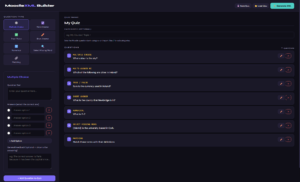
The purpose of this resource is to allow Moodle teachers to quickly create quizzes for Moodle. Users can quickly select between questions types through a single interface and export their questions as an XML file which can be imported into Moodle.
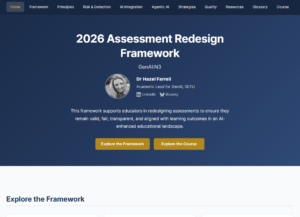
This OER presents an updated Assessment Redesign Framework for higher education in the age of GenAI. It supports educators and programme teams in designing valid, transparent, and scalable assessments, integrating AI literacy, process-focused approaches, and guidance on AI detection, large cohorts, and emerging agentic AI challenges.
This Pressbook features an interactive tool that helps you plan and structure your essay step by step. The book provides a clear starting point to reduce stress, prevent overwhelm, and support different learning preferences through examples, , quick guides, and PowerPoint videos with voiceover. This resource is a living document.