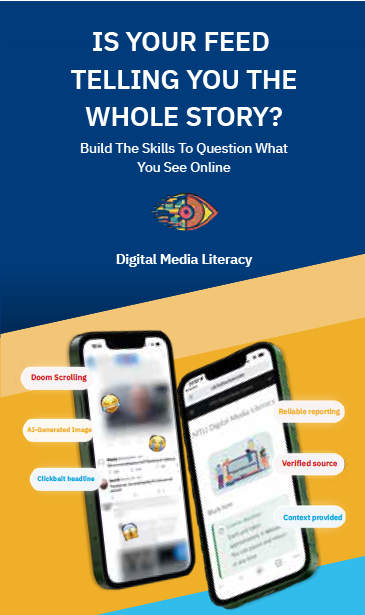
This interactive online resource is a set of eight units to support learners in their online information ecosystem. It is a mix of text, images, video, audio and interactive tasks. The resource can be accessed directly via the link provided or embedded in any Learning Management System compatible with SCORM files.
Benefit of this resource and how to make the best use of it
The ability to identify high-quality information and use it to make informed decisions is an essential skill for university graduates, particularly in today’s digital environment. The European Parliament Youth Survey 2024 found that social media is the primary source of information on political and social issues for people aged 16–30. However, few third-level students receive dedicated media literacy education after leaving secondary school.
This OER develops the skills learners need to:
• Understand how media shapes the information we receive and how misinformation and disinformation are used to mislead.
• Understand the impact of algorithms, digital surveillance, and media ownership on the information ecosystem.
• Evaluate the credibility and reliability of media sources using critical thinking and fact checking skills.
• Make considered decisions about media engagement through awareness of digital citizenship and responsible participation in a digital community.
• Reflect on digital media habits and develop strategies for maintaining digital wellbeing.
The resource can be completed independently but will have maximum benefit when part of a taught course with opportunities to reflect and build on the content with an instructor and peers. Because the resource is self-contained, it can be used by educators from diverse backgrounds across a variety of subject areas. The content can be extended to suit different disciplines, through classroom based activities and discussions.
The units are: 1. Introduction, 2. Decoding Digital Media, 3. Critical Thinking About Media, 4. Media Ownership and Regulation, 5. Practical Skills and Useful Resources, 6. Critical Thinking About Data and Science, 7. Digital Wellbeing, 8. Shaping Our Future.
The SCORM files can be downloaded and modified, allowing other institutions to incorporate their own visuals and content and tailor the resource to suit their students.
?
This citation is automatically generated and may require adjustment. Always verify it against your style guide.
Munster Technological University, and Munster Technological University Digital Media Literacy Team (31/03/2026). Digital media literacy: build the skills to question what you see online. National Resource Hub (Ireland). Retrieved from: https://hub.teachingandlearning.ie/resource/digital-media-literacy-build-the-skills-to-question-what-you-see-online/ License: Creative Commons Attribution-NonCommercial (CC BY-NC).
Adapting this resource? Share your version!
If you have modified or adopted this resource, share your version here. Tracking adaptations helps us measure impact and connects others with useful updates.
This is an interactive multimedia open educational resource (OER), created using H5P, on the topic of Open Education. It has been developed by the Department of Technology Enhanced Learning at Munster Technological University.
The purpose of which is to give an overview of OEPs, using interactive features of H5P
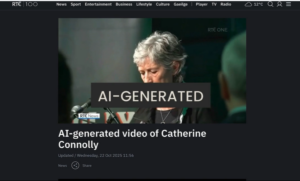
A video that discusses how Artificial Intelligence is impacting the way disinformation is created and spread to manipulate public opinion. It also outlines importance of Media Literacy education and regulatory measures, referencing Ireland’s Online Safety and Media Regulation Act and the EU’s Digital Services Act.
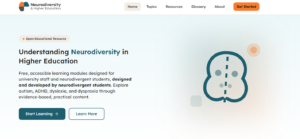
An open educational resource that supports academic, professional, and support staff to build more neuro-inclusive teaching, services, and policies in higher education. This resource was conceptualised & developed through the experiences of neurodivergent students in third-level education, with co-creation at the heart of every stage of the process
Purpose of the MTU Student Guidelines
Supports Academic Integrity Principles and MTU’s Academic Integrity Policy by:
1. Explaining what academic integrity is.
2. Helping students avoid bad decisions during assessments.
3. Outlines and signposts supports available across MTU