Benefit of this resource and how to make the best use of it
In part of this resource is an example of a teaching plan (these are sometimes called lesson plans). You may be surprised that it does not include a section on content. Many teachers still think of planning a teaching session in terms of making a list of the content to be covered; but this approach can lead to problems because it focuses on what the teacher will do without sufficient thought being given to what the students might do. The learner-centred model of Higher Education, however, requires a clear focus on what students need to do in order to maximise their marks. It requires that teaching sessions (and courses) should be described in terms of what it is that the students should be able to do on completion. Statements that describe what it is the students should be able to do at the end of a session are called intended outcomes or outcomes for short. A template for a teaching plan is also included.
Creative Commons Attribution (CC BY)
This work is licensed under a CC BY license, allowing sharing and adaptation with proper attribution.
?
This citation is automatically generated and may require adjustment. Always verify it against your style guide.
Jennings, D., & McMahon, T. (2021). Curriculum design: session planning. National Resource Hub (Ireland). Retrieved from: https://hub.teachingandlearning.ie/resource/curriculum-design-session-planning/ License: Creative Commons Attribution (CC BY).
Adapting this resource? Share your version!
If you have modified or adopted this resource, share your version here. Tracking adaptations helps us measure impact and connects others with useful updates.
This is an interactive multimedia open educational resource (OER), created using H5P, on the topic of Open Education. It has been developed by the Department of Technology Enhanced Learning at Munster Technological University.
The purpose of which is to give an overview of OEPs, using interactive features of H5P
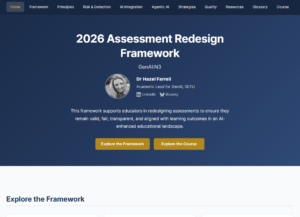
This OER presents an updated Assessment Redesign Framework for higher education in the age of GenAI. It supports educators and programme teams in designing valid, transparent, and scalable assessments, integrating AI literacy, process-focused approaches, and guidance on AI detection, large cohorts, and emerging agentic AI challenges.
This Pressbook features an interactive tool that helps you plan and structure your essay step by step. The book provides a clear starting point to reduce stress, prevent overwhelm, and support different learning preferences through examples, , quick guides, and PowerPoint videos with voiceover. This resource is a living document.
The work presented in this practice paper illustrates how the use of immersive 360o
video and photographs, viewed in virtual reality headsets or via 360o media players,
can enhance and broaden student knowledge and experience when undertaking
Project Based Learning (PBL) assignments.