This compendium captures examples of internationalisation of the home curriculum in TUS. It includes cases of internationalised modules; teaching and assessment practices that promote inclusive learning; collaborative learning and teaching projects involving international partners; and co-curricular intercultural competence initiatives.
Benefit of this resource and how to make the best use of it
A relatively small minority of students avail of the opportunities provided through the university’s membership of and participation in initiatives and programmes such as RUN-EU and Erasmus to travel and study abroad. While such opportunities will always be offered and promoted, by nature they are not entirely inclusive. By embedding internationalisation in the home curriculum, the university offers all students access to global and intercultural perspectives regardless of whether they can access education opportunities abroad
In doing so, it also promotes and supports sustainable internationalisation. Beyond reduced carbon emissions, internationalisation at home also contributes to the agenda ‘to develop healthy, sustainable human societies’ (Jones et al, 2021) by helping HEIs to produce graduates who represent the ‘responsible global citizens committed to a sustainable future’ described by de Wit and Leask (2017).
By publishing these contributions from both faculty and students as a compilation of case studies outlining already existing instances of an internationalised home curriculum, it is hoped that there will be an increased awareness of the value of global perspectives and intercultural competence for all stakeholders, both as current members of the university community and as future graduates contributing to society and enacting their global social responsibility.
Creative Commons Attribution (CC BY)
This work is licensed under a CC BY license, allowing sharing and adaptation with proper attribution.
?
This citation is automatically generated and may require adjustment. Always verify it against your style guide.
O'Donoghue, C., & Kelly, E. (11/04/2024). Compendium of approaches to internationalisation of the home curriculum. National Resource Hub (Ireland). Retrieved from: https://hub.teachingandlearning.ie/resource/compendium-of-approaches-to-internationalisation-of-the-home-curriculum/ License: Creative Commons Attribution (CC BY).
Adapting this resource? Share your version!
If you have modified or adopted this resource, share your version here. Tracking adaptations helps us measure impact and connects others with useful updates.
This is an interactive multimedia open educational resource (OER), created using H5P, on the topic of Open Education. It has been developed by the Department of Technology Enhanced Learning at Munster Technological University.
The purpose of which is to give an overview of OEPs, using interactive features of H5P
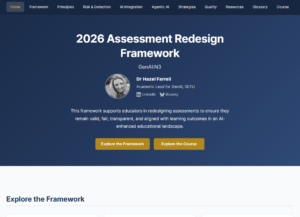
This OER presents an updated Assessment Redesign Framework for higher education in the age of GenAI. It supports educators and programme teams in designing valid, transparent, and scalable assessments, integrating AI literacy, process-focused approaches, and guidance on AI detection, large cohorts, and emerging agentic AI challenges.
This Pressbook features an interactive tool that helps you plan and structure your essay step by step. The book provides a clear starting point to reduce stress, prevent overwhelm, and support different learning preferences through examples, , quick guides, and PowerPoint videos with voiceover. This resource is a living document.
Purpose of the MTU Student Guidelines
Supports Academic Integrity Principles and MTU’s Academic Integrity Policy by:
1. Explaining what academic integrity is.
2. Helping students avoid bad decisions during assessments.
3. Outlines and signposts supports available across MTU