DCU has issued a set of guiding principles to inform the development and approval of alternative assessments. The authors unpack these principles here and link them to a set of actions to guide the choice of alternative assessments in the immediate term.
Benefit of this resource and how to make the best use of it
The overriding concern and key principle underpinning all tests and assessments is that the inferences based on students’ performance are valid. Validity refers to the accuracy of the inferences and descriptions of performance (e.g. First Class Honours; Second Class Honours, Grade l; Second Class Honours, Grade ll; Third Class Honours). Of course assessments must also be reliable. Reliability refers to the consistency of the information we are using to make decisions about our students. The extent to which different graders are applying the same criteria to judge a performance is an example. However, we need to remember that some assessments can be consistently inaccurate. In other words, an assessment can be reliable but lead to decisions with low validity. The resource presents some reflective questions around assessment practice and format. Please remember that even during normal testing times there is no such thing as a perfect assessment and these questions are not meant to overwhelm. All that is required of anyone is that we do our best. Please let your colleagues know about this document if you think it will be helpful to them. There are additional assessment related resources on the CARPE and NIDL websites you might like to consult.
Creative Commons Attribution (CC BY)
This work is licensed under a CC BY license, allowing sharing and adaptation with proper attribution.
?
This citation is automatically generated and may require adjustment. Always verify it against your style guide.
O'Riordan, F., Glynn, M., O’Leary, M., & Lysaght, Z. (2021). Advice for choosing alternative assessments. National Resource Hub (Ireland). Retrieved from: https://hub.teachingandlearning.ie/resource/advice-for-choosing-alternative-assessments/ License: Creative Commons Attribution (CC BY).
Adapting this resource? Share your version!
If you have modified or adopted this resource, share your version here. Tracking adaptations helps us measure impact and connects others with useful updates.
This is an interactive multimedia open educational resource (OER), created using H5P, on the topic of Open Education. It has been developed by the Department of Technology Enhanced Learning at Munster Technological University.
The purpose of which is to give an overview of OEPs, using interactive features of H5P
The purpose of this resource is to allow Moodle teachers to quickly create quizzes for Moodle. Users can quickly select between questions types through a single interface and export their questions as an XML file which can be imported into Moodle.
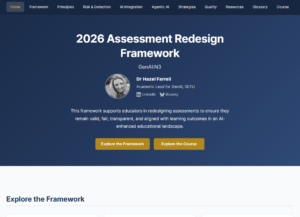
This OER presents an updated Assessment Redesign Framework for higher education in the age of GenAI. It supports educators and programme teams in designing valid, transparent, and scalable assessments, integrating AI literacy, process-focused approaches, and guidance on AI detection, large cohorts, and emerging agentic AI challenges.
Conor Moynihan, Senior Engineer John Sisk & Sons. Structural Engineering @MTU Alumnus. In this video we meet Conor who graduated from MTU and is now a senior Engineer with Sisks in the UK.