This open licensed course/book has 12 chapters that have been developed to help transition to teaching online.
Benefit of this resource and how to make the best use of it
In the words of the authors “This course is an attempt to re-frame the idea of what it means to start teaching online. It will not give you a step by step process to create a syllabus or tell you what buttons to press. The intent of this course is to present you with online learning as a conceptual challenge. These 12 chapters are meant to help transition to teaching online. It is based on our first seven weeks of working with faculty in an intensive synchronous/asynchronous course at the University of Windsor in Canada. Our advice is that you choose one topic a day, watch the short (2-3 min) video, and do the suggested action. Find a friend. Work together.”
Creative Commons Attribution (CC BY)
This work is licensed under a CC BY license, allowing sharing and adaptation with proper attribution.
?
This citation is automatically generated and may require adjustment. Always verify it against your style guide.
O'Neil, A., & Cormier, D. (2021). 12 key ideas: an introduction to teaching online. National Resource Hub (Ireland). Retrieved from: https://hub.teachingandlearning.ie/resource/12-key-ideas-an-introduction-to-teaching-online/ License: Creative Commons Attribution (CC BY).
Adapting this resource? Share your version!
If you have modified or adopted this resource, share your version here. Tracking adaptations helps us measure impact and connects others with useful updates.
This is an interactive multimedia open educational resource (OER), created using H5P, on the topic of Open Education. It has been developed by the Department of Technology Enhanced Learning at Munster Technological University.
The purpose of which is to give an overview of OEPs, using interactive features of H5P
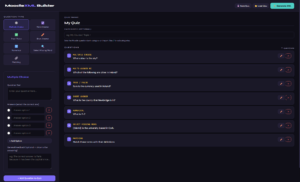
The purpose of this resource is to allow Moodle teachers to quickly create quizzes for Moodle. Users can quickly select between questions types through a single interface and export their questions as an XML file which can be imported into Moodle.
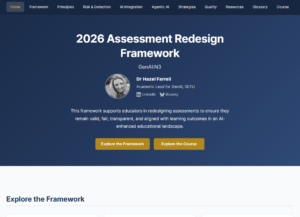
This OER presents an updated Assessment Redesign Framework for higher education in the age of GenAI. It supports educators and programme teams in designing valid, transparent, and scalable assessments, integrating AI literacy, process-focused approaches, and guidance on AI detection, large cohorts, and emerging agentic AI challenges.
This Pressbook features an interactive tool that helps you plan and structure your essay step by step. The book provides a clear starting point to reduce stress, prevent overwhelm, and support different learning preferences through examples, , quick guides, and PowerPoint videos with voiceover. This resource is a living document.