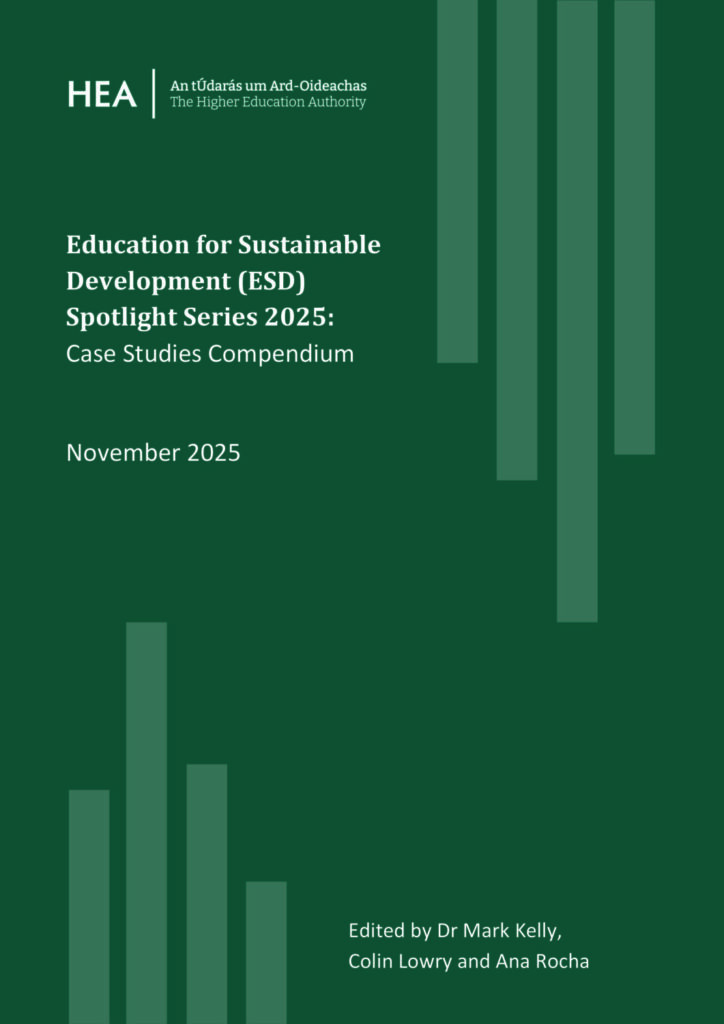
Higher Education Authority (HEA) Education for Sustainable Development (ESD) Spotlight Series 2025: Case Studies Compendium

[favorite_button]

Creator(s) (alphabetical)

Ana Rita Rocha, Colin Lowry, Mark Kelly

Organisation(s)

Higher Education Authority, National Forum for the Enhancement of Teaching and Learning

Discipline(s)

Teaching & Learning

Topic(s)

Assessment and Feedback, Curriculum Design, Education for Sustainable Development (ESD), National Forum Publications, Professional Development, Student Success, Teaching and Learning Practice

License

CC BY

Media Format

Website

Date Submitted

PID https://doi.org/10.82110/ykz2-dq66

Submitted by

Export Resource Data

Description

The HEA Education for Sustainable Development Spotlight Series 2025: Case Studies Compendium brings together 115 case studies from higher education institutions across Ireland. It showcases how universities and colleges are integrating sustainability and the UN Sustainable Development Goals into teaching, research, curriculum design, assessment practices and community engagement. It offers a comprehensive picture of national ESD activity and provides an accessible resource for educators and policymakers seeking examples of practice-based innovation.

Benefit of this resource and how to make the best use of it

This compendium provides practical insights into how education for sustainability is being implemented across diverse disciplines and institutional contexts. Readers can identify approaches that relate with their own institutional needs and consider how the underlying context, challenges encountered, enabling factors and resulting outcomes might be translated or adapted to suit their own settings. Engaging with the compendium can support curriculum development, staff collaboration and institutional strategic planning by grounding discussions in concrete examples of what has already been shown to work. It is also effective used as a reflective and exploratory tool, for example, as a catalyst for conversations within programme teams, as inspiration for new sustainability initiatives, or as a reference point for aligning teaching and learning with national ESD priorities.

Creative Commons Attribution (CC BY)

This work is licensed under a CC BY license, allowing sharing and adaptation with proper attribution.

https://creativecommons.org/licenses/by/4.0/
? This citation is automatically generated and may require adjustment. Always verify it against your style guide.
Rocha, A. R., Lowry, C., & Kelly, M. (2025). Higher education authority (hea) education for sustainable development (esd) spotlight series 2025: case studies compendium. National Resource Hub (Ireland). Retrieved from: https://hub.teachingandlearning.ie/resource/higher-education-authority-hea-education-for-sustainable-development-esd-spotlight-series-2025-case-studies-compendium/ License: Creative Commons Attribution (CC BY).

Adapting this resource? Share your version!

If you have modified or adopted this resource, share your version here. Tracking adaptations helps us measure impact and connects others with useful updates.

Related OER

This case study outlines a first-year intervention at SETU Waterford using a timetabled weekly session to tackle common causes of academic failure such as time management, assessment planning. and study skills. It is intended for programme teams seeking practical, low-resource approaches to improving student progression and retention.

This OER guides students through human-in-the-loop software development, demonstrating how AI tools can be effectively supervised, refined, and integrated across the Software Lifecycle. Designed for computing educators and learners, it combines agile practice, teamwork, DISC awareness, testing, and critical reflection on human–AI collaboration.

This OER introduces students to designing and developing AI-powered assistants for agile software development using Flowise (no code). Learners as a team explore Retrieval Augmented Generation (RAG) and agent-based systems, applying AI to real-world agile practices while considering technical design, evaluation, and cost-aware decision-making